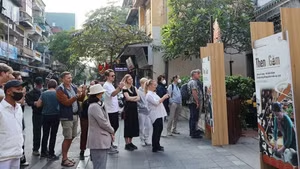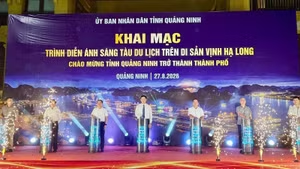
The event marked a historic milestone: for the first time, after 65 years of establishment and development, Viet Nam’s tourism sector has reached the threshold of 20 million international arrivals in a single year.
Comprehensive breakthrough
In the context of global economic volatility and increasingly intense destination competition, this achievement demonstrates the strong momentum of Viet Nam’s tourism sector and reflects the confidence of international friends in a country that is safe, friendly, and culturally rich.
Speaking at the ceremony welcoming the 20-millionth international visitor to Viet Nam (Polish national Karolina Agnieszka Muskus, born in 1984), Ho An Phong, Deputy Minister of Culture, Sports and Tourism, affirmed:
“This milestone is even more meaningful as it is achieved in a context where global tourism has just experienced an unprecedented period of difficulty caused by the Covid-19 pandemic. Since Viet Nam fully reopened tourism activities on March 15, 2022, the sector has recovered and grown continuously: welcoming 12.6 million international visitors in 2023, 17.6 million in 2024, and an estimated over 21 million in 2025, far surpassing the 18 million recorded in 2019, the pre-pandemic peak.”
According to assessments by UN Tourism, this growth rate not only far exceeds the global tourism average of 5%, but is also higher than the 8% average of the Asia–Pacific region, placing Viet Nam among the countries with the world’s fastest recovery and growth rates. Compared with the pre-Covid-19 period, while global tourism has recovered to only about 90%, Viet Nam’s tourism has rebounded to over 110%.
This is the result of many factors. Viet Nam boasts spectacular natural landscapes, warm and hospitable people, and a diverse culture with a rich identity. Subjectively, Viet Nam has implemented open visa policies, expanded visa exemptions for many countries, widely deployed e-visas, and extended permitted lengths of stay, creating highly favourable conditions for visitors. These measures have significantly boosted arrivals from Asia, the key market with more than 13.6 million visitors. Arrivals from Europe exceeded 2.1 million, up 34.9% compared to 2024 (General Statistics Office, Ministry of Finance).
Moreover, tourism promotion and marketing efforts have been continuously renewed, embracing modern approaches and applying digital technologies, big data and AI to capture market trends. International promotion programmes have been strengthened, with increased investment in experiential tourism, green tourism, cultural tourism, ecotourism, and tourism in combination with event and conferences, targeting high-spending and long-stay visitor segments. At the same time, air connectivity has been significantly expanded with key markets.
Looking at the overall picture in 2025, Viet Nam’s tourism breakthrough is reflected not only in the milestone of 20 million international visitors, but also in the quality of growth. Along with the sharp rise in international arrivals, domestic tourism continues to serve as a pillar. According to experts, tourism revenue in 2025 is expected to reach a record level, contributing to the promotion of national economic growth, affirming Viet Nam’s position on the world tourism map, and opening new opportunities for the development of this potential “smokeless industry”.
From rapid growth to sustainable development
With these achievements, Viet Nam’s tourism sector stands before a major opportunity to further confirm its role as a spearhead economic sector. However, it is also necessary to frankly acknowledge the challenges and limitations.
Speaking at the review conference on the “Strategy for Viet Nam’s tourism product development to 2025, with a vision to 2030” held on December 15, Ha Van Sieu, deputy head of the Viet Nam National Authority of Tourism, pointed out shortcomings. These include an incomplete legal framework and management mechanisms, a lack of breakthrough policies, and inadequacies in tourism-related infrastructure and support services in some localities, such as transport connectivity, public sanitation, parking facilities, security and order, and planning. Many tourism products do not fully tap into the value of cultural heritage; inter-regional tours and routes remain limited; and signature products have not left a strong imprint. Therefore, there is a need to renew development thinking, to improve the quality and sustainability of tourism products in the coming period.
He proposed that as world tourism shifts strongly towards green development, the experience economy, and the night-time economy, Viet Nam’s tourism product development should adopt an integrated, multi-value approach, placing quality, sustainability, and visitor experience at the centre. Improving institutions and policies are identified as a key task to create a favourable legal corridor for tourism product development, with an emphasis on building and replicating distinctive, high-potential tourism product models linked to resource advantages and identity.
The human factor and technology in tourism development are always a priority for Nguyen Trung Khanh, head of the Viet Nam National Authority of Tourism. According to him, Viet Nam’s tourism workforce needs to be trained more systematically, from foreign language and communication skills to professional competencies, to meet international standards. At the same time, accelerating the application of technology to enhance tourism value is an inevitable requirement.
At present, neighbouring countries are intensifying efforts to attract tourists through flexible policies and new products. Retaining visitors, encouraging repeat visits, and turning them into “tourism ambassadors” is crucial. Therefore, along with addressing the aforementioned shortcomings, many experts emphasise that authorities and local administrations must establish a friendly tourism environment and timely prevent negative practices such as overcharging, excessive profiteering, and disorder or insecurity, which could otherwise undermine the sector’s long-term appeal.
The orientation for implementing the strategy for Viet Nam’s Tourism Product Development to 2030 emphasises the requirement for sustainable tourism development, closely linking heritage conservation and promotion with green tourism, responsible tourism development, and environmentally friendly practices, thereby contributing to building an attractive and distinctive image of Viet Nam’s tourism. When tourism develops in a healthy and sustainable manner, it becomes the most effective and natural way to promote Viet Nam’s image to the world.








![[In Pictures] Nui Chua Rock Park: A million-year-old outdoor museum of landforms on the Khanh Hoa coast](https://en-cdn.nhandan.vn/images/nyM650OGFWrOVWc-xajqNz57td8idIAL_VG9puyG2UZEKOnmq1DVlT1--ZclbO3z2WBaWZhbt6O3e8kjPZqJMWkfEz7RO9qhcwg8o8LQFK8/ndo-br-cao-nguyen-da-moi.jpg.avif)