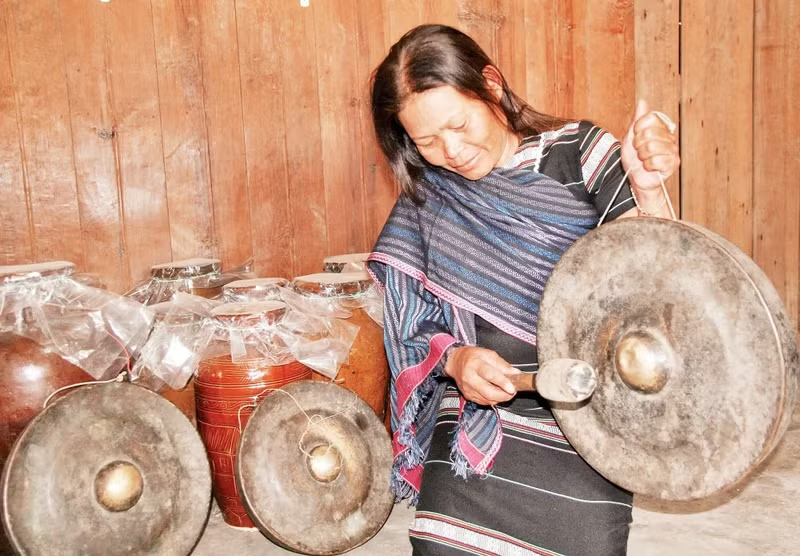
Many have limited formal education, and some cannot read or write. They only know that their ancestors once lived this way, once did things this way. Seeing the value and beauty in those traditions, later generations have preserved them and naturally inherited what was passed down. And they tell visitors who wish to listen the stories of their villages, their ethnic groups, and the mountains and rivers of the places where they live.
One morning, wandering through Plei Yong Village in Kong Chro Commune, Gia Lai, at the headwaters of the Ba River, we happened to meet Dinh Van Hnock, a son of the Ba Na people.
As he started his motorbike, Hnock said that he was on his way to Pleiku. Knowing he was busy, we quickly asked him a few questions about his village, his people's culture, tomb houses, brocade weaving, and the wooden statues of monkeys and leopards placed in the traditional communal house.
Hnock enthusiastically answered everything he knew. Then, the middle-aged man switched off his engine and said something that deeply moved us: “Well, if I do not go today, I can go tomorrow. It is not often that you make the journey all the way to a remote village like this. I will stay and take you to the places you need to see and help you meet the people you want to learn from!”
For the entire day, Dinh Van Hnock became a voluntary guide, leading us around while chatting as though we were old friends.
We could sense this Ba Na man’s deep love for his village, his homeland, and the culture of his people.
He introduced and recounted the heritage of his ancestors with a pride that shone through his eyes and words. On another occasion in Gia Lai, we met Y Kuen, a young Gia Rai woman.
When she heard visitors say that they genuinely wanted to know more about her homeland and her people's culture, the mountain girl immediately climbed onto the vehicle and said: “I am ready to travel with you across this whole region! I am so happy to see how much you love the cultures of the ethnic groups of the Central Highlands!”
As our companion, Y Kuen became a confident and natural storyteller of her people's culture.
One evening at sunset, we arrived in the Bra Yang mountain region. Before we came, my friend had made only a single phone call. Yet that evening, beside Ka La Lake, Co Ho mothers and grandmothers had gathered with their children and grandchildren, filling a stilt house in the village with lively conversation.
Knowing that we valued them and their culture, these women willingly told the story of their people through smooth and deeply emotional folk songs.
Travelling throughout the Central Highlands, I have met countless women and men like them. They have many concerns in their daily lives, yet simply because “I feel close to you”, they are willing to put aside their machetes and forest knives to sit and talk. When the stories do not end by day, they continue into the night.
Add a jar of rice wine, a few stream fish, and a jar of pickled bamboo shoots, and before anyone realises it, the rooster is crowing.
At times, however, their enthusiasm has left me both admiring and saddened.
During the recent Lunar New Year holiday, we heard that K'Diep, a man deeply devoted to Co Ho culture, had been diagnosed with cancer, so we went to visit him. Yet after only a few words of thanks for our concern about his health, the village elder in his seventies immediately turned the conversation to preserving and promoting cultural heritage.
K'Diep spoke with such passion that we had to remind him to rest. Feeling sympathy for him, I thought about how this wise man of the forest was battling a serious illness, with no certainty about how much longer he might live, and yet remained utterly devoted to the cultural heritage of his people.
The ethnic minorities of the Central Highlands are not particularly polished in conversation and have no intention of flattering listeners. Their stories simply flow naturally. That is why I cherish them and always value their sincerity and generous willingness to share.
Like my old friend Ya Loan of the Chu Ru people. No matter how busy he is, whenever I tell him I am coming to visit, he sets aside everything to spend time talking with me. Sitting together beneath an old mango tree, Ya Loan passionately recounts the ancient history of the land and his people, their customs, language, and even the closely guarded stories of major Chu Ru clans, allowing an outsider like me to record them.
Meanwhile, his wife, Ma Wy, never misses an opportunity to show off her deep and melodious singing voice. While preparing a chicken and seasoning fresh figs — a dish she knows I particularly enjoy — Ma Wy sings Chu Ru folk songs so beautifully that I am left speechless.
Village elder Y Wan R'tung, a M'nong Gar man from Sa Luk Village, is another person with a remarkable way of expressing himself. As a boy, Y Wan accompanied the ethnologist Condominas to an earthen mound in Ndut Lieng Krak Village, where they unearthed unusual stone slabs. These turned out to be the world's first-discovered prehistoric lithophone set, dating back more than 3,000 years.
Whenever we sit together, the elder reflects on a time when the M'nong Gar people still maintained rituals, customs, modes of behaviour, and ways of life deeply imbued with the wisdom of the forest.
His Sa Luk Village today presents a fresh new image, yet within the depths of his eyes remain memories tinged with sadness.
While we were talking indoors one day, he suddenly took me by the arm and said: “Come. Come with me to the great waters of the Krong No River. Everything here has changed, except for the wind over the river.”
Standing beside Y Wan on a high rocky outcrop, silently listening to the wind tell its stories, I suddenly realised that he was living in this place while longing for this very place. By letting the wind of his homeland speak on his behalf, the old M'nong Gar man conveyed his emotions with extraordinary depth.
Speaking of silence, many times while interacting with the people of the Central Highlands, I have encountered what I call a “sacred silence.”
And I know that this silence is itself a profound form of eloquence unfolding within their souls. It may be an elderly man sitting motionless beside a staircase like a statue. It may be an old woman sitting by her doorstep exhaling smoke while gazing into the distance. It may be a young woman absent-mindedly watching a K’lình bird soar towards a distant mountain, or a young man standing silently for hours, watching a river flow endlessly by.
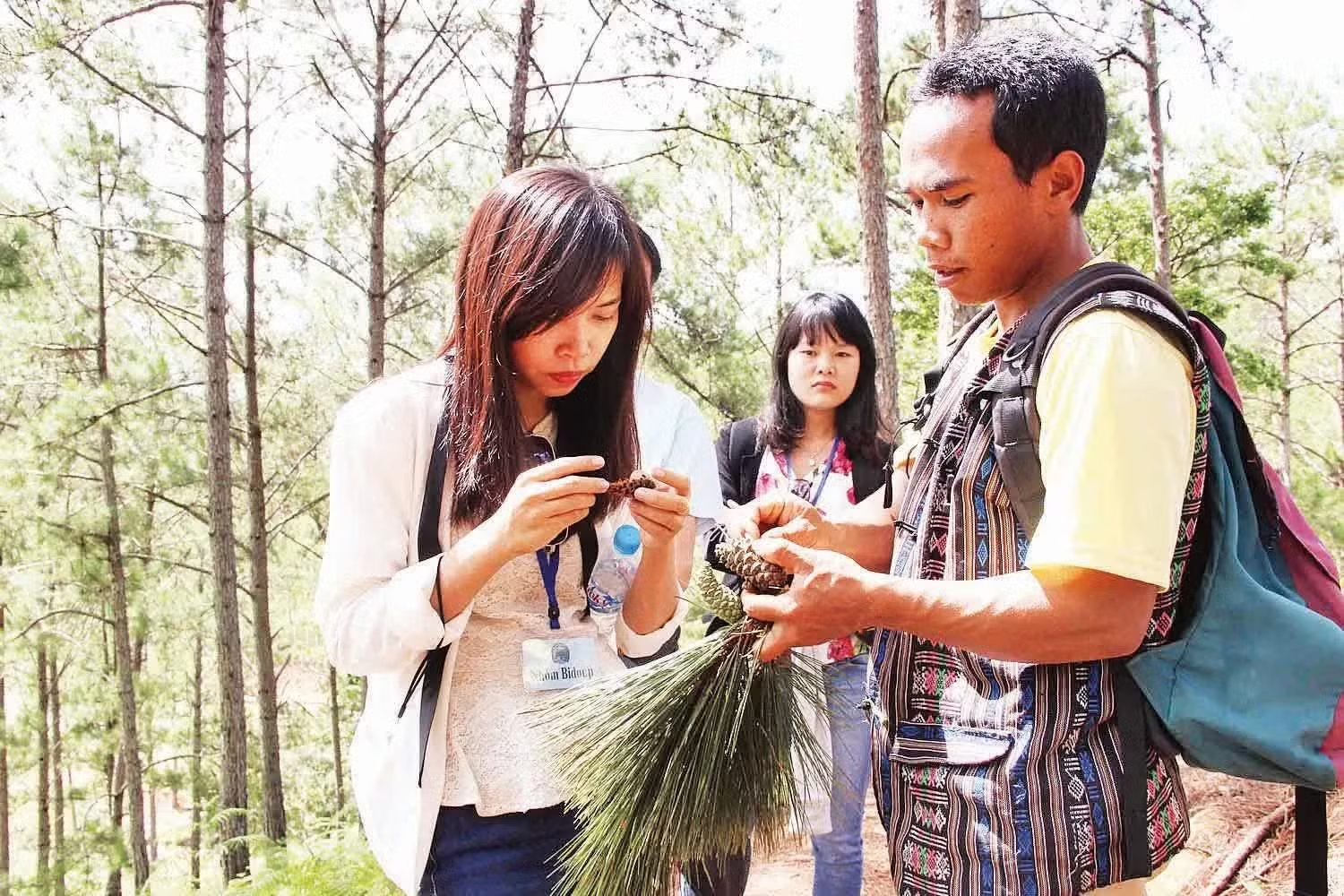
I do not know what occupies their minds at such moments. But to me, their silence seems to be speaking volumes.
There was one occasion, however, when the silence of an elderly highlander left me feeling ashamed.
It happened when I first visited a Ma village and met village elder K'Noi, who taught me an important lesson in human conduct.
His house was filled with ancient gongs and jars. I was fascinated by everything I saw, especially a small sharp knife with a buffalo-horn handle. I liked it so much that I repeatedly asked to buy it, no matter the price.
No matter how many times I asked, he remained silent. When I persisted, he became visibly irritated.
Just before we parted, after I had finally stopped asking to buy the treasured knife, K'Noi picked it up, placed it in my hand and said: “We Ma people do not sell precious things. We only give them to people we value. I value you, so it is yours.”
It is impossible to recount all the sincere and unpretentious people whose behaviour embodies the wisdom of the forest. How could I possibly tell all those stories when nearly four decades of my life and writing have been illuminated by the light of forest firesides?
The people of the Central Highlands love their forests, villages, and ethnic communities. They cherish the distinctive features of their appearance — their skin colour, hair, and eyes. Men once took pride in their strong bodies and preferred to go bare-chested, wearing only loincloths and allowing themselves to merge more fully with nature.
Women took pride in their healthy beauty and graceful forms, preferring to walk barefoot and leave their breasts uncovered to the water and the wind. They may not be skilled conversationalists, but they always welcome guests with sincerity, openness, and generosity.
In my journey to discover cultural heritage, I have travelled to many places, met many people, and gradually absorbed countless precious values. They do not tell these stories only to me; they tell everyone about the places that are part of their very blood and flesh, and about the noble values painstakingly built by their ancestors.
I recall the many times I sat with Meritorious Artisan Touneh Ma Bio and talked with her. And I realised that whether she was appearing on Discovery Channel broadcasts seen around the world or speaking with me, she always spoke with the same simplicity of a Chu Ru woman.
The subject that this female artisan never tires of discussing is the extraordinary richness and appeal of Chu Ru culture and the culture of the Central Highlands.