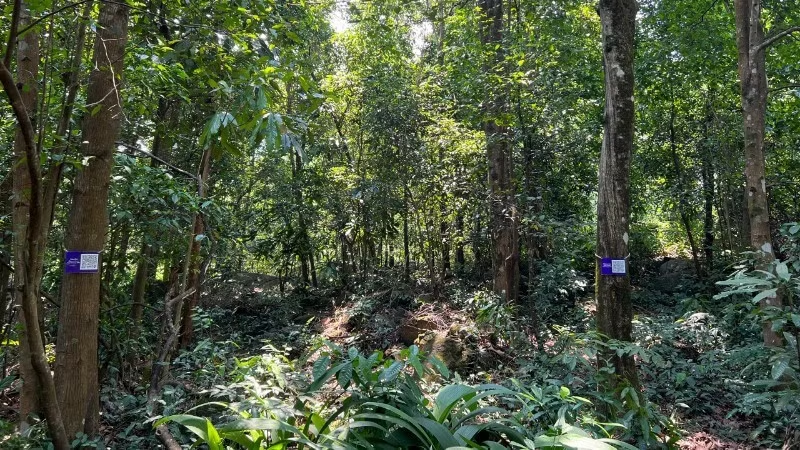
Synchronous implementation of legal provisions under the National Target Programme on Sustainable Forestry Development 2021–2025
In recent years, the formulation and refinement of institutions, policies, and legislation on forestry have been given particular priority by the Ministry of Agriculture and Environment, which views this as a key task in translating sustainable forestry development goals into reality.
Pursuant to government directives, the Ministry of Agriculture and Environment has reviewed, amended, and promulgated numerous legal documents guiding the implementation of the 2017 Law on Forestry, ensuring coherence, consistency, and practical relevance. This policy framework comprehensively covers forest management and protection, sustainable forest development, multi-purpose forest use, payment for forest environmental services (PFES), forestry-based economic development, and forest product processing.
The improved legal framework has created favourable conditions for the implementation of the National Target Programme on Sustainable Forestry Development 2021–2025, providing localities with a unified legal basis for planning, allocating resources, and organising programme activities.
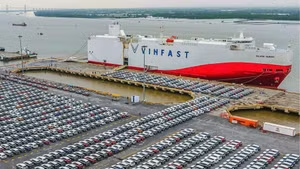
To date, national forest cover has remained stable at over 42 per cent, while more than 800,000 hectares of forest have been certified under sustainable forest management schemes such as FSC and VFCS. The value of wood and forest product exports has reached approximately 14–15 billion USD annually, making a significant contribution to national economic growth.
Creating a legal corridor for effective forest management, protection, and development
One of the most notable highlights of Viet Nam’s forestry policy is the mechanism for payment for forest environmental services. With average annual revenue of around 3 trillion VND, this policy not only provides economic incentives for local people to protect forests, but also helps to reduce pressure on the state budget and effectively mobilise social resources. Hundreds of thousands of households in mountainous areas have gained stable additional income from forests, fostering long-term engagement in forestry livelihoods and proactive participation in community-based forest management models.
At the same time, the legal framework governing plantation forest development, natural forest management, biodiversity conservation, and the development of non-timber forest products has been further completed, helping to promote sustainable forestry production. Regulations on timber traceability, legal timber trade, and sustainable forest management certification have enabled Viet Nam to meet international commitments such as the VPA/FLEGT Agreement and the EVFTA while also expanding export markets to Europe, the United States, and Japan.
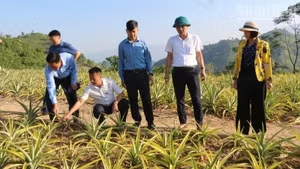
Alongside policy refinement, the Ministry of Agriculture and Environment has strengthened inspection, supervision, and implementation guidance at the local level. Numerous models of sustainable forest management, large-timber plantations, mixed forests, and agroforestry systems have been replicated, enhancing economic value while safeguarding natural ecosystems.
However, implementation has also revealed certain challenges, including overlaps in some legal provisions, limited investment resources, and, at times, insufficient coordination among sectors and administrative levels. These issues are currently being reviewed by the Ministry of Agriculture and Environment, with proposals for adjustment in the next phase to ensure policy feasibility and effectiveness.
Translating policy into practice towards a modern, integrated forestry sector
Looking ahead to the 2026–2030 period, the forestry sector aims to develop in a green, modern manner with deeper international integration. In this context, the continued improvement of policies and legislation has been identified as a central pillar underpinning all sectoral activities.
The Ministry of Agriculture and Environment is formulating the Sustainable Forestry Development Programme for 2026–2030, with key priorities including: revising and supplementing the Law on Forestry and its implementing regulations to align with the new context, particularly green transition requirements, the circular economy, and the goal of net-zero emissions by 2050; improving financial mechanisms, encouraging public–private partnerships, and attracting business investment in afforestation, wood processing, and forest products; reforming land policies to safeguard the legitimate rights and interests of communities, households, and economic organisations allocated or leased forest land; and applying science and technology, as well as digital transformation, in forest resource management and monitoring, geographic information systems, and forest product traceability.
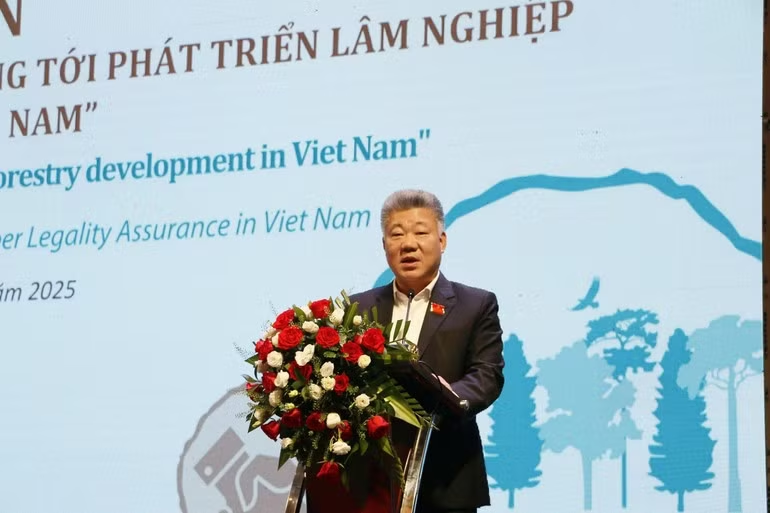
Nguyen Huu Thien, Deputy Director of the Department of Forestry and Forest Protection (Ministry of Agriculture and Environment), emphasised: “Strengthening policies and legislation is the foundation for the effective implementation of forestry programmes and projects. When the legal framework is clear, enforcement mechanisms are transparent, and people’s rights and interests are protected, we can mobilise society as a whole to participate in forest protection and development, moving towards a modern, sustainable, and internationally integrated forestry sector.”
According to Thien, as Viet Nam accelerates green growth and fulfils its global climate commitments, forestry is not merely a technical economic sector but also the country’s “green lungs”, playing a vital role in ecological balance, water resource protection, biodiversity conservation, and greenhouse gas emission reduction.
When policies are implemented in a synchronous, transparent manner and effectively translated into practice, Viet Nam’s forestry sector will not only contribute to green economic growth but will also emerge as a sustainable ecological economy, supporting national commitments to greenhouse gas emission reduction and sustainable development.