Focusing on digital transformation
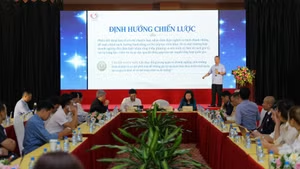
Recently, Ca Mau Province coordinated with several units and enterprises in Ho Chi Minh City to organise a conference on digital transformation for collective economic development in Vinh Loi Commune. On the occasion, cooperatives producing high-quality rice in Ca Mau Province and enterprises signed contracts and initially purchased 30 tonnes of the Tai Nguyen Vinh Loi specialty rice for export to the US, between the Sai Gon Green Economy Cooperative, Total Feeling LLC Company (US), and Hung Thinh Cooperative (Ca Mau).
At the conference, many scientists and enterprises from Ho Chi Minh City proposed that authorities and agricultural cooperatives in key high-quality rice-producing areas should carefully select eligible farming households to participate in production zones, promote the application of digital transformation, and gradually forming digital maps for products.
Departments, sectors and the Ca Mau Provincial Cooperative Alliance should support farmers in trademark registration and create favourable conditions to access to capital to develop local rice brands, particularly Tai Nguyen Vinh Loi rice. From fragmented, small-scale and inefficient production, the emergence of the large model field has changed farming practices of farmers in Ca Mau Province.
“Large rice fields with synchronised sowing, same varieties, and the application of technical advances have made important contributions to production and consumption chains, increasing the value of rice grains and generating higher profits for thousands of farming households in the province,” affirmed Cao Xuan Thu Van, Chairwoman of the Viet Nam Cooperative Alliance.
According to Nguyen Van Vu, Chairman of the Ca Mau Provincial Cooperative Alliance, production–consumption linkages or chain linkages in rice production were still unfamiliar to local farmers around 15 years ago. Most households only focused on production and harvesting, waiting for traders to purchase their rice, and rice prices were entirely dependent on traders.
Moreover, due to fragmented and small-scale production, fields of just a few dozen hectares often contained more than ten different rice varieties, sown at different times. This made pest control, soil improvement and the application of mechanisation extremely difficult.
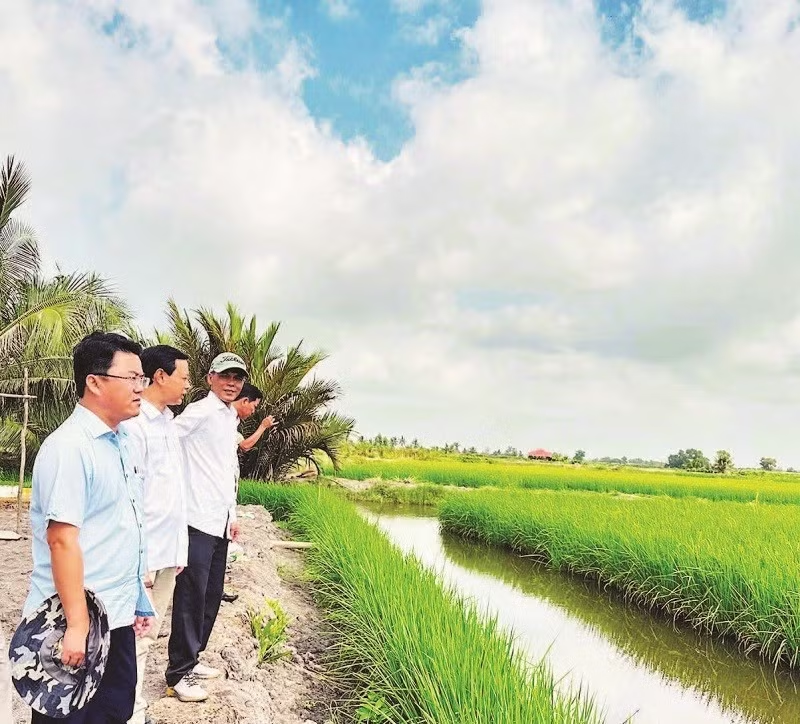
These shortcomings placed many rice-growing households at a disadvantage. Encouragingly, over the past more than 10 years, the largemodel field programme has been officially implemented widely across the province, changing farmers’ thinking, perceptions, and practices. At present, most farming households are producing on a large and concentrated scale, applying technical advances in a synchronous manner, reducing input costs, and maintaining stable rice yields.
Effectiveness of large model fields
Gian Thanh Su (now residing in Vinh Thanh Commune, Ca Mau Province), one of the province’s outstanding farmers and an early participant in the large model field, said that compared with previous crops, participating in the large model field has resulted in fewer pests and diseases, higher yields and more convenient harvesting. Profits have increased by around 500,000–600,000 VND per 1,000 square meters compared with before.
“I participate in rice production on a 50-ha large model field, with synchronised sowing and the same rice variety. The state also connects us with traders and enterprises to purchase rice within just one to two days. It is quick, efficient and economically beneficial,” shared Diep Quoc Cuong (Ninh Quoi Commune).
The Ba Dinh Agricultural Cooperative (Vinh Loc Commune, Ca Mau Province) is one of the exemplary units in building production linkages. With more than 700 ha of rice cultivated on shrimp-farming land, the cooperative has signed agreements with suppliers of high-quality fertilisers and pesticides at prices lower than the market, and is linked with enterprises to fully purchase rice after harvest, thereby ensuring members’ interests.
“Currently, the cooperative also directly purchases members’ rice at market prices plus an additional 300 VND per kg, for milling and packaging under the Ba Dinh rice–shrimp brand,” said Nong Van Thach, Director of the Ba Dinh Cooperative, with enthusiasm. In addition to high-quality varieties such as ST24, ST25 and Tai Nguyen Vinh Loi rice, many communes in the former Bac Lieu Province have been granted special permission by competent authorities to continue cultivating the BL9 rice variety, with an area of nearly 1,000 ha. Despite being an older variety, BL9 rice is sticky, aromatic, and commands high market prices.
To promote these results and replicate production linkage models for high-quality rice varieties, meeting export requirements in many markets, Ca Mau’s authorities and agricultural sector are continuing to intensify communication and effectively implement the Government’s Decree No. 98/2018/ND-CP on policies encouraging cooperative and linkage development in agricultural production and product consumption.
At the same time, the province has issued policies to support farmers to participate in linkages and produce along value chains, while calling on large, capable and reputable domestic enterprises to actively participate in these linkages on the basis of mutual benefit, ensuring effective and long-term cooperation.