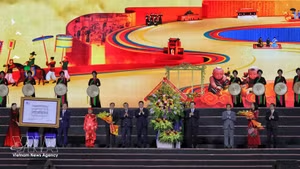
On Sunday, the Vietnam Academy of Social Sciences and Thai Binh Museum announced their new findings relating to Lo Giang Palace that were recently discovered this year.
According to historical records, Lo Giang is one of several major palaces built under the Tran dynasty on its traditional land in Long Hung, which is now a part of Thai Binh province. Despite its vast area and the close connections between Long Hung with the area of Thien Truong (Nam Dinh province) and Thang Long Imperial Citadel (Hanoi), Lo Giang’s location, scale and appearance still remain a mystery.
From November 15, experts have been conducting archaeological excavations in Hong Minh commune on an area of 600m2 around the Tran Temple (Thai Lang temple).
Accordingly, archaeologists have found traces of gravel bases used for reinforced walls dating back to the 13th century, with a width of about one metre, and double architectural foundations with large columns (sand columns) constructed in the form of stone foundation with sand pavings underneath, also dating back to the 13th century.
Most notably, experts unearthed Le Trung Hung dragon-heads dating back to the 17th-18th centuries along with Tran red tiles.
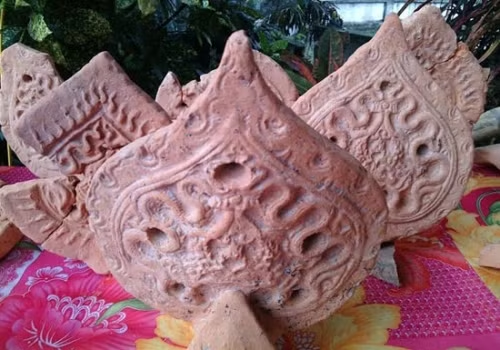
In addition, a range of tile eaves, roof decorations in the shape of pipal leaves, lovebird tiles, and ancient dragons symbolising kingship were also found. The objects are characterised by ancient Dai Viet’s typical characteristics and are not mixed with other cultures.
According to Prof. Dr. Bui Minh Tri, Director of Citadel Research Centre under the Vietnam Academy of Social Sciences, the artifacts unearthed are abundant in quantity and diverse in form, which confirms that a large scale and magnificent structure of an elaborate royal palace has been discovered. However, there should be more research and excavation in the future to further clarify if this is in fact the centre of Lo Giang or not.
Excavations in Hong Minh commune have provided significant evidence serving for the evaluation of the value of Tran dynasty’s monuments and relics.

Ceramic items unearthed.