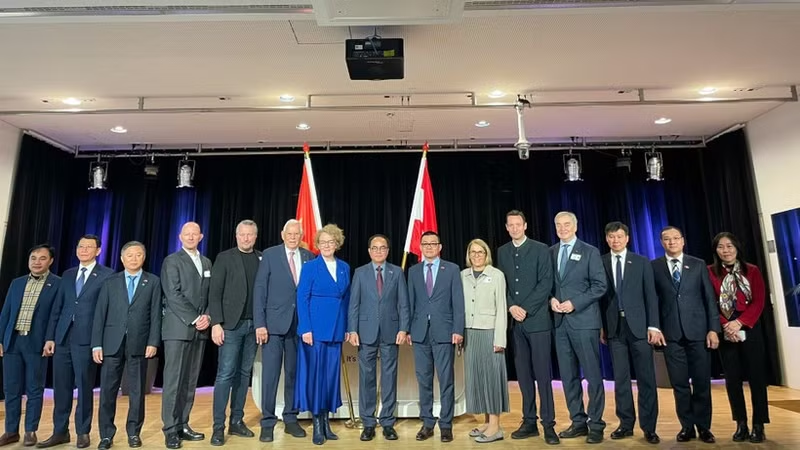
The event was organised by the Vietnamese Embassy in Austria in partnership with IMC Krems University of Applied Sciences, the Austrian Federal Economic Chamber and the Austrian Business Agency.
Some 170 delegates attended in person, with 150 joining virtually, including representatives from the Directorate of Vocational Education and Continuing Education, the Ministry of Education and Training, and more than 30 Vietnamese companies and vocational institutions.
The Austrian side was represented by Margit Kreuzhuber, Deputy Director General for Labour at the Austrian Business Agency, Christiane Teschl Hofmeister, Lower Austria’s Minister for Social Affairs and Education, and Peter Molnar, Mayor of Krems.
Across three thematic sessions, the forum reviewed policy and legal frameworks on labour mobility, alongside opportunities in health and nursing, tourism and hospitality, information technology and other skilled sectors.
Vietnamese Ambassador Vu Le Thai Hoang highlighted the strong interest of government agencies, associations and training institutions, noting significant potential for expanding the skilled labour market between the two countries.
Minister Teschl Hofmeister described the forum as timely, pointing to IMC Krems longstanding cooperation with Viet Nam, including full scholarships for 150 Vietnamese nursing trainees.
Deputy Minister Thang underlined Viet Nam’s demographic advantage, with 68% of its population of working age and an annual labour force increase of around one million. With more than 860,000 Vietnamese working in over 40 overseas markets, he stressed that labour mobility serves both socio economic development and a broader human resources diplomacy agenda. Austria, facing shortages linked to population ageing, is increasingly interested in Viet Nam’s young and diligent workforce.
Delegates held open exchanges on challenges and solutions to deepen labour cooperation. Although no formal agreement exists yet, 55 Vietnamese workers are already employed in Austria under pilot schemes, earning stable incomes and receiving strong welfare protections. Both sides agreed to accelerate negotiations towards a bilateral labour agreement, establishing a stable legal framework for future cooperation and reinforcing labour collaboration as a pillar of Viet Nam Austria relations.