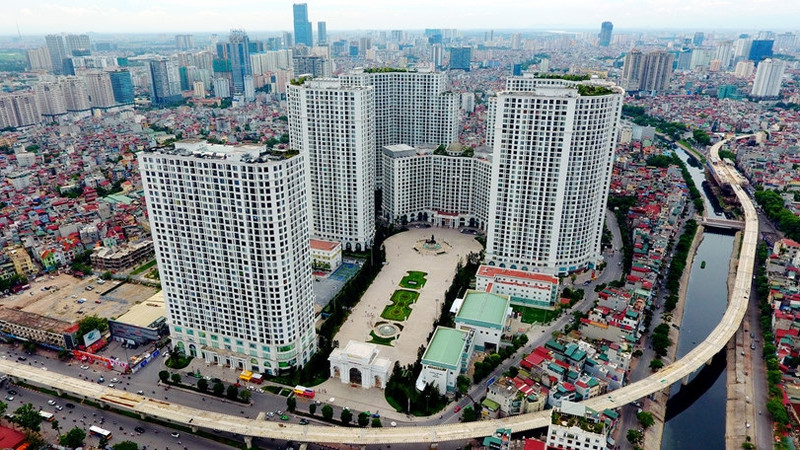
Vietnam is among the countries with the fastest urbanisation rates in the region and the world, with around 700 square kilometres of land incorporated into towns and cities annually.
Such figures show the importance of managing urban land resources effectively in sustainable urban development.
However, experts said the efficiency of urban land use in Vietnam remains relatively low, as seen in the population density of 2,100 persons per square kilometre, compared with the regional average of 9,000.
Large areas of urban land are left unused when many projects are discontinued or delayed, tens of thousands of semi-detached houses and villas are left deserted, and numerous residential tower blocks are not fully occupied, leading to billions of US dollars being untapped in these areas.
The ineffective use of urban land, when a fair share of land and financial resources are earmarked for residential buildings, while little is allocated for social and transport infrastructure, has resulted in increased traffic congestion, flooding and pollution, which are also reasons why many new urban areas and satellite cities fail to attract residents.
Urban land in old city centres is also used improperly and even arbitrarily, in favour of developers. Many high-rise buildings emerge in areas which were previously factories, while there is a serious lack of land for green areas, parks and schools, causing population density to rise rapidly, which runs counter to the policy of reducing the population in urban centres.
Although there are already clearly drawn-up plans, local governments in some places have repeatedly failed to follow the plans, leaving new developments unconnected, reducing the efficiency of investment and impairing urban land use plans.
Recently, the central government has promulgated many resolutions on land use plans but in order to enhance the effectiveness of land use management, stronger and more synchronised measures are needed. One of the top priorities should be concentrating financial and human resources to create detailed plans, currently accounting for just 35% of total master plans. The lack of detailed plans is a loophole for the arbitrary issuance of construction permits.
At the same time, it is necessary to review the current plans to increase the ratio of land for social and urban infrastructure, and restrict the issuance of construction permits and land use permits for socially and economically inappropriate projects.
Furthermore, the concerned authorities should step up oversight of urban land use and increase sanctions for violations in order to reduce unlicensed construction projects. Regulations and administrative procedures concerning construction in urban areas are also in need of revision.