Russian Deputy Foreign Minister Sergei Ryabkov stated that Washington has signalled a willingness to engage in constructive dialogue and demonstrated a certain understanding of Russia's position. However, a notable detail in the Russian statement is the insistence that any agreement must align with "realities on the ground."
This partly reflects Moscow's desire to approach to the negotiating table with the aim of using the results already achieved as the for a new security order, rather than negotiating a return to the status quo that existed before the conflict began.
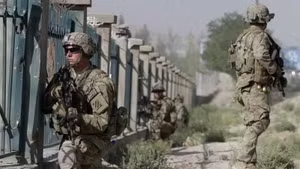
Russia is currently believed to hold the upper hand on the battlefield. After nearly five long years, the confrontation between Moscow and Kyiv is seen as entering a fiercer new phase, characterised by complex strategic calculations and the intensive use of high-tech equipment.
Russian authorities reported that between the night of August 19 and the early hours of August 20, their air defence forces intercepted and destroyed 726 unmanned aerial vehicles (UAVs) heading towards various regions across the country — including the capital of Moscow — as well as over the Black Sea and the Sea of Azov.
The peace process depends not only on the actions of Russia and Ukraine but is also shaped by the complex strategic interests of other stakeholders, most notably the European Union (EU).
To demonstrate their pivotal role in coordinating international efforts to support Kyiv, the leaders of Germany, the UK, and France co-chaired a high-level meeting of the coalition of willing partners on August 24.
Resolving the war in Ukraine and shaping relations with Russia are crucial for long-term European security and stability.
Consequently, Europe seeks to maintain its position and voice in the process of proposing peace solutions, rather than relying entirely on the US — an increasingly unpredictable partner. However, diplomats note that the EU's lack of direct communication channels with Russia over an extended period poses a significant limitation to proactive diplomacy.
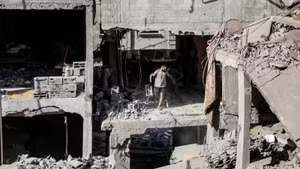
The longer the conflict drags on, the greater the pressure on the parties involved to sustain military and financial resources. Another harsh winter is approaching, posing a severe test of Kyiv's resilience, as critical energy infrastructure is likely to be targeted by attacks.
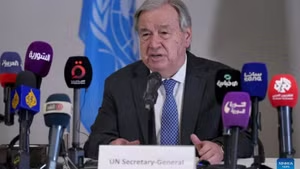
Resolving the Ukraine issue — a protracted war entailing immense human, security, and economic costs, and profoundly impacting Europe's security structure — remains a shared goal of the international community.
Given recent diplomatic signals, the door to peace in Ukraine is inching ajar, although a dramatic breakthrough leading to a peace agreement in the near future remains highly unlikely.