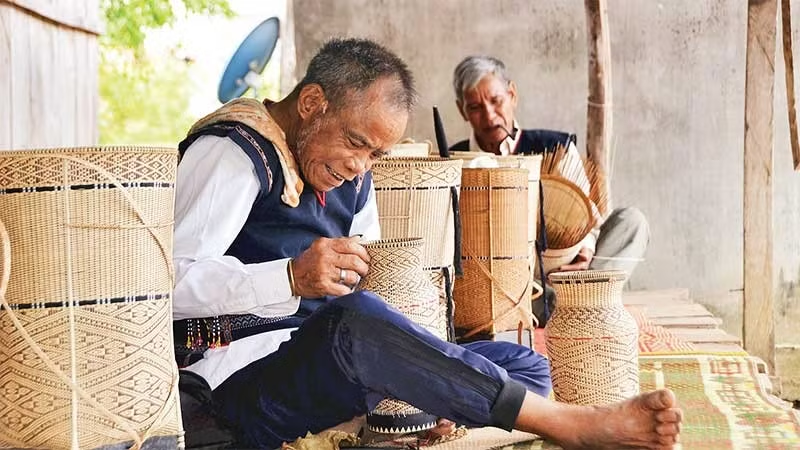
The basket is so intimately connected to daily life, yet few know that to create a durable and beautiful basket requires the weavers in Kgiang to cultivate the virtues of perseverance, diligence and creativity.
The people of Kgiang Village often say that master craftsman Dinh Bi has golden hands, because those hands have created products that strongly embody the cultural identity of the Ba Na people. Dinh Bi was born in 1954 and began weaving baskets at 22.
That time, young Dinh Bi happened to visit his uncle just as the uncle was meticulously inserting bamboo strips to create floral patterns on a Ba Na basket. Quietly observing, his love for the craft began to kindle, and from then on, Dinh Bi decided to try his hand at it. In the early learning phase, it took Dinh Bi from 2 to 3 months to complete a basket.
To achieve his first satisfactory basket, he had previously ruined four baskets. From being an apprentice, gradually over time, he experimented and improved his techniques, his craftsmanship becoming increasingly refined. Now his hands work with steady rhythm, a hundred bamboo strips appearing as one, each strip thin, smooth and sturdy, with products that always bear distinctive characteristics.
In recognition and honour of individuals who have made outstanding contributions to preserving and promoting the nation’s intangible cultural heritage values, in 2022, Dinh Bi was conferred with the title of Excellent Craftsman.
Tran Thi Bich Ngoc, the cultural and social officer of Kong Long Khong Commune, noted that many people in the commune still hold the technique for weaving everyday baskets, but only two craftsmen can weave decorative patterns.
This past April, at the traditional weaving, basketry and cuisine competition organised by the Department of Culture, Sports and Tourism, both craftsmen from the village - Dinh Van Rinh and Dinh Bi - won first and second prizes respectively.
To create focal points, the craftsmen of Kgiang Village use doac, a species of tree in the palm family that grows in the highland region of Son Lang, about 60 kilometres from the village. After sun-drying the doac tree for about a week, they whittle it thin and take the heartwood portion, which has a dark brown colour.
The craftsmen use the dark brown doac fibres as longitudinal strips combined with light-coloured giang fibres as horizontal strips, forming the harmonious and prominent structure of the Brung pattern (a diamond-shaped motif commonly seen on brocades and traditional communal houses of the Ba Na people).
Dr Vu Huyen Trang explained that “Brung” in the local language means “pair of eyes.” In basketry and brocade weaving, skilled craftsmen incorporate elements of daily life, transforming them into stylised symmetrical imagery, including borders resembling the stepped forms of stilt houses, squares and rectangles representing door frames, with central accents depicting the image of eyes (Brung).
To create a well-proportioned basket, each craftsman has their secret. Dinh Van Rinh shared that a well-proportioned basket is based on the ratio of height to base area, typically with the height equalling 2 and 1/3 times the length of the base edge to ensure standard dimensions.
With skilful hands and creative minds, the village craftsmen transform dry, lifeless materials into something supple and soulful. Still using traditional materials and patterns, Dinh Bi has continued to produce unique decorative vases - products that are creative, technically challenging, and highly aesthetic.
Dinh Bi shared that the most difficult part is the strip-locking process, narrowing the waist to connect the body to the mouth of the vase. This technique requires careful attention to detail in each lock stitch, and this crucial stage takes about three days to complete.
In the early morning, the rhythm of new day life in Kgiang Village flows slowly. In the neighbourhood, children chatter as they call to each other on their way to school, tractors and machinery bustle along village roads, and women with baskets on their backs hurry along briskly.
In a corner of a stilt house veranda, in the fields, or beside glowing kitchen fires, the craftsmen of Kgiang Village are absorbed in whittling and shaping each bamboo strip, weaving beauty into life. Though advanced in age with eyes no longer sharp and hands no longer as nimble as before, the craftsmen of Kgiang Village remain steadfast and persistent, devoting their complete love to the weaving craft - partly for livelihood, partly from the responsibility to preserve and maintain the ancient craft left by their ancestors.