2025 has shown that when financial and budgetary discipline is maintained, public investment is organised effectively, and social resources are mobilised in the right direction, growth not only recovers but also creates a foundation for longer-term steps in the medium- and long-terms.
At the conference reviewing operation in 2025 and deploying tasks for 2026 of the finance sector, the leaders of many localities shared outstanding results in managing budget revenue and expenditures, disbursing public investment capital, and attracting investment, while also clarifying major orientations to create room for sustainable development for following periods.
Proactive budget management, public investment makes a foundation for growth
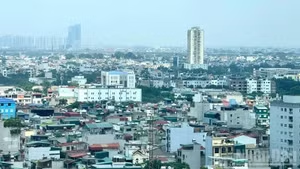
According to Nguyen Xuan Luu, Vice Chairman of the Ha Noi Municipal People’s Committee, the guiding spirit in the capital’s governance is “responsibility – action – creativity – development.” Based on this spirit, in 2025, Ha Noi implemented many synchronous solutions and achieved positive and comprehensive results in the socio-economic fields.
In terms of economic growth, Ha Noi’s GRDP in 2025 was estimated at 8.76%, this figure exceeded the target of 8% and is significantly higher than the growth rate of 6.52% in 2020. This not only reflects recovery after a period of changes, but also shows a more sustainable development trend of the capital, with growth drivers restructured towards more balance and quality.
A highlight in Ha Noi’s fiscal management was its state budget revenue performance. In 2025, total budget revenue in the city was estimated at around 711 trillion VND, equal to 138.4% of the estimate and up 38.74% compared to the previous year, the highest level in the past nine years.
Notably, this marked the first time Ha Noi surpassed the threshold of 700 trillion VND in budget revenue, with domestic revenue reaching about 600 trillion VND, accounting for nearly 95% of total revenue. This result reflects the effectiveness of revenue management measures as well as efforts to prevent revenue losses and expand the tax base, while also demonstrating the strong momentum of production, business, and service activities in the city.
Apart from budget revenue, Ha Noi has attached special importance to public investment as a “lever” for stimulating growth. In 2025, the city proactively and resolutely directed and organised the disbursement of public investment capital, reaching 106.8% of the assigned plan. Exceeding the disbursement plan not only helped boost short-term growth but also created an important infrastructure foundation for medium- and long-term development, especially as private and international investments are still impacted by external environment.
Together with Ha Noi, Quang Ninh continues to be a bright spot in budget management and public investment. According to Nguyen Thi Hanh, Vice Chairwoman of the Quang Ninh Provincial People’s Committee, amid the common difficulty context, Quang Ninh seriously implemented major policies of the central agency on restructuring the organisational apparatus, streamlining staff, and strengthening local governments at all levels. The reorganisation of public service units, especially in fields of healthcare and education, not only streamlined the apparatus but also created room to save regular expenditure and increase resources for development investment.
Quang Ninh’s budget management results in 2025 were impressive. Total state budget revenue in the locality reached about 85,045 billion VND, up 54% compared with the estimate assigned by the central agency. Of which, domestic revenue reached about 182% of the central agency’s estimate, while revenue from import-export activities reached about 138% of the estimate. At the same time, the province disbursed 100% of its public investment capital plan, ensuring resources for key infrastructure projects while prioritising spending on social welfare and human development policies.
Hung Yen also recorded a year of effective budget management. According to Pham Quang Ngoc, Chairman of the Hung Yen Provincial People’s Committee, 2025 was a pivotal year after the rearrangement of administrative units, which expanded development space and improved the connection of resources. In this context, total state budget revenue in the locality surpassed 99.9 trillion VND for the first time, exceeding the assigned estimate and creating important room for development investment and social welfare.
Overall, the figures on budget revenue and expenditures and public investment disbursement of localities highlight the crucial role of fiscal and budgetary discipline and decisive leadership in implementation. This is an important foundation for maintaining macroeconomic stability and creating space for long-term development policies.
Attracting investment, shifting towards in-depth growth models
Besides budget management and public investment, improving the investment environment and attracting social resources are key for development strategies of localities.
In Ha Noi, investment attraction continued to record notable results. In 2025, total foreign direct investment (FDI) into the capital reached about 4.4 billion USD, up 160% compared with 2024. The investment and business environment were improved dramatically, creating confidence for domestic and foreign enterprises and investors.
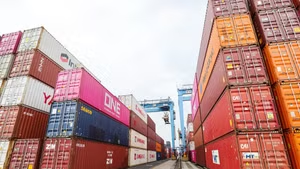
During the year, around 32,000 new enterprises were established across the city, up 12% year on year, with total registered capital of about 420 trillion VND, an increase of 45%. Import-export activities continued to play an important role, with export turnover in 2025 estimated at about 68 billion USD, making a significant contribution to macroeconomic stability and major balances of the economy.
Quang Ninh has clearly identified its orientation towards improving growth quality in the coming period. Basing on GRDP growth of about 11.89% in 2025, among the high group of the country, the province aims for growth of around 12.9% in 2026 and strives to manage growth at no less than 13%. In terms of budget revenue, Quang Ninh targets to soon achieve the threshold of over 100,000 billion VND.
To realise these targets, the province plans to attract around 2–2.5 billion USD in investment in 2026, develop about 11 industrial parks and three coastal economic zones, while promoting green transition, with science, technology, and innovation as key development drivers.
For Hung Yen, its geographical advantages after administrative unit mergers are opening new development space. Located at the centre of the northern key economic region and direct connection to Ha Noi, Hai Phong, and Quang Ninh, Hung Yen has set a goal of rapid and sustainable development, aiming to become a modern industrial centre in the Red River Delta.
The province is focusing on planning and synchronously building industrial parks and clusters, identifying clean and high-tech industry as the main growth driving force, while proactively attracting large investors with strong financial capacity, advanced technology, and modern governance.
At the same time, Hung Yen is coordinating with ministries and sectors, including the Ministry of Finance, to study and propose the establishment of large-scale economic zones and industrial parks oriented towards the development of high-tech industry, logistics services, and new economic sectors, creating breakthroughs in investment attraction and improving competitiveness.
From the practical experience of localities, there is a clear common point: effective public investment is playing the role of a “backbone” for growth, while improving the investment environment and shifting towards in-depth growth models are the key for sustainable development.