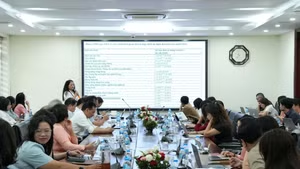
This figure clearly reflects a mismatch between labour supply and demand, as a segment of employees who wish to work have not been fully absorbed or properly utilised according to their capabilities.
Mismatch in the labour market
At the age of 28, Hoang Yen Nhi graduated with a degree in languages from the Academy of Journalism and Communication and is now working at a Singaporean technology company with an office in Ha Noi. The job provides her with a stable income, but it is not entirely aligned with her field of study. “My current job still involves language skills, editing, and teamwork, so I adapted quite quickly. However, there are times when I want to take on more in-depth roles to better utilise my abilities,” Nhi shared.
According to the young girl, to help employees fully realise their capacities, both employees and employers need to be proactive in making changes. Employees must continuously learn, while companies should create more opportunities for their employees to take on more challenging tasks.
Meanwhile, Dao Ngoc Long (born in 1976, currently living in Ha Noi), who works at Thien Truong An Investment, Trading and Tourism Company Limited, has had a different journey. After graduating in information technology from Ha Noi University of Science and Technology, he shifted to the transport and logistics sector. “My current job is not in my original field, but the logical thinking and learning ability I gained have helped me a lot. Thanks to that, I have been able to adapt and develop in my work,” Long said.
After many years, Long has built a business with more than 20 vehicles, creating stable jobs and incomes for many employees. However, he noted that to better utilise the capacity of both enterprises and employees, more policies are needed to stabilise operating costs and facilitate access to capital, enabling businesses to expand their scale and improve labour efficiency.
According to the 2025 Employment Trends Report by the National Employment Service Centre, labour underutilisation includes the unemployed, the underemployed, and those who are ready to work but have failed to find suitable jobs. This is a composite indicator reflecting labour surplus and the degree of mismatch between supply and demand in the market.
According to the 2025 Employment Trends Report by the National Employment Service Centre, labour underutilisation includes the unemployed, the underemployed, and those who are ready to work but have failed to find suitable jobs.
Master Ngo Xuan Lieu, Director of the National Employment Service Centre, said it is necessary to fully understand the nature of this indicator. Labour underutilisation does not only refer to those without jobs, it also includes those who are working but not reaching standard working hours or not working in roles suited to their abilities, indicating gaps in the allocation and use of human resources in the labour market.
“One clear manifestation is the prolonged job search time for employees. When employees spend a long time looking for suitable jobs, it means their potential is not being effectively utilised. This delay reduces the efficiency of resource use of the whole society,” Lieu explained.
In Ho Chi Minh City, Nguyen Van Hanh Thuc, Director of the city’s Employment Service Centre, also pointed out specific issues: “The situation of employees not working in roles suited to their abilities and qualifications remains quite common, especially among young employees. The reasons come from the mismatch between training and businesses’ actual needs, as well as limited adaptability of employees.”
According to Thuc, many bottlenecks remain in connecting labour supply and demand. “The mismatch in skills, especially soft skills, is a notable issue. In addition, labour market information is not fully accessible, making it difficult for employees to choose suitable jobs. Expectations between employees and employers have also not been met.” These factors explain why vacancies remain unfilled while some employees still cannot find suitable jobs.
Comprehensive solutions are needed
From the above analysis, it is clear that effectively promoting labour potential requires a comprehensive set of solutions linked to improving human resource quality and completing the labour market. According to experts, restructuring the workforce towards modernisation, increasing the share of labour in industry and services, and raising the proportion of trained employees are all necessary directions.
Ngo Xuan Lieu emphasised that it is essential to enhance the effectiveness of matching labour supply and demand. Job fairs should be organised more frequently and in diverse formats. Combining in-person and online methods would help expand access and reduce job search time for employees. Another key solution is to accelerate the application of technology. “Building and effectively operating a national online job exchange platform will help connect employees and businesses more quickly. When data is fully updated, job finding and recruitment will become more accurate and efficient,” Lieu stressed.
According to the 2025 Employment Trends Report by the National Employment Service Centre, developing labour market information systems and databases is a crucial pillar in improving the operational effectiveness of the labour market. At the same time, improving human resource quality is considered as a long-term solution. “Greater attention should be paid to skills training, especially digital skills, so that employees can adapt to the increasingly demanding market. Retraining and upskilling should also be prioritised to support career transitions whenever necessary,” Lieu affirmed.
Nguyen Van Hanh Thuc highlighted the role of career counselling and guidance: “Helping employees correctly identify their abilities, strengths, and market trends will support them to make better job choices. This is a very important step in reducing the mismatch between jobs and qualifications.”
According to Thuc, it is necessary to expand the network of enterprises participating in the employment service system, thereby increasing job access opportunities for employees. When the supply of job positions becomes more diverse, the chances of finding suitable employment will be higher. In addition, strengthening skills training aligned with business demands is considered a practical solution. Coordination between training institutions and enterprises will help narrow the gap between theory and practice, thereby improving the effective utilisation of human resources.
Upholding labour potential is not only the responsibility of employees but a challenge for the entire labour market system. When employees are placed in the right positions suited to their abilities, efficiency will improve, contributing to socio-economic development in a more qualitative and sustainable manner.