In this context, digital payments are not just tools to support transactions but are becoming a “strategic piece,” determining the ability to retain value and enhance the competitiveness of the economy.
Accelerated cash flow along with tourism recovery
One of Viet Nam’s outstanding advantages is its stable socio-political environment, a factor increasingly prioritised by international tourists when choosing a destination. Additionally, increasingly liberal visa policies are becoming an important “lever” for growth. Thanks to these policies, after the disruption caused by the pandemic, Viet Nam’s tourism industry is making a strong comeback. In 2025, the country is estimate to have welcomed approximately 21.2 million international visitors, the highest level to date, surpassing even the pre-pandemic period. This growth momentum is expected to continue in 2026, with a target of 25 million visitors.
Not only has the volume of tourism increased, but the market structure has also shifted positively, with a strong recovery from traditional markets such as China, the Republic of Korea, and Japan, while expanding into high-spending markets such as Europe, the US, and India. Tourist cities like Ha Noi, Da Nang, and Ho Chi Minh City continue to attract large numbers of visitors, while natural destinations and community-based tourism are gaining increasing attention.
According to UN Tourism, Viet Nam’s tourism sector is currently among the fastest-recovering and fastest-growing countries in the world, with a growth rate of approximately 21%. The international travel magazine Condé Nast Traveler also included Viet Nam in its list of the world's most beautiful countries thanks to its diverse natural landscapes and rich cultural heritage.
Despite impressive growth, the tourism industry still faces a significant bottleneck: inconsistent payment experiences. According to a 2025 study by Visa and Mastercard on travel payment behaviour, approximately 60% of travellers in Southeast Asia prefer using cards or e-wallets over cash, indicating a growing demand for convenient digital payment experiences.
Meanwhile, a 2025 data reconciliation report between payment intermediaries and Vietnamese tourism authorities shows that businesses could lose approximately 15% of potential revenue if they only accept cash payments, while around 65% of international travellers prefer mobile payments.

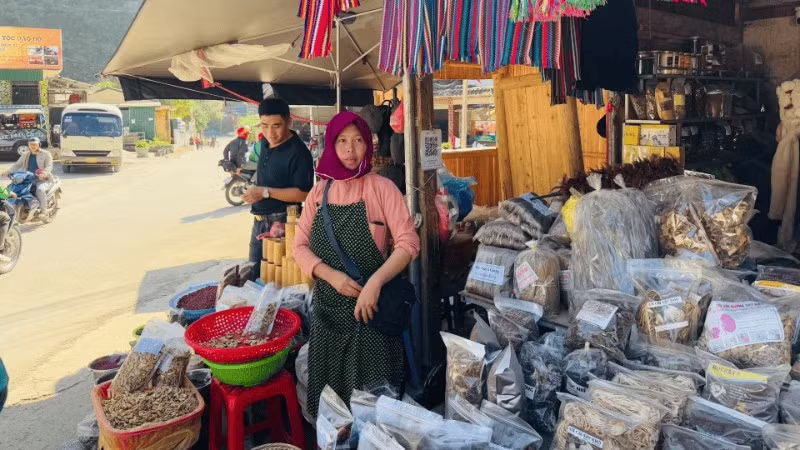
One of the reasons international tourists love Viet Nam is its street food and local cultural experiences. However, the reality at many destinations shows a “mismatch” between demand and infrastructure. At small eateries, homestays, or local experience services — places that create the identity of Vietnamese tourism — payment still mainly relies on cash.
According to a survey in Da Nang, the readiness rate for digital payments at service establishments is only 65-70%. This makes the tourism experience less seamless and reduces tourists’ spending potential.
A lodging establishment owner in Son Tra District said that the number of international tourists has increased sharply since the end of 2024. “Many tourists are returning, but they no longer carry as much cash as before. They ask to pay by card, e-wallet, or QR code,” this person shared. This requires the development of multi-channel, flexible, and easily integrated payment solutions to enhance the entire travel experience.
The “All-in-One” payment ecosystem
One of the leading localities in the trend of combining tourism and financial technology is Da Nang. The city has recently received many groundbreaking mechanisms and policies from the central government, including the establishment of a Free Trade Zone and the construction of an International Finance Corporation (IFC). These factors are creating a favourable ecosystem for connecting tourism, finance, technology, and logistics.
The combination of a dynamic coastal tourist city with a modern fintech hub is expected to help Da Nang attract foreign investment as well as high-spending international tourist segments such as MICE (Meetings, Incentives, Conferences, and Exhibitions) tourists, golf tourists, and business travellers. In this context, digital payment platforms play a crucial role in creating a convenient experience.
From a fintech perspective, many companies are developing solutions to support the tourism industry in expanding its reach to international tourists. A representative from 9Pay — the first payment intermediary to join IFC Da Nang — stated that the company has built an “all-in-one” payment ecosystem for tourism businesses, including online payment solutions such as payment gateways, Payment Link, collection and disbursement services, and direct payment devices like 9PayPOS and transaction announcement speakers. The future will see cross-border payments with ScanOn QR, allowing international tourists to pay by scanning QR codes using their own e-wallets or banking apps at stores in Vietnam.

According to the 9Pay representative, the payment system is developed using a payment orchestration model, enabling intelligent transaction routing. With the smart routing mechanism, each transaction will be automatically routed to the channel with the highest approval rate and optimal cost. In the event of a channel failure, the system can immediately redirect transactions to ensure uninterrupted service. The platform is also secured according to the international PCI DSS standard — one of the highest security standards in the payment industry — and the ISO/IEC 27001:2022 information security management system. Furthermore, the system utilises artificial intelligence to detect risks and monitor transactions in real time.
Experts believe: “In the digital economy, whoever controls the payment system controls the flow of money, and beyond that, controls value.” And one of the notable trends in travel payments today is cross-border connectivity.
Recently, the Vietnam National Payment Corporation (NAPAS), in collaboration with Ant International and the Vietnam Foreign Trade Commercial Bank (Vietcombank), officially expanded the deployment of cross-border payment services via QR code between Viet Nam and China. Accordingly, Chinese tourists can use Alipay — an e-wallet member of Ant International — to scan VIETQRGlobal codes and make direct payments at participating merchants within the NAPAS network in Vietnam.
9Pay is also collaborating with NAPAS to expand QR Cross-Border payments in the near future, which will allow tourists from many Southeast Asian countries such as Thailand, Laos, Cambodia, and Malaysia to use their banking apps or e-wallets to scan QR codes and make direct payments in Vietnam.
Notably, within the framework of the pilot programme at IFC Da Nang, 9Pay is also researching the implementation of stablecoin payments via QR codes. If successfully implemented, this model could open more convenient payment options for tourists from markets such as Russia, India, or the Middle East, while also helping international e-wallets and financial platforms connect more deeply with the Vietnamese market.
It is evident that, along with liberal policies that provide leverage for growth, technology companies and payment intermediaries are striving to implement solutions aimed at creating a payment ecosystem that allows tourists to spend in Vietnam as easily as in their home countries. In the long term, businesses expect to “package” the entire travel experience into an “all-in-one” model, contributing to enhancing the competitiveness of Vietnamese tourism on the international map.