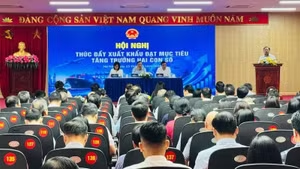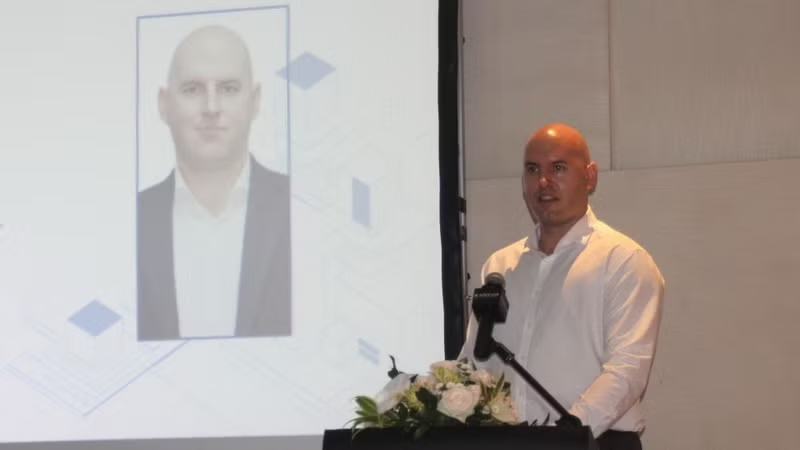
Speaking at the event, co-organised by the Nordic Chamber of Commerce Viet Nam (NordCham) and its partners, Sivert Skarn, Vice Chairman of NordCham Viet Nam, said the Southeast Asian nation has made remarkable progress over the past three decades, emerging as one of Asia’s most dynamic manufacturing and export economies. The country has attracted diverse global investment flows and established a solid industrial foundation.
He noted that Viet Nam is now on the threshold of becoming a leading manufacturing hub for both global and ASEAN markets, with the potential to position itself as one of Asia’s foremost high-value manufacturing centres. However, the country is also facing increasing competition from regional economies such as Malaysia, Indonesia and India.
According to Skarn, as Viet Nam pursues its strategic objectives for 2030, it must address the challenge of moving further up the global value chain while strengthening its position as a hub for advanced manufacturing, engineering excellence, innovation, and sustainable industrial growth.
He emphasised that the energy sector would be one of the decisive factors shaping its next phase of industrial development, as rising economic growth will drive increasing demand for reliable energy supplies.
From a Nordic perspective, experts recommended Viet Nam to make better use of its strengths to develop new ecosystems in high-value manufacturing, engineering, maritime services, logistics and technology development.
They suggested that Viet Nam should gradually shift its competitive advantage away from low-cost production towards the provision of reliable infrastructure, stable energy supplies, stronger domestic capabilities, and consistent legal enforcement. Such foundations would enable the country to become one of Asia’s leading centres for industrial and green manufacturing.
From the business community’s perspective, Michael Zinck Jensen, Vice President of the Viet Nam Pandora factory, observed that many European companies once believed that simply carrying a “Made in Europe” label would be sufficient to enter the Vietnamese market. However, that is no longer the case, as the country has evolved from being merely a production base for the world into a gateway to the wider ASEAN market.
Meanwhile, Lasse Pedersen Hjortshøj, Trade Counsellor at the Embassy of Denmark in Viet Nam, said Danish companies no longer view Viet Nam solely as a traditional sourcing destination or a basic manufacturing base.
Instead, investments are increasingly linked to advanced manufacturing, automation, energy-efficient production, digital optimisation, sustainable supply chains and strategic local partnerships. Viet Nam is increasingly being recognised as an independent strategic market and an important regional hub within broader Asian supply chains.
Hjortshøj added that the country possesses significant advantages to develop renewable energy, creating substantial opportunities for cooperation with Nordic businesses whose approaches aligns closely with the Vietnamese Government's long-term vision. He noted that Nordic companies typically engage with Vietnamese firms as long-term partners, focusing on quality, compliance, technology, sustainability, and the development of local capacity.