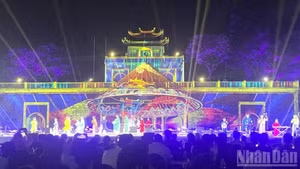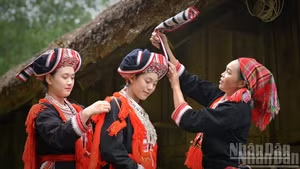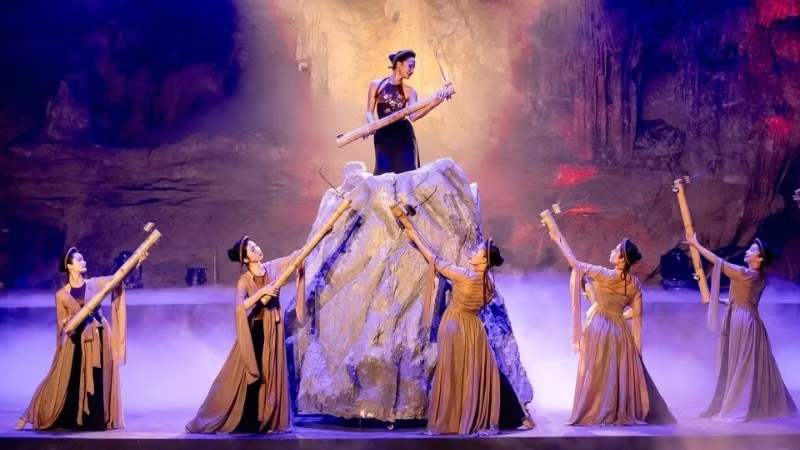
In recent years, Quang Ninh Province has emerged as a leading locality in restructuring tourism products linked to Ha Long Bay, shifting from simple sightseeing to building a diverse, multi-duration experience ecosystem. In addition to traditional products such as bay tours and overnight stays on the bay, ecological tourism associated with environmental protection, exploration of cultural values, and sports tourism has been expanded. A clear highlight of Quang Ninh is tourism products linked with culture, the arts, and the night-time economy.
Many localities have also gradually diversified their tourism products, such as Lai Chau province with urban tourism, MICE tourism, adventure sports, and cultural festivals that create new experiential spaces for visitors; Ha Noi and neighbouring provinces forming inner-city and inter-regional inland waterway tours, school tourism programmes, and more. Many new tourism forms have emerged, including mega music festivals, wellness tourism, and tourism linked with digital technology and creative experiences. Overall, localities are shifting from a “do whatever is available” approach to developing in-depth products that are rooted in regional identity, spatial connectivity and sustainability.
The biggest bottleneck is not a shortage of product ideas, but an approach heavily focused on copying models and following short-term “tourism trends”, while failing to fully explore their own unique values.
Associate Professor Dr Bui Hoai Son, Standing Member of the National Assembly’s Committee on Culture and Education
Changes in both quality and quantity have helped Vietnamese tourism make breakthroughs and deliver many positive outcomes. However, looking more closely at reality, Ha Van Sieu, Deputy Head of the Viet Nam National Authority of Tourism, pointed out that many products are repetitive, under-invested, lack distinctive cultural highlights, and have yet to form strong brands.
Associate Professor Dr Bui Hoai Son, Standing Member of the National Assembly’s Committee on Culture and Education, believes that the biggest bottleneck is not a shortage of product ideas, but an approach heavily focused on copying models and following short-term “tourism trends”, while failing to fully explore their own unique values.
Some localities invest heavily in infrastructure but lack a solid foundation of serious cultural research. Festivals are “stage-managed”, community-based tourism is standardised into “template scripts”, and local culture is reduced to decorative elements. In a context where visitors increasingly prioritise deep, personalised, and sustainable experiences, product quality becomes the decisive factor. This lies not only in facilities or premium services, but more importantly in the value of the cultural–human–environmental experience.
Dr Son suggests that local communities must be regarded as co-creators of tourism development, rather than merely service providers or beneficiaries. Communities should participate from the stage of shaping products, telling their own cultural stories, sharing benefits, and monitoring tourism’s impacts on their living environment.
To avoid repetitive products and similar experiences, there needs to be a strong shift from the mindset of “each locality having one complete product” to a mindset of linkage and complementarity within regional spaces. Each locality should clearly define its role in the inter-regional, inter-provincial, and even international tourism value chain. Some places may serve as heritage hubs, others as ecological spaces, others as transport and service connectors, and others as “cultural back offices” with craft villages, cuisine, and festivals. When localities assume the right “roles” within the overall picture, they will create uniqueness within a unified whole.
Deputy Head of the Viet Nam National Authority of Tourism Ha Van Sieu affirmed that the 2026–2030 period will require strong transformations in quality, sustainability, and competitiveness of Viet Nam’s tourism products. To achieve this, the tourism sector cannot continue along old paths, but must dare to change its thinking, approaches, and methods of organising product development.