Prevention over cure
During discussions on the investment policy for the National Target Programme on Healthcare, Population and Development for the 2026–2035 period, many National Assembly deputies stressed that ensuring every citizen has access to quality primary healthcare, reducing disease incidence, and strengthening early and community-level prevention must be considered a central task — not only for the health sector but for society as a whole. If continuing to follow well-trodden paths, circling around what has already been done, and setting goals without clear outcomes, it will be difficult to build a foundation for improving the population’s health indicators in the years ahead.
In reality, many non-communicable and infectious diseases long eradicated elsewhere in the world still persist in Viet Nam. This is largely because the country continues to focus on treatment as a “fire-fighting” measure rather than strengthening preventive work. Environmental protection, the mitigation of water pollution, food safety, and control over products harmful to health have not been sufficiently prioritised, creating conditions where illness can thrive.
According to the deputies, the programme must set clear targets for each timeframe and define implementation methods. For example, if over the next five years Viet Nam aims to eliminate malaria, tuberculosis, hepatitis, polio, and similar diseases, it would yield tangible benefits for public health. If not, no matter how many hospitals are built or how many doctors are trained, the problem cannot be solved.
Public healthcare requires a comprehensive combination of macro-level policy, technical infrastructure, human resources, and community awareness. Yet deputies emphasised that the approach must be in-depth and foster the joint participation of society as a whole. The principle of “prevention is better than cure” must be regarded as fundamental, as noted by Deputy Nguyen Anh Tri (Ha Noi): according to professional calculations, effective disease prevention yields benefits thousands of times greater than treatment, particularly for non-communicable and hereditary diseases.
According to professional calculations, effective prevention brings benefits thousands of times greater than treatment, especially for non-communicable and hereditary diseases.
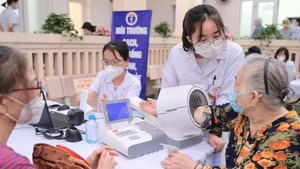
From this standpoint, National Assembly deputies proposed that the national target programme should invest in strengthening and renewing the grassroots healthcare system, as this is the most essential foundation. Improving the capacity of healthcare workers, the quality of commune and ward health stations, applying artificial intelligence in primary healthcare, developing electronic health records, and ensuring adequate equipment and essential medicines will help citizens feel confident receiving care at the local level. This, in turn, contributes promptly to disease surveillance, epidemic prevention, and the effective formulation of health policies.
Education in an era where AI is redefining global work
Education and training in the new period are being profoundly reshaped by the Fourth Industrial Revolution, particularly by the rapid rise of artificial intelligence (AI), which is transforming jobs worldwide. According to the International Labour Organisation (ILO), the work of one-quarter of the global labour force is now affected by generative AI.
National Assembly deputies noted that Viet Nam is also experiencing these sweeping shifts. Ongoing reform initiatives, including deliberations on the investment policy for the National Target Programme on modernising and improving the quality of education and training for the 2026–2035 period, must aim to build a strong foundation that allows the country not only to respond effectively to these challenges but to turn them into opportunities that yield tangible, inclusive, and sustainable outcomes for education.
According to the International Labour Organisation (ILO), the work of one-quarter of the global labour force is now affected by generative AI.
A key priority, deputies stressed, is that innovation in education and training cannot remain confined to the traditional goal of “teaching well, learning well”. A fundamental shift in mindset is required, moving from knowledge transmission to developing learners’ problem-solving abilities. The role of teachers must evolve from delivering knowledge to guiding and inspiring students. The classroom should no longer be limited by four walls but expand to learning anytime, anywhere, through multiple platforms. Student assessment must shift from test scores to evaluating learning processes and outputs.
Many opinions emphasised that the goals, indicators, and design of the programme should not only address persistent problems in the education sector but, more importantly, help propel Vietnamese education into a new stage — modern, open, interconnected, digitalised, and internationally integrated.
For the programme to generate real and inclusive impact, it requires synchronised implementation across multiple areas: investing in modern school infrastructure, especially in disadvantaged regions; building a unified sector-wide data platform that supports lifelong learning for every citizen; establishing a national open digital learning repository; developing digital teacher standards, digital schools, and AI-based assessment systems. However, these objectives may extend beyond the scope, capacity, and resources of the programme.
According to deputies, Viet Nam is building a new development architecture, reflected through the Party’s breakthrough resolutions in education, healthcare, science–technology, culture, institutions, integration, and the private economy. National target programmes should not function as isolated pillars; they must reach beyond the boundaries of individual ministries and sectors, interlinking with each other and mobilising wider resources to form a unified ecosystem that collectively nurtures knowledge, character, cultural values, and physical well-being.
As deputies suggested, the alignment and consolidation of currently separate national target programmes into a unified framework will help build a modern, globally integrated education system; a workforce capable of competing internationally; and a generation of Vietnamese citizens who are well-rounded, healthy, confident, creative, resilient, and deeply rooted in national cultural values, ensuring the foundations for rapid and sustainable development.