However, alongside expanding park areas, it is essential to consider strategies for management and utilisation so that these spaces can meet the diverse needs of the community.
Allocating prime land to the community
Amid rapid urbanisation, land designated for public spaces has become increasingly precious. Ho Chi Minh City’s initiative to transform vacant, prime real estate into lush green parks has garnered positive feedback from residents. This approach also reflects an urban development mindset that places the quality of life of its citizens at the centre.
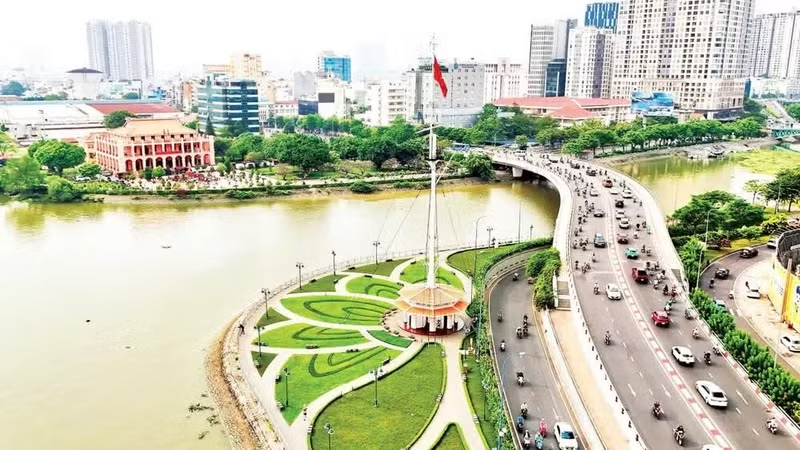
A prime example is the recently launched project to develop the Nha Rong Wharf–Khanh Hoi Cultural Park and the Ben Bach Dang public green space, with a total investment exceeding 29.3 trillion VND. Notably, while the Ho Chi Minh City People’s Committee had previously approved a commercial project for the site in 2018, the city later decided to pivot towards developing a cultural park following further study.
According to Architect Khuong Van Muoi, former Chairman of the Ho Chi Minh City Association of Architects, this was a prudent decision that demonstrated a humane, long-term vision, addressing the city's shortage of greenery and community spaces.
Meanwhile, Phan Dinh Phung Park in Xuan Hoa Ward — transformed after more than a year of renovation following a stalled project — has become a familiar hub for daily activities and local events in the city centre.
The municipal Department of Construction reported that for the 2020–2025 period, the programme for developing parks and public greenery set targets to add 10 hectares of public green space, plant or renovate 30,000 trees, add 150 hectares of public parkland, and increase the average public park area per capita by 0.65 m².
Driven by strong determination, the city successfully developed over 237.5 hectares of public parks (reaching 158% of the target), created 54 hectares of public green space (540% of the target), and planted or renovated 42,534 trees (140% of the target).
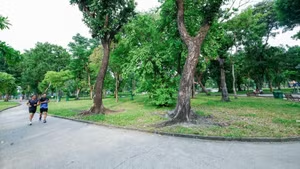
While the city centre boasts several large parks, their utility remains limited in scope. Le Van Tam Park hosts numerous cultural events and major city fairs, attracting large crowds for exercise, walking, and relaxation; however, outside of these events and festivals, much of the space remains underutilised, serving primarily basic functions.
Hoang Van Thu Park enjoys a prime location and significant size but caters mainly to residents seeking exercise and rest. Gia Dinh Park sees high usage, yet the heavy foot traffic places strain on playgrounds, lawns, and infrastructure. Meanwhile, 23/9 Park is bisected by traffic, parking facilities, and commercial activities, resulting in a fragmented green space.
Many experts argue that current parks focus heavily on basic physical activity and lack cultural depth; management and operations prioritise greenery maintenance and public order over dedicated programming or content curation. Crucially, individual parks lack clearly defined social functions and distinct identities.
Dr Daisy Kanagasapapathy, Deputy Head of the Tourism and Hospitality Management Department at RMIT University Viet Nam, suggests that modern urban parks should serve not merely as “green lungs” but as hubs for social connection and experiential activities.
However, the quality and accessibility of green spaces in Viet Nam — and Ho Chi Minh City in particular — remain inconsistent. Some parks lack interactive elements and digital technology, while maintenance, waste management, and safety infrastructure vary in standard. Given this context, shifting the mindset from simply “having parks” to actively “leveraging parks” is essential.
Thematic development to give parks distinct identity
Amid rapid urbanisation and a lack of public spaces that meet actual needs, transforming every public space into a destination with its own specific function, theme, and identity has become an urgent priority for Ho Chi Minh City.
Pham Thi Anh, a resident of Binh Trung Ward, shared: “My family often visits parks on weekends, but they tend to be monotonous — lacking playgrounds or spaces for arts and culture — which causes the children to lose interest. I hope the city will soon establish parks dedicated to reading and knowledge, street music, art, family culture, urban heritage and memory, youth creativity, and community culture and sports.”
Dr Pham Viet Thuan, Director of the City Institute of Natural Resources and Environmental Economics, suggests that this approach increases the value of every square metre of park space.
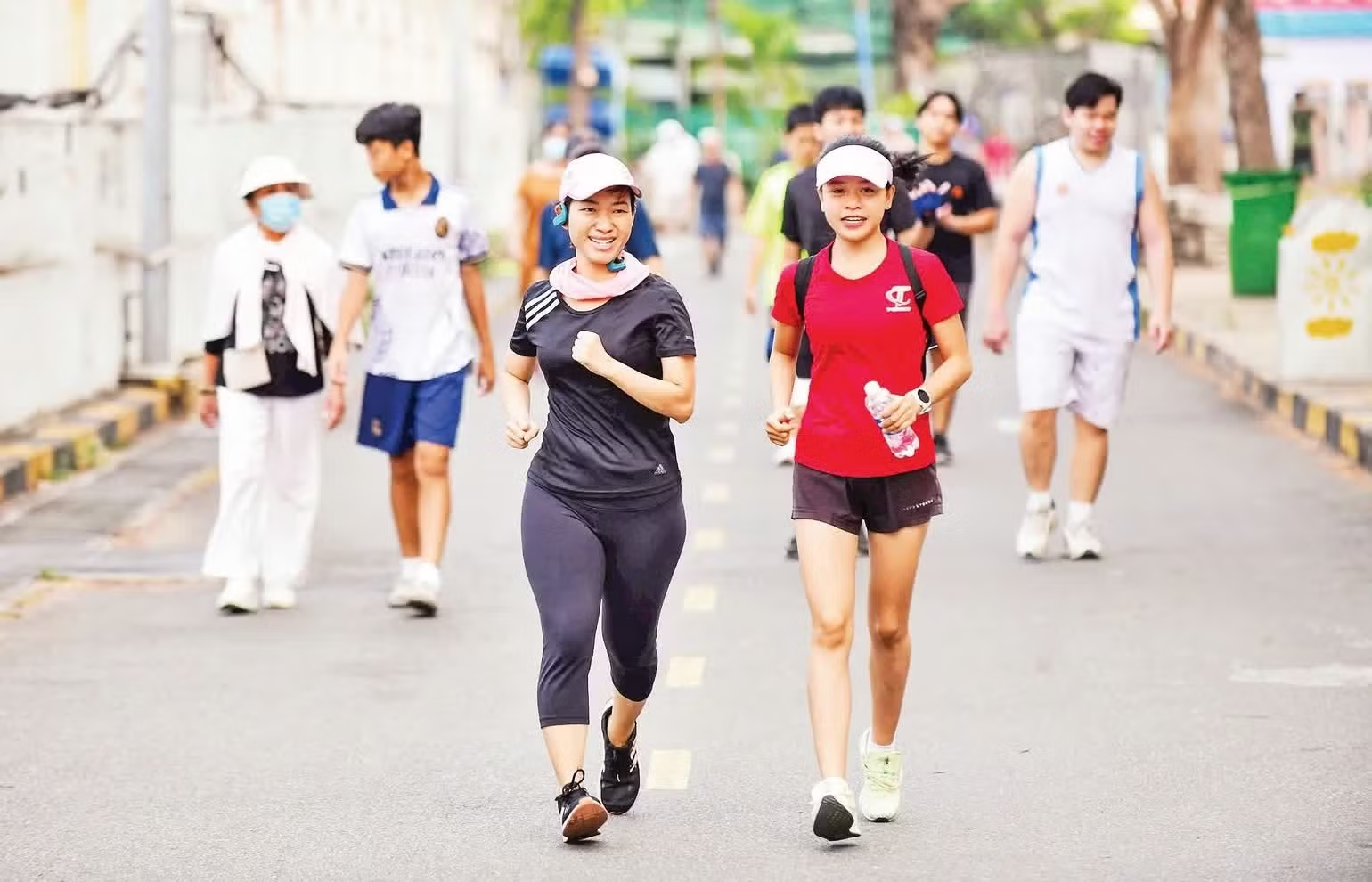
Instead of attracting crowds only during the early morning or late afternoon, activities — ranging from recreation and leisure to sports — can be distributed throughout the day, the week, and the entire year. Consequently, the park serves not only as a place for relaxation but also as a cultural and creative ecosystem that meets the needs of diverse population groups.
Infrastructure investment should also be planned with a multi-functional approach. Priority must be given to shaded walkways, bicycle lanes, and green transport links connecting the park to public transit. Park designs must be climate-resilient, featuring increased permeable surfaces and native vegetation, while ensuring accessibility for children, the elderly, and people with disabilities.
Achieving this requires a shift in how authorities manage these spaces. Dr Thuan argues that management agencies need to regularly evaluate parks based on specific criteria aligned with usage needs and the city’s development goals. Simultaneously, a unified and synchronised management mechanism should be established across the area to minimise administrative overlap.
The city needs to devise a suitable mechanism that ensures parks remain free public spaces while allowing for the provision of certain reasonably priced services. This approach aims not to commercialise the parks, but to generate additional resources for maintenance, operations, and the organisation of activities.
In this context, the themed park model at 21 Thong Nhat Street, Vung Tau Ward, serves as a notable example. Spanning over 13,000 square metres, the park is envisioned as a STEAM-focused creative space that integrates greenery with cultural and outdoor recreational areas, while also incorporating artistic lighting and smart security systems.
The master plan allocates more than 65% of the site to trees and flower gardens. Such models demonstrate that the park of the future need not be merely a vast expanse of greenery and walking paths.
For Ho Chi Minh City, parks represent a vital public asset. According to the Department of Construction, the city aims to increase public green space to 1 square metre per capita and develop an additional 10 hectares of public greenery by 2030. This is a significant goal, particularly as the city continues to face pressure from urbanisation and population growth.


![[Video] Renewal and growth milestones of Ha Noi through the lens](https://en-cdn.nhandan.vn/images/1XgBTSIw0KyfD4abQsg-hd4ly6fBUHXC7_OAKyN4YwPfAhBw0Xs6rVX3rF0up9Tr6rLNn30Muc4bzp90E7yOqg/10-10-hanoi-cover.jpg.avif)