In the context of Central Viet Nam playing the role of the “backbone” of the North–South power transmission system, ensuring the safe and stable operation of the power grid in this region is of particular importance to balancing electricity supply and demand nationwide.
Proactive planning and improved operational reliability
According to forecasts from the National Power System and Market Operation Company Limited (NSMO) and the Central Power System Dispatch Center (CSO), the load in the central region in 2026, especially during the peak of the dry season, may increase by over 10%. In the context of prolonged hot weather, the risk of localised overload and equipment failures increases, posing many challenges to the operation of the transmission grid.
Currently, Power Transmission Company 2 (PTC2) manages and operates 4,933km of 110kV to 500kV power lines and 24 substations with a total capacity of 11,658MVA in the area from Quang Tri to Quang Ngai. Over the past period, the company has effectively coordinated with relevant parties to alleviate power congestion from various sources, especially hydropower and renewable energy, contributing to ensuring electricity supply for the central region.
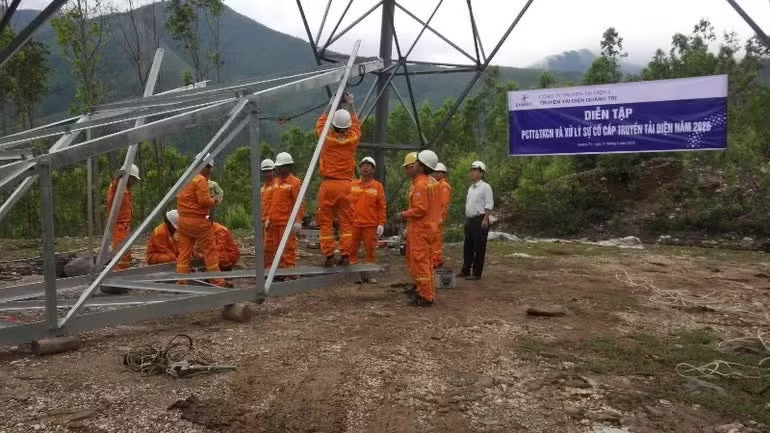
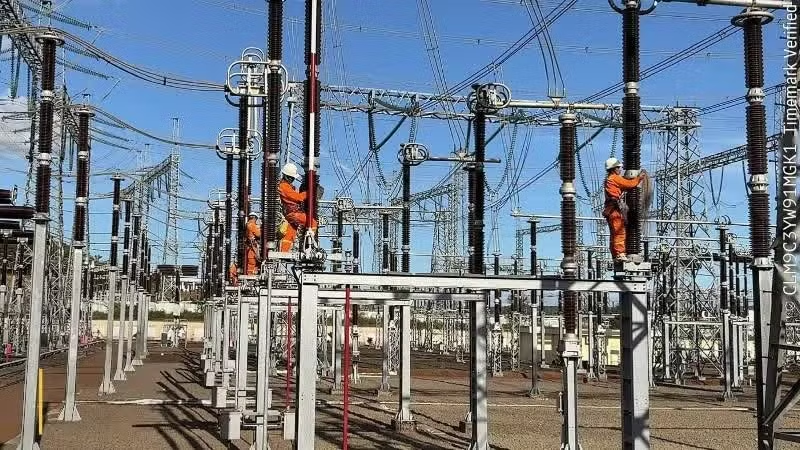
To proactively respond to the peak dry season, Power Transmission Company 2 has developed a detailed operating plan, strengthening coordination with dispatching levels and power plants to unify flexible operating methods. At the same time, the unit focuses on inspecting, reviewing, and thoroughly addressing equipment defects; promoting insulation cleaning, periodic testing, and major repairs to improve system reliability.
Sharing about the pressures and proactive measures taken by the unit during the peak period, Le Dinh Chien, Director of Power Transmission Company 2, emphasised: The company’s top priority is ensuring safe system operation in the context of high load demand. Despite facing numerous challenges, especially the extreme weather in central Viet Nam, Power Transmission Company 2 remains steadfast in its “four on-site” principle. We are prepared to divide our teams into smaller groups, deploying 100% of our personnel to key locations during storms, while ensuring on-site conditions to maintain continuous power transmission even when cut off.
In addition, Power Transmission Company 3 (PTC3) — the unit managing the power grid in the four provinces of Khanh Hoa, Dak Lak, Gia Lai, and Lam Dong, with its complex terrain and prolonged hot weather — has identified its key tasks as proactively preventing incidents, strictly controlling equipment conditions, strengthening corridor safety management, and improving the reliability of power supply during operation.
Power Transmission Company 3 proactively developed an operational plan early on, identifying the peak period from mid-December 2025 to July 2026, focusing on closely monitoring equipment status and preventing incidents. The company has developed incident response plans for dozens of 500kV, 220kV, and 110kV transformers at 28 substations.
In addition, it has cleaned more than 5,280 locations and equipment on the transmission grid, including 475 locations and equipment cleaned using hotline insulation cleaning technology. This is one of the important solutions contributing to improving the reliability of power supply during operation and reducing electricity consumption for transmission, especially in the context of prolonged hot weather and high load demand during the dry season months of 2026.
According to Dinh Van Cuong, Deputy Director of Power Transmission Company 3, pre-dry season operational management at affiliated units was completed before March 31. In particular, with the connection of 75 renewable energy plants, the company organised workshops and technical conferences to enhance coordination, share experiences, and identify shortcomings that need to be addressed, thereby improving the efficiency of ensuring electricity supply during the dry season.
Strengthening corridor management and technology application
Along with technical solutions, managing the safety corridor of the power grid is identified as a key task during the dry season, especially in the central region, where there is a high risk of forest fires, vegetation fires, and violations of transmission line corridors.
According to Nguyen Manh Tuong, Head of Safety Department of Power Transmission Company 3, prolonged hot weather increases the risk of forest fires, undergrowth fires, fires caused by tall trees outside the power line corridor, and agricultural and construction activities near the power grid that can directly affect system operation. Therefore, units must strengthen inspections and reviews of high-risk areas, closely coordinate with local authorities and people to promptly address unsafe factors.
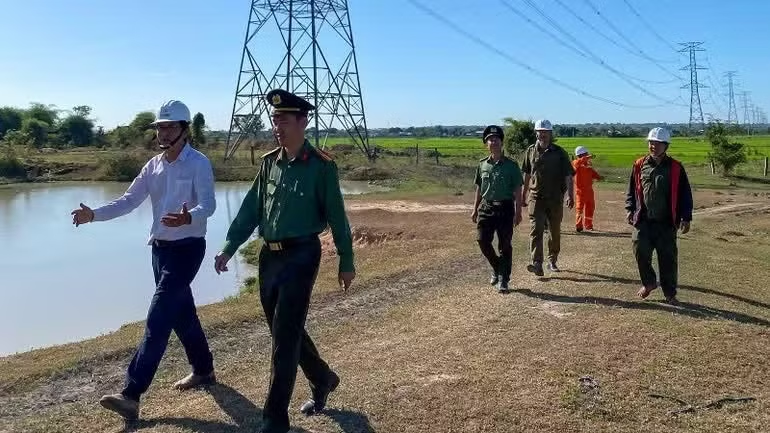
“From the end of 2025 to the present, the company has implemented many comprehensive solutions to prevent incidents caused by violations of the safety corridor. This includes clearing vegetation and preventing fires in the safety corridor, covering a total area of 2,202,453 m2, reaching 64.13%, with key areas in the Central Highlands already completed and expected to be fully completed by early May 2026; monitoring sugarcane cultivation and harvesting within and outside the safety corridor, covering an area of 677,365 m2, reaching 41.85%, expected to be completed by mid-June 2026. Simultaneously, we have intensified public awareness campaigns, signed commitments with residents, and applied technologies such as UAV-based line inspection and online equipment monitoring to improve operational reliability,” Tuong added.
In fact, Power Transmission Company 3 has implemented vegetation clearing and fire prevention along the power line corridor covering an area of over 2.2 million m², focusing on key areas within its management territory; at the same time, it closely monitors farming activities inside and outside the corridor to minimise the risk of violations.
Furthermore, transmission units are aggressively implementing corridor management through coordination with local authorities, forest rangers, and residents to clear vegetation, address potential safety hazards, and promote awareness campaigns and sign commitments to protect the power grid corridor.
Simultaneously, units are accelerating the application of science and technology and digital transformation in operational management. The use of unmanned aerial vehicles (UAVs) and online monitoring systems helps detect abnormalities on power lines early, improving inspection efficiency and minimising risks. In remote areas, solar-powered cameras transmitting real-time data are being deployed to detect forest fires, landslides, or violations of the power grid corridor.
In addition, Power Transmission Company 3 maintains close coordination with dispatching levels in operating the SCADA-EMS system, ensuring stable and reliable power system operation. Information on the SCADA connection status at substations is regularly updated, enabling parties to promptly address any emerging issues.
The unit also proactively works with relevant partners to develop a backup transmission channel plan, ready to switch when the SCADA system or hotline fails, thereby ensuring continuous signal maintenance for power system operation. At the same time, Power Transmission Company 3 proposes strengthening the information sharing mechanism between dispatching levels to shorten processing time and improve coordination efficiency.
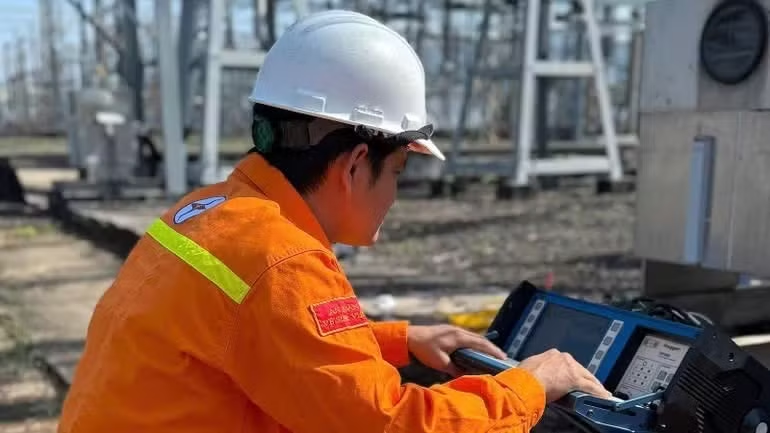
In the coming period, Power Transmission Company 3 will continue to implement solutions to improve technical infrastructure, enhance SCADA signal quality and connection reliability, aiming to build a power transmission system that operates safely, flexibly, and adapts better to practical requirements.
Mr Dinh Van Cuong, Deputy Director of Power Transmission Company 3, emphasised the requirement of “clear responsibilities, clear tasks, clear accountability,” strengthening discipline and order in operation, and implementing tasks with a proactive and decisive spirit, ensuring progress and quality.
Through proactive management, equipment maintenance, grid upgrade investments, and the strong application of digital transformation achievements, along with the high determination of leaders and employees, power transmission units are building a solid foundation, ready to overcome the challenges of the 2026 dry season, contributing to maintaining energy security and serving socio-economic development in the central region and the whole country.