Ho Chi Minh City is experimenting with various approaches to expanding access to books. New models, together with the growth of the publishing market, point to a noteworthy direction: shaping and nurturing reading demand, expanding reader communities, and building a market suited to changes in daily life.
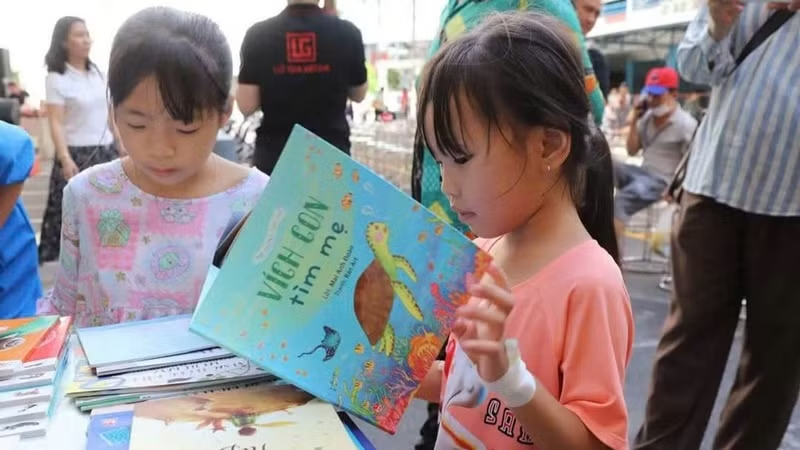
The Reading Promotion Book Fair model at Vista Verde Apartment Complex in Cat Lai Ward was piloted in 2026. Instead of centralising all activities on streets, book streets, or cultural centres, books were brought closer to residents, especially children and families. Exchanges, reading activities, experiences, and interactions with books were organised within the residential area, creating a reading space more closely connected with everyday life. This approach has sparked a shift in thinking about the development of reading culture.
In many cases, books and reading promotion activities need to proactively reach readers. Apartment complexes, schools, cultural houses, hospitals, and boarding houses, if properly organised, can all become attractive reading venues. Driven by this approach, more than 150 activities of the Ho Chi Minh City Children’s Book Fair 2026 were held in various spaces, including boarding houses and hospitals.
Another approach being piloted is bringing books and technology to remote areas of the city through digital library vehicles. Mobile trips to Can Gio, Hoc Mon, Nha Be, Xuan Thoi Son, and several disadvantaged areas brought books, reading devices, and interactive activities to children.
As the ways in which the public receives information are changing rapidly, technology is also being used as a tool to expand access to books. Digital libraries, e-books, audiobooks, and technology-based experiences are being tailored to help readers enter the world of books more easily.
According to the Ho Chi Minh City Department of Culture and Sports, in the first six months of 2026, revenue in the city’s publishing and distribution sector reached nearly 3 trillion VND, while the distribution segment recorded more than 50 million book copies sold. These figures show that the city continues to play an important role in the country’s publishing and distribution market. However, a closer look at the market also reveals issues that need to be addressed. In the first half of the year, the city’s Book Street recorded high revenue, up 2.91% year on year, but the number of books sold fell by 5.59% to just over 320,000 copies.
The development of reading spaces needs to be closely linked to market development. When a reading activity is organised in a residential area, school, or suburban locality, it is necessary to assess its potential and effectiveness in forming reading habits and demand for books.
Assoc. Prof. Dr Ngo Van Gia
Assoc. Prof. Dr Ngo Van Gia said the development of reading spaces needs to be closely linked to market development. When a reading activity is organised in a residential area, school, or suburban locality, it is necessary to assess its potential and effectiveness in forming reading habits and demand for books. If that demand increases, the market will have a stronger foundation for developing suitable products.
According to Le Thuy Duong, head of the Sach Nha Minh (Books of Our Home) Project in Ha Noi, the reality in Ho Chi Minh City shows that expanding the publishing market does not necessarily mean opening more bookstores. What matters is creating more points of contact between books and daily life through models such as book streets, bookstores, libraries, and schools.
In addition, residential areas, hospitals, industrial parks, and public spaces can all become new connection points if organised properly. Digital transformation is an indispensable element, and a new ecosystem should be formed in which distribution and access to readers are effectively linked on digital platforms.