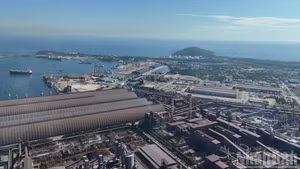
A key priority is the development of large-scale modern logistics hubs integrated with seaports, cross-border rail links, border gates, and multimodal transport infrastructure to reduce costs, optimise supply chains, and enhance the competitiveness of Vietnamese goods.
The development of modern, green and smart logistics hubs is expected to become a new driver enabling Viet Nam to integrate more deeply into regional and global supply chains.
Key link in supply chain
With total import-export turnover exceeding 930 billion USD in 2025, together with an extensive network of free trade agreements covering markets around the world, Viet Nam now has an opportunity to transform itself from a "trans-shipment point" into a "supply chain organisation hub."
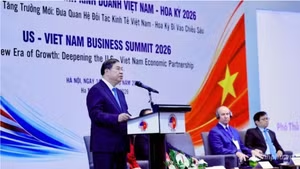
According to Dr Bui Ba Nghiem, Senior Specialist at the Import-Export Agency under the Ministry of Industry and Trade, the Logistics Services Development Strategy for 2025–2035, with a vision to 2050, marks the beginning of a new stage of development in which logistics is no longer merely a supporting service but has become a strategic component of national competitiveness.
If the strategy is implemented comprehensively — from improving institutions and accelerating infrastructure investment to strengthening business competitiveness and developing free trade zones alongside green and smart logistics hubs — then Viet Nam can become an important logistics link within ASEAN and gradually integrate more deeply into the global logistics network.
The Logistics Services Development Strategy for 2025–2035, with a vision to 2050, has ushered in a new phase of development in which logistics is no longer simply a supporting service but has become a strategic component of national competitiveness.
Dr Bui Ba Nghiem, Senior Specialist, Import-Export Agency, Ministry of Industry and Trade
Bui Nguyen Anh Tuan, Deputy Director General of the Agency for Domestic Market Management and Development under the Ministry of Industry and Trade, said that logistics services in Viet Nam remain relatively fragmented and dispersed. As a result, service flows need to be reorganised into a more integrated, professional, and cost-efficient system.
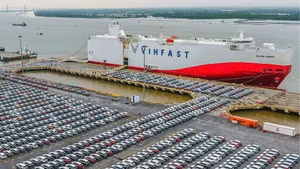
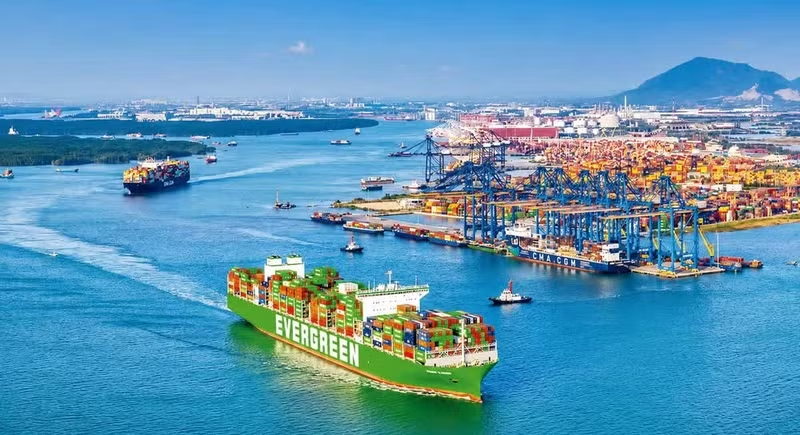
The breakthrough solution lies in establishing several regional and inter-regional logistics hubs linked to seaports, cross-border railways, border gates, and multimodal transport infrastructure.
In the north, logistics hubs could be developed in Hai Phong and Quang Ninh in connection with deep-water ports and major international border crossings. In the south, development would focus on Ho Chi Minh City, linked with the Cai Mep–Thi Vai port complex, Long Thanh International Airport, and the industrial zone of the Southeast region.
The Ministry of Industry and Trade's logistics development strategy will avoid scattered investment by establishing a clearly tiered system ranging from national and regional logistics hubs to local hubs, specialised logistics centres, and cargo consolidation points. Such a structure will help prevent overlapping investment and underutilised infrastructure while creating hubs large enough to connect regional and global logistics networks.
Logistics hubs will therefore serve as strategic infrastructure supporting production and international trade, rather than functioning merely as warehouses or cargo transit points.
Opportunities from green and smart logistics
"If Viet Nam succeeds in developing a modern network of green, smart, tiered, and interconnected logistics hubs, the impact on national competitiveness will be substantial," Deputy Director General Bui Nguyen Anh Tuan said. The first benefit would be lower logistics costs and reducing production, distribution, and export expenses.
This is particularly important as Viet Nam seeks to achieve high economic growth during the 2026–2030 period. Sustaining rapid growth will require improving the efficiency of the entire economy, with logistics playing a pivotal role.
As Viet Nam strives to achieve high economic growth during the 2026–2030 period, it must improve the efficiency of the entire economy in order to sustain rapid growth, with logistics serving as a key pillar.
Secondly, modern logistics hubs not only enable goods to move faster and at lower costs, but also strengthen supply chain quality, improve product quality management and traceability, and help meet the stringent standards of major export markets while supporting domestic consumption.
Thirdly, well-developed logistics infrastructure will give investors in manufacturing, retail, e-commerce, agricultural processing, and other sectors greater confidence to establish factories, transit warehouses, distribution centres, and supply chains in Viet Nam.
Fourthly, logistics hubs will strengthen regional connectivity. A tiered and interconnected logistics network will ensure that regions complement rather than develop independently of one another. Production areas, processing centres, consumer markets, border gates, and seaports will be integrated into a unified network. Ultimately, the development of green and smart logistics will enhance Viet Nam's position within global supply chains.
From the business perspective, Nguyen Le Hang, Head of Department and Director of External Affairs at SLP Viet Nam, said that the development of logistics hubs and green logistics has become an inevitable trend. Vietnamese enterprises have every opportunity to achieve significant growth by proactively investing in, or partnering with, developers of modern green logistics infrastructure while embracing technological transformation.
This would allow businesses to participate more deeply in supply chains, moving away from competing solely on low prices towards competing on service quality, speed, and the ability to meet international standards.
At the same time, companies will have opportunities to serve larger markets in rapidly expanding sectors such as e-commerce, cold-chain logistics, and express delivery. Furthermore, a green investment strategy will make businesses more attractive to investors and financial institutions, enabling them to secure the capital needed for future growth.