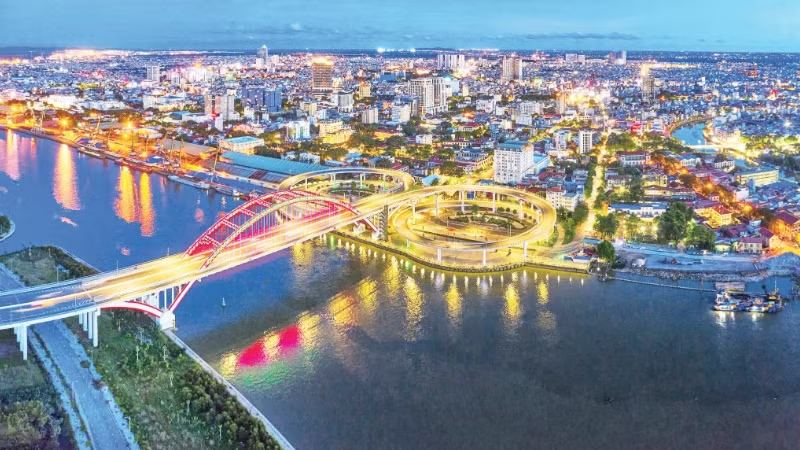
Leveraging key economic strengths
Hai Phong City and the former Hai Duong Province have taken a proactive and persistent approach to economic restructuring in tandem with renewing the growth model, capitalising on their competitive advantages in seaports and industry.
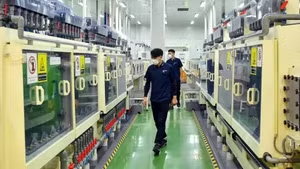
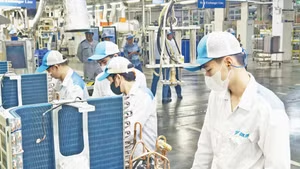
A key highlight is the system of industrial parks and industrial clusters linked with logistics infrastructure and seaports.
During the 2020-2025 period, Hai Phong established 10 new industrial parks and 13 industrial clusters, bringing the total to 23 industrial parks and 20 industrial clusters.
Hai Duong has planned and developed eight new industrial parks and 24 industrial clusters, raising the total to 20 industrial parks and 60 industrial clusters, while also developing several major logistics centres.
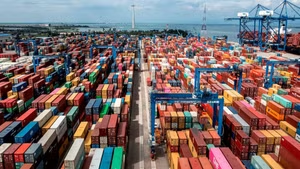
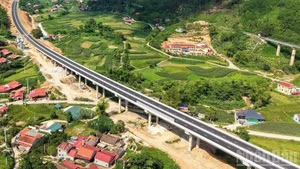
Transport infrastructure connecting logistics hubs with the international seaport area has received synchronous investment, creating a clear competitive edge in attracting investment for large-scale manufacturing.
As a result, the economic structure has shifted in the right direction, the economic scale of pre-merger Hai Phong has witnessed significant expansion. Over the past five years, the city’s economy has grown at an average annual rate of 11.39%. Industrial production has continued to expand, with the share of industrial value added in its economy rising from 43.33% in 2020 to 49.85% in 2025.
During the 2021-2025 period, the economy of the former Hai Duong Province is estimated to have grown by an average of 9.8% per year, with industry-construction and services accounting for 92.2% of the economic structure, and total factor productivity (TFP) contributing approximately 53.2% to economic growth.
According to Hai Phong Party Secretary Le Tien Chau, Hai Phong has set the goal of becoming one of Southeast Asia’s most modern, civilised, ecological, and liveable industrial port cities by 2030. The city’s approach is to restructure the economy towards modernity and sustainability, identifying science and technology, innovation, and digital transformation as the primary driving forces.
The economic growth target for the 2026-2030 period is at least 13% per year. Of this, industry-construction is expected to grow by 15.2% per year, services by 10.9% per year, and agriculture, forestry and fisheries by 2% per year.
By 2030, the digital economy is expected to contribute more than 35% of the city’s economy; the industrial production index (IIP) is projected to grow by 15.5%-16.5% per year; the share of manufacturing in the economy is expected to reach 47%-48%; and high-tech industrial products are projected to account for more than 60% of manufacturing output.
In implementing the National Assembly’s resolution, Hai Phong has established a free trade zone (FTZ), creating a space with a special institutional framework that integrates non-tariff zones, high-tech industrial parks, logistics centres, commercial and service centres, financial and banking services, and research and development (R&D).
In the FTZ, Hai Phong will pilot superior management mechanisms and preferential policies in areas such as land, taxation, customs, investment, finance, labour, foreign exchange, and import-export activities.
Administrative procedures will be simplified, state governance capacity enhanced, and the most favourable environment created for global strategic investors.
Hai Phong is also prioritising the development of modern logistics services linked with seaports, airports, railways, roads, and inland waterways, while forming new logistics service spaces associated with key projects such as the Lao Cai-Ha Noi-Hai Phong Railway, Nam Do Son Port, and the Lach Huyen International Gateway Port. The city aims to become a model for green and smart ports in Viet Nam and the wider region.
Unlocking private-sector resources
Hai Phong identifies the development of a multi-sector economy as an important foundation for mobilising and maximising social resources for development.
The private sector is regarded as a key driver of the economy, with strong growth in both number and scale, forming a balanced and flexible economic structure together with the state sector and the foreign-invested sector.
According to Hai Phong Chairman Le Ngoc Chau, the business community has always played a pioneering role and serves as a core force across all socio-economic fields.
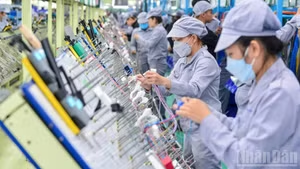
The private sector contributes more than 40% of the city’s economy and over 50% of its domestic budget revenue, as well as provides jobs for about half of the workforce. Sixteen private enterprises from the city are ranked among the top 500 largest private enterprises in Viet Nam. Many businesses have accelerated technological innovation, improved productivity, and expanded markets, particularly in key sectors.
With the strength of the business community and the support of the municipal authorities, Hai Phong has developed numerous large-scale, green, modern, sea-oriented urban areas and has essentially completed the target of building more than 16,000 social housing units assigned by the prime minister for the 2021-2025 period.
In a new phase of development, Hai Phong is committed to diversified and comprehensive development of all economic sectors, with the private sector identified as the most important driving force of the city’s economy.
By 2030, the city aims to have more than 87,000 private enterprises, including at least three large enterprises participating in global value chains. The private sector is expected to achieve an average growth rate of 14.5%-15% per year, contributing around 43%-45% of the city’s economy and 55%-57% of domestic budget revenue.
Alongside continued efforts to promote administrative reform and improve the investment and business environment, the city will implement “green lanes” for administrative procedures related to investment, construction, and land, and will hold regular dialogues to promptly address difficulties and obstacles faced by enterprises.
Notably, the city will provide accounting software, legal consultancy, and basic management training for all small and medium-sized enterprises; encourage and facilitate private-sector investment in strategic projects; and expand satellite linkages around foreign-invested enterprises and large domestic firms.
It will also establish an effective connectivity platform between government, businesses and innovation actors, fostering a community of resilient, forward-looking entrepreneurs with social responsibility and a strong aspiration to contribute.