Strategic position and advantages
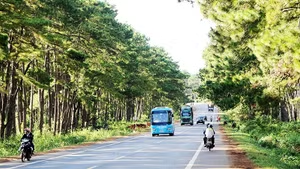
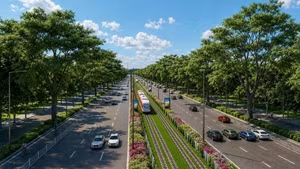
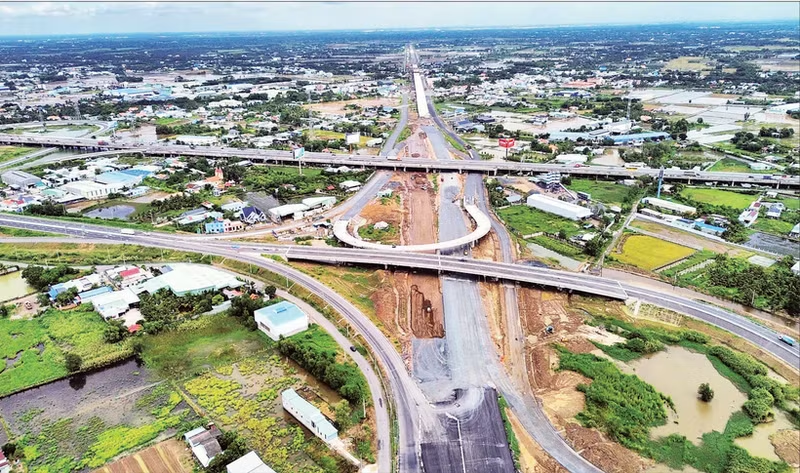
In mid-December 2025, complicated weather conditions directly affected the construction of hot-mix asphalt concrete layers, causing the plan for the technical traffic opening of Ring Road 3 (the section passing through Tay Ninh Province) to be delayed. However, with high determination, the project has still achieved more than 90% of its construction volume, creating an important foundation for the goal of opening the entire route to traffic in a synchronised manner at the earliest possible time.
At the same time, several branches connecting the Ben Luc–Long Thanh Expressway and the Ho Chi Minh City–Trung Luong Expressway have been completed and temporarily opened to traffic, demonstrating their effectiveness in regional transport connectivity. According to the Long An Construction Investment Project Management Board, in 2025 the project disbursed more than 382 billion VND. Once put into operation, this road section will help reduce traffic pressure at the gateway area of Ho Chi Minh City.
During the past term, transport projects contributed to an increase of 14.74% in the industrial and construction index, helping Tay Ninh Province achieve an economic growth rate of 9.52%, with state budget revenue of nearly 50 trillion VND. However, key transport routes such as National Highway 1A, N2, 50, and 62, and provincial roads connecting neighbouring localities, remain overloaded during peak periods, while major routes connecting to Ho Chi Minh City and the Mekong Delta are still lacking.
The Resolution of the First Tay Ninh Provincial Party Congress for the 2025–2030 term resolved to focus on directing compensation and site clearance, mobilising all resources to implement a road connecting the industrial corridor, the Moc Bai–Xuyen A urban area, and National Highway 50B; a road connecting the Ho Chi Minh City, Tay Ninh, and Dong Thap; and the Duc Hoa–Tan An–Binh Hiep road.
Le Van Han
Chairman of the Tay Ninh Provincial People’s Committee
Le Van Han, Chairman of the Tay Ninh Provincial People’s Committee, said that Tay Ninh has a border line of more than 368 km with international border gates of Xa Mat, Moc Bai, Tan Nam, Binh Hiep, and the Long An International Port. With these advantages, the province is both an important bridge between key domestic economic zones and a gateway for trade, tourism and international cooperation. Accordingly, the Resolution of the First Tay Ninh Provincial Party Congress for the 2025–2030 term resolved to focus on directing compensation and site clearance, mobilising all resources to implement a road connecting the industrial corridor, the Moc Bai–Xuyen A urban area, National Highway 50B; a road connecting the Ho Chi Minh City, Tay Ninh, and Dong Thap; and the Duc Hoa–Tan An–Binh Hiep Road.
Tay Ninh has identified key growth axes including the Ho Chi Minh City–Moc Bai Expressway; the Go Dau–Xa Mat–Binh Chanh route (Ho Chi Minh City); Ring Road 4 connecting to My Quy Tay Border Gate; and a waterway transport route along the Vam Co River system. Once put into operation, all these important projects will help Tay Ninh make a strong breakthrough.
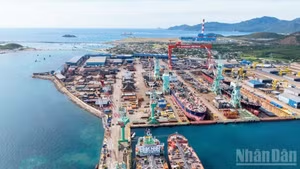
On December 18, 2025, Corps 20 – Tan Cang Sai Gon Corporation officially put the Tan Cang–Moc Bai Inland Container Depot at the Moc Bai Border Gate Economic Zone into operation, marking an important step forward in the logistics infrastructure development strategy and cross-border trade between Viet Nam and Cambodia.
Moc Bai is the largest land border gate in the southern region, located on National Highway 22, about 70 km from Ho Chi Minh City. It is the shortest land route connecting the Southern Key Economic Region with Phnom Penh, the capital of Cambodia. Covering more than 21,000 hectares, the Moc Bai Border Gate Economic Zone is attracting logistics, warehousing, and duty-free supermarket projects as part of a complete logistics supply chain.
Mobilising the entire political system
To resolve intra-provincial transport bottlenecks, it is estimated that the demand for the investment capital in transport infrastructure in the 2026–2030 period is about 13.6 trillion VND, mobilised from public and private investment sources, especially through public–private partnership (PPP) models. Tay Ninh will also ensure stable and continuous funding for national transport infrastructure development projects by maximising financial resources from both the public and private sectors as well as taking advantages of preferential loans and international support.
Another project drawing attention is the Ho Chi Minh City–Moc Bai Expressway (phase 1) passing through Tay Ninh Province, with a length of 26.3 km. The province is responsible for compensation, support, and resettlement, with total disbursement of 1,504 billion VND. Ring Road 4 is a strategic transport axis connecting the Southwest and Central Highlands regions. The section passing through Tay Ninh is 74.5 km long, with total investment for phase 1 estimated at 120,413 billion VND, and the province is currently carrying out site clearance.
Building transport and urban infrastructure is a major driving force to help Tay Ninh realise the targets set out in the resolution of the provincial Party Congress, including: eliminating poor households by 2030; achieving an urbanisation rate of 45–50%; increasing the contribution of total factor productivity (TFP) to growth to more than 55%; ensuring over 90% of communes meeting new-style rural area standards; raising GRDP per capita to 8,000–8,500 USD, equivalent to 210–225 million VND; achieving the digital economy scale of 30% of GRDP; and increasing social labour productivity in the 2026–2030 period by an average of 8–9% per year.
Building transport and urban infrastructure is a major driving force to help Tay Ninh realise the targets set out in the resolution of the provincial Party Congress, including: eliminating poor households by 2030; achieving an urbanisation rate of 45–50%; increasing the contribution of total factor productivity (TFP) to growth to more than 55%; ensuring over 90% of communes meeting new-style rural area standards; raising GRDP per capita to 8,000–8,500 USD, equivalent to 210–225 million VND; achieving the digital economy scale of 30% of GRDP; and increasing social labour productivity in the 2026–2030 period by an average of 8–9% per year.
To successfully implementing the goal of mobilising all resources and diversifying investment forms, Nguyen Van Quyet, Secretary of the Tay Ninh Provincial Party Committee, directed the Party Committee of the Tay Ninh Provincial People’s Committee to carry out plans for key project implementation and driving force axes according to the resolution of the provincial Party Congress. Through measures such as strengthening public–private partnerships, utilising all resources effectively, and using public investment to lead and activate all social resources, the locality will prioritise investment resources to develop and improve the infrastructure system.
“All members of Standing Board of the Provincial Party Committee, members of the Executive Board of the Provincial Party Committee, and leaders of agencies and units, must adjust and supplement their personal plans to implement the resolution based on the issued action programme, and must be accountable to the Provincial Party Committee and the Standing Board of the Provincial Party Committee for leadership, direction, and organisation of implementation in the sectors, fields, and localities under their responsibility,” emphasised Nguyen Van Quyet.