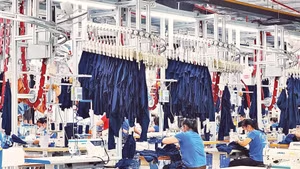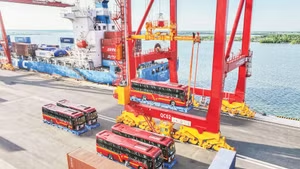
According to the National Statistics Office under the Ministry of Finance, the manufacturing and processing industry contributed 33.07% of the economy's total value-added growth, reaffirming its role as the primary engine of GDP growth in the first half of 2026.
Opportunities and challenges
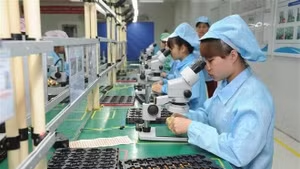
According to the Viet Nam Electronic Industries Association (VEIA), the electronics industry represented more than 30% of the country's total export turnover during the first six months of 2026.
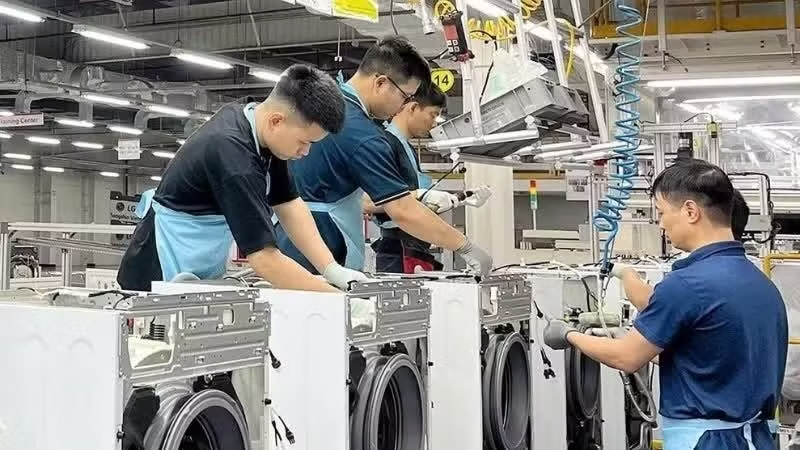
Do Thi Thuy Huong, a member of VEIA's Executive Committee, stated that the global market is expected to steadily rebound in the coming months, supported by year-end shopping demand in the US and Europe, as well as growing investment in artificial intelligence (AI), cloud computing, and data centres worldwide. The ongoing shift in global supply chains is also yielding substantial opportunities for Viet Nam to attract additional electronics manufacturing projects and expanded investment plans from major technology companies. Many businesses have already secured orders through the third quarter and partly into the fourth quarter, while suppliers for Samsung, Apple, and LG continue to operate at high capacity. Buoyed by these positive indicators, VEIA forecasts that electronics exports will increase by 15–20% in 2026 compared with 2025.
The steel industry has also witnessed a broad recovery across its value chain. Crude steel output reached 2.6 million tonnes in May, up 27.2% year-on-year, representing the highest growth rate among the world's 10 largest steel-producing countries. Total steel production during the first six months is estimated at nearly 15 million tonnes, surging by more than 21% compared with the same period last year.
However, Dinh Quoc Thai, Vice Chairman and General Secretary of the Viet Nam Steel Association (VSA), cautioned that the steel industry must proceed with vigilance in the second half of the year. Challenges include global overcapacity, mounting trade protectionism, and stricter carbon emission reduction standards, while the industry still relies partly on imported raw materials such as iron ore and scrap steel.
To support the steel industry's robust momentum in the coming period, VSA emphasises two key tasks: protecting the domestic market from the deluge of cheap imported steel and accelerating green transformation and digital transformation to better meet market demands; expanding opportunities to access high-quality export markets and minimising trade barriers.
At the same time, VSA recommends that the State develop policies to encourage investment, promote domestic production, and protect the steel industry sustainably over the long term; promptly finalise regulations on the quality management of imported steel, strengthen trade defence measures to limit unfair competition, and support businesses in effectively responding to trade defence cases.
A key pillar of growth
According to experts, to achieve high growth while maintaining macroeconomic stability, the decisive factor is to improve the supply capacity of the economy through investment in infrastructure, development of processing and manufacturing industries, promotion of science, technology, innovation, and increased labour productivity. When production capacity is expanded, the increase in consumption and investment will create real growth instead of stoking inflationary pressure.
Phi Thi Huong Nga, Head of the Industrial and Construction Statistics Department at the National Statistics Office, asserted that industrial production remains the pillar of economic growth during the second half of the year. Accordingly, the strong increase in imports of machinery, equipment, components, and raw materials in the first half of the year indicates that businesses are actively expanding production and stockpiling inputs, creating a foundation for increased output and exports in the coming period. On the other hand, thanks to improved export orders and stable production in the foreign direct investment (FDI) sector, many industries such as electronics, automobiles, machinery, and construction materials are expected to maintain positive growth momentum.
To achieve the double-digit economic growth target, the Ministry of Industry and Trade will focus on advancing industrial production development, particularly processing, manufacturing, supporting industries, and high-technology sectors. It will also work with localities to accelerate industrial and energy projects scheduled to become operational in 2026.
To achieve the double-digit economic growth target, the Ministry of Industry and Trade will focus on advancing industrial production development, particularly processing, manufacturing, supporting industries, and high-technology sectors. It will also work with localities to accelerate industrial and energy projects scheduled to become operational in 2026. At the same time, the ministry will continue refining institutional frameworks, reforming administrative procedures, advancing digital transformation, and supporting businesses to enhance their competitiveness and deepen their participation in global value chains.
In addition, the global trend of supply chain shifts and FDI flows is unlocking unprecedented opportunities for Viet Nam to cement its position on the world manufacturing map. Thanks to its stable political foundation, favourable geoeconomic location, and network of Free Trade Agreements (FTAs), Viet Nam is becoming a preferred destination for high-quality investment projects in technology, electronics, semiconductors, data centres, and smart manufacturing.
Experts therefore advocate elevating workforce quality, developing supporting industries, and fortifying links between domestic enterprises and FDI businesses to increase domestic value-added.