Potential for future technologies
Rare earths are increasingly regarded as strategic materials for cutting-edge technology sectors such as semiconductors, new energy, artificial intelligence, high-tech defence, and the green transition. In response to emerging development requirements, the Party and State have issued policies to effectively exploit, process, and utilise these critical resources to advance scientific and technological development and to bolster economic self-reliance.
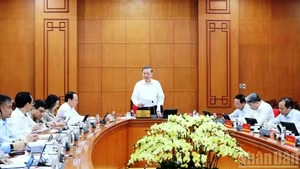
The Politburo’s Resolution No. 57-NQ/TW and the Prime Minister’s Decision No. 21/2026/QD-TTg clearly outline the strategic direction for developing strategic technologies based on mastering material resources. Recently, during a working session with the Central Policy and Strategy Commission and ministries on material technology development, Party General Secretary and State President To Lam emphasised the need to develop the materials industry as a foundational and strategic industrial sector, with rare earth materials identified as a priority area moving forward.
Many rare earth elements, such as Nd, Pr, Dy, Tb, Y, and Eu, play crucial roles in producing high-performance magnets, energy storage batteries, LED lights, luminescent materials, and high-tech devices. Thanks to their exceptional physical and material properties, rare earths are widely used in magnetic materials, superconductors, specialised alloys, electronic components, emission treatment catalysts, petrochemical technology, precision optics, and high-tech agriculture.
Despite being recognised as a critical and highly valuable resource, Viet Nam’s rare earth industry has not developed in line with its potential. The main limitation remains the low rate of deep processing, as activities are still largely focused on exploitation and primary processing. The country has also not established a comprehensive industrial chain from exploitation, separation, and refining to material production and high-tech applications. This is considered the most significant disparity between resource potential and national technological capability.
Professor and Doctor of Science Dang Vu Minh, Academician of the Russian Academy of Sciences and former President of the Viet Nam Academy of Science and Technology, noted that Viet Nam is among the countries with abundant rare earth reserves, estimated at around 20 million tonnes of oxides. These reserves are distributed across mines such as Dong Pao, Nam Xe, Muong Hum, and Yen Phu, as well as coastal placer deposits. In recent years, the State has invested in research and strategic frameworks for exploiting and processing this strategic mineral. However, the rare earth industry has not developed proportionately due to fragmented investment in science and technology, while the application of rare earths remains limited and overall economic efficiency remains low.
Prof. Dr. Tran Dai Lam, Head of the Institute of Materials Science under the Viet Nam Academy of Science and Technology, pointed out that a country possessing rare earth elements but only extracting and exporting them as primary ores or concentrates is essentially only selling the lowest part of the value chain. The highest value lies not in exploitation but in separation technology, high-purity refining, and the production of rare earth metals, magnetic alloys, luminescent materials, battery materials, semiconductor chips, and high-tech components. Therefore, if Viet Nam continues to export raw resources, it will not only lose added value but also miss the opportunity to build strategic technological capabilities.
Building national strategic technological capacity
With its significant potential, Viet Nam has favourable conditions to develop a modern rare earth industry. Experts argue that the country needs to shift from a mindset of “resource extraction” to one focused on “building strategic technological capacity.”
Prof. Dr. Tran Dai Lam asserted that the principle of “no raw exports” should be institutionalised as a clear national policy. This would ensure that rare earth mining projects are linked with deep processing, environmentally friendly technology, higher localisation rates, and meaningful contributions to the domestic materials industry ecosystem.
In the long term, Viet Nam should establish a national key science and technology programme on rare earths and strategic minerals covering the entire value chain. Simultaneously, deep-processing complexes should be developed in advantageous regions such as Lai Chau Province, linked to the development of materials and high-tech industries.
furthermore, Viet Nam needs selective international cooperation to absorb modern separation and refining technologies, while ensuring technology transfer, workforce training, and domestic research facility development. This approach would prevent the recurrence of the model of exporting raw resources in exchange for imported equipment.
The Politburo’s Resolution No. 68-NQ/TW on private sector development is expected to provide momentum for technology enterprises and deep-tech start-ups to commercialise high-tech materials, contributing to the growth of the rare earth industry. Therefore, it is necessary to develop the domestic market for rare earth materials through strategic industries such as energy storage batteries, electric vehicles, electronics, defence, and renewable energy.
To harness the potential of rare earth elements, Prof. Dr. Dang Vu Minh emphasised the importance of training high-quality human resources, developing experienced experts, and investing in key laboratories for rare earth technology. In particular, it is essential to promptly establish a development project for Viet Nam’s rare earth technology and industry for the 2025–2030 period as a basis for synchronised planning and development of mining, processing, and application technologies, gradually building national strategic technological capacity.
Research into rare earths in Viet Nam was first initiated by Prof. Dr. Dang Vu Minh in 1986. Trained in chemistry in the Soviet Union, he graduated from Moscow State University in 1968 and later earned both his doctorate and Doctor of Science degrees at the Soviet Academy of Sciences. With deep expertise and research experience at one of the world’s leading scientific centres, he laid the foundation for developing Viet Nam’s rare earth research community.
Building on this pioneering research, Vietnamese scientists have gradually mastered many important technologies related to rare earth processing and applications. Notably, the project cluster “Rare earth material technology for production, daily life, and environmental protection”, conducted by Professor Dang Vu Minh and his colleagues, received the State Prize for Science and Technology in 2005. These achievements not only affirmed Viet Nam’s research capacity but also created an important scientific and technological foundation for developing the rare earth industry in the modern era.