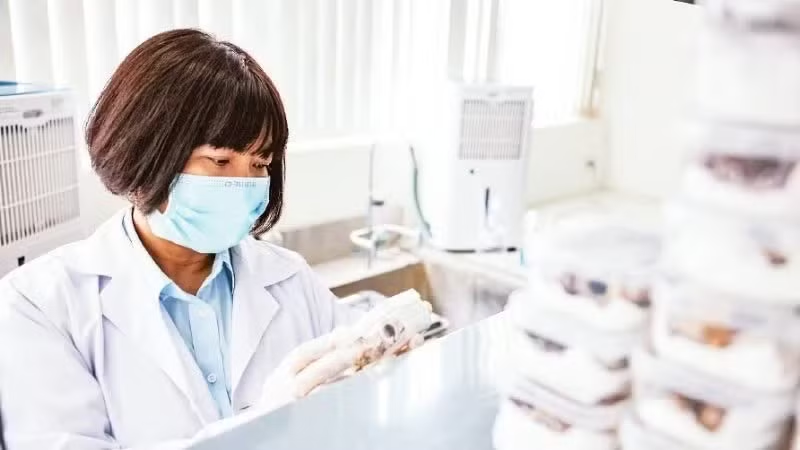
As time gradually erases the traces of history, breakthroughs in science and technology, particularly next-generation gene sequencing (NGS-SNP), are offering renewed hope for identifying fallen soldiers.
Each successful identification represents not only the homecoming of a loved one to their family but also the continuation of the nation’s tradition of gratitude.
From a difficult challenge to a scientific solution
Accompanying the staff from the DNA Identification Centre at the Institute of Biotechnology, under the Viet Nam Academy of Science and Technology (VAST), we were deeply struck by the reverence reflected in every task undertaken there.
To them, a fragment of bone or a single tooth is not merely a sample but the remaining trace of a fallen soldier, behind which lie the decades-long hopes of countless families.
Despite the immense pressure of the 500-day campaign to identify unknown fallen soldiers, the scientists remain steadfast in adhering to scientific principles: a name is restored only when supported by conclusive evidence.
In this highly specialised field, every conclusion represents not simply the outcome of research but a long-awaited answer for a life once lost, and for the families who have waited decades for it. Although the war is long over, the mission of restoring the identities of fallen soldiers remains fraught with challenges.
Time has not only erased the traces of war but has also caused the DNA in many sets of remains to deteriorate severely. At the same time, records have been lost and eyewitnesses have become increasingly scarce. Science and technology have therefore become the key to bridging the gaps left behind by history.
Previously, the DNA Identification Centre relied primarily on mitochondrial DNA analysis. While this approach yielded many significant results, it proved limited when applied to remains that had been buried for several decades.
Between 2019 and 2021, the centre analysed 4,276 samples, but only 1,205 produced sufficient data for comparison, leading to the successful identification of just nine fallen soldiers.
According to Dr Tran Trung Thanh, Director of the DNA Identification Centre, the breakthrough came with NGS-SNP technology, which combines next-generation sequencing with SNP analysis to provide a new foundation for identifying fallen soldiers.
The technology enables the simultaneous analysis of thousands of genetic markers, even from severely degraded DNA samples. It also broadens the scope for comparison with relatives across multiple generations and lays the groundwork for establishing a national DNA database.
Most notably, the DNA extraction success rate from recovered remains has risen from around 22% to more than 80%, creating new opportunities to identify cases once considered virtually impossible.
The effectiveness of NGS-SNP technology was clearly demonstrated during a recent pilot project at the Tra Linh Martyrs’ Cemetery in Cao Bang Province.
Associate Professor Dr Phi Quyet Tien, Director of the Institute of Biotechnology, said that most of the 58 sets of remains eligible for testing had suffered extensive DNA degradation.
Nevertheless, thanks to a specialised DNA extraction protocol optimised by the Institute, researchers successfully obtained high-quality SNP data from 54 samples, a success rate of 93%. This level of efficiency would have been extremely difficult to achieve using conventional mitochondrial DNA analysis.
Using these data, the research team compared them with DNA samples from relatives of 14 fallen soldiers and successfully identified two individuals during the first pilot phase. The remaining unmatched cases were mainly due to the absence of relatives’ DNA samples for comparison, rather than any limitation of the technology itself.
The results achieved at Tra Linh have provided an important practical foundation for VAST to recommend that Steering Committee 515, which is responsible for directing the identification of unknown fallen soldiers, officially adopt the NGS-SNP process and expand its implementation to Giong Rieng Martyrs’ Cemetery in An Giang Province from 2026, where 964 graves contain unidentified remains.
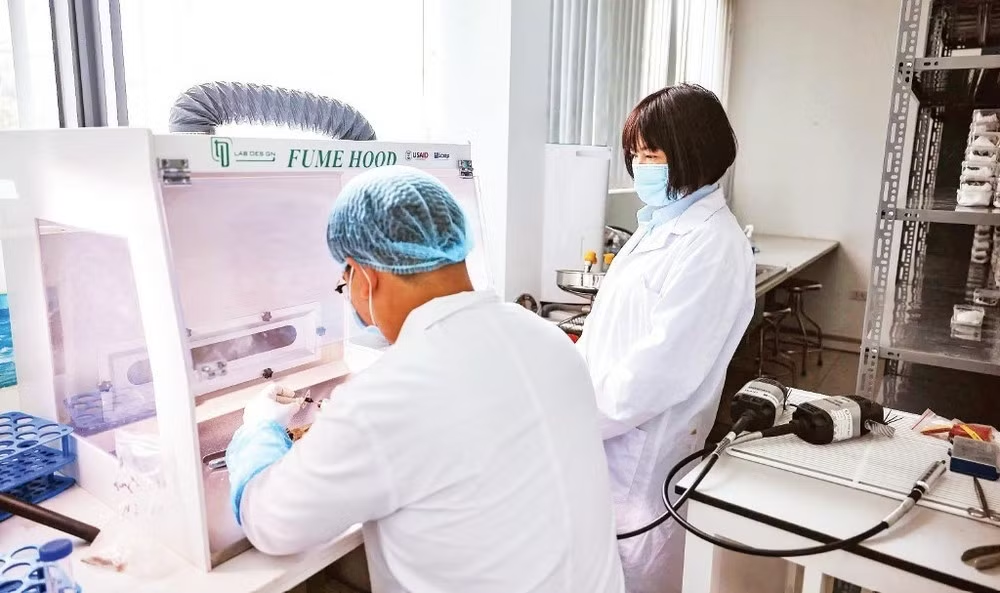
Putting technology into practice
Although technological advances have opened up promising new possibilities, the task of identifying fallen soldiers still faces many obstacles.
Speaking about these challenges, Associate Professor Phi Quyet Tien noted that the tropical climate, characterised by heat and humidity, combined with prolonged burial periods, has caused severe DNA degradation in many sets of remains. In addition, many cases lack records or sufficient information about surviving relatives for comparison.
To improve identification efficiency in the years ahead, he said it is essential to master DNA analysis techniques for severely degraded samples and to establish a sufficiently comprehensive reference database through the National Gene Bank.
Alongside technological challenges, DNA comparison is becoming increasingly difficult because many soldiers died decades ago, leaving fewer and fewer direct descendants. In many cases, only distant relatives remain.
According to Dr Tran Trung Thanh, it is therefore necessary to keep expanding the nationwide collection of DNA samples from relatives, standardise and centrally manage the database, and integrate DNA data with martyrs’ records and information gathered during the search and recovery of remains.
Professor Dr Chu Hoang Ha, Vice President of the Viet Nam Academy of Science and Technology, said that with an estimated 200,000 to 300,000 samples requiring analysis, current capacity can process only around 1,000 to 2,000 samples each year.
It is therefore vital to expand the forensic testing system, transfer technology, train additional specialists and invest comprehensively in modern equipment to increase processing capacity many times over.
To address this challenge, the Prime Minister has assigned VAST to serve as the lead agency to receive and implement an ODA-funded project from the US government aimed at strengthening Viet Nam’s capacity for DNA identification of fallen soldiers’ remains.
Over the past two years, VAST has worked closely with international experts and the International Commission on Missing Persons (ICMP) to pilot new technological procedures, achieving encouraging initial results.
Having witnessed many relatives quietly leave after unsuccessful identification attempts, DNA specialists understand that trust can only be built upon robust scientific evidence.
That understanding drives them to strive even harder. For those engaged in DNA identification, every successful match represents not only a scientific achievement but also the moment when a fallen soldier is finally called by their rightful name and a family is reunited after decades of searching.
This is the profound humanitarian value of science and, above all, the heartfelt mission of those who work tirelessly, day and night, to help bring the nation’s fallen soldiers home.