At present, post-harvest losses for mangoes and dragon fruit are estimated at between 20% and 30%, resulting in substantial losses for farmers and undermining the competitiveness of Vietnamese produce in international markets.
At the same time, export markets are imposing stricter limits on harmful residues, while quality assessment still relies heavily on practical experience combined with physicochemical and microbiological analyses. These methods typically require lengthy testing, substantial manpower and high costs, while also posing a risk of damaging the agricultural samples.
Against this backdrop, Dr Bui Quang Minh and colleagues at the High-Tech Innovation Centre under the Viet Nam Academy of Science and Technology have led the project "Research on the application of artificial intelligence in agricultural produce quality assessment".
The project involved compiling a database of around 10,000 images capturing the appearance, size, and nutritional composition of mangoes and dragon fruit; analysing fruit quality through a combination of chemical testing and image analysis to identify correlations between quality and visual characteristics; establishing a database of the physicochemical properties of both fruits; and developing AI-powered software to assess their quality.
The research team selected well-known mango- and dragon fruit-growing areas, including Dong Thap Province, Can Tho City, Long An Province and Dong Nai City, as pilot locations.
According to Dr Bui Quang Minh, the project's principal investigator, applying AI to agricultural quality assessment is no longer confined to the laboratory. The technology now combines deep learning models with image processing techniques to detect, classify and evaluate agricultural produce. Successful deployment of the system can significantly reduce post-harvest losses while improving the productivity, quality and reputation of Vietnamese agricultural products in international markets.
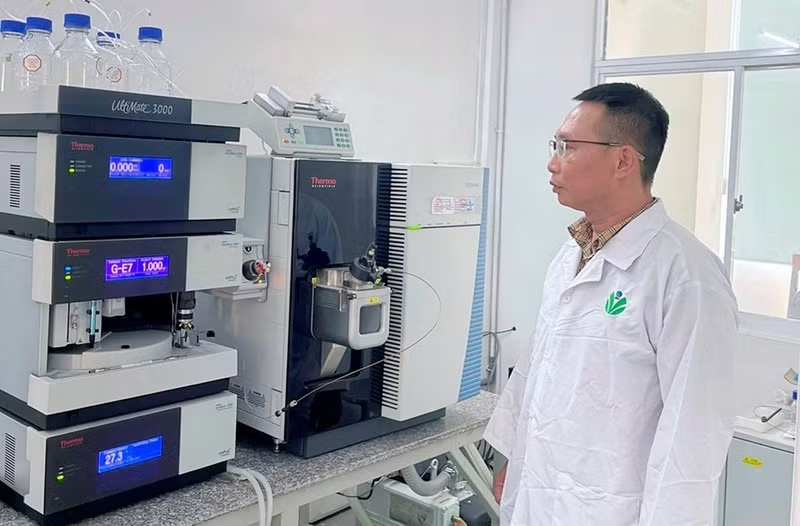
The AI technology also integrates hyperspectral imaging (HSI) with advanced machine learning models, enabling spectral analysis of agricultural produce to accurately estimate nutritional content, moisture levels, and internal quality without destructive testing. This substantially shortens laboratory analysis time.
Furthermore, converting conventional RGB images into hyperspectral images using HSI technology provides lower-cost, faster processing while enabling on-site quality assessment directly in the field.
To improve product traceability and ensure transparency throughout the supply chain—from harvesting to the consumer—the AI system is integrated with blockchain technology. AI also enables quality monitoring at every stage of the agricultural value chain, improving the efficiency of storage, transportation, and distribution.
Meanwhile, predictive algorithms based on environmental data, including temperature, humidity, soil pH and crop growth indicators, help farmers determine the optimal harvest time, thereby reducing post-harvest losses and increasing profitability.
During the project, the research team built a database comprising 14,411 images of mangoes and dragon fruit at different quality levels. This dataset serves as a valuable resource for training, testing and operating AI models for agricultural quality assessment.
The project also developed Fruit Monitor/Fruit AI, software capable of identifying, assessing and issuing quality alerts for these fruits with an accuracy of more than 90%. The system also supports the management of user information, farms, storage facilities, cameras, AI models and training histories.
The project established a complete workflow for applying AI to fruit quality assessment, covering image acquisition and pre-processing, data labelling, chemical analysis of mangoes and dragon fruit at different quality grades, AI model development and training, and deployment of the system through web and mobile platforms.
Nevertheless, applying AI to agricultural quality assessment requires robust data storage and cloud computing infrastructure capable of processing large volumes of sensor and image data, together with reliable internet bandwidth to transmit information to central analysis systems.
In addition, the high initial investment required for specialised cameras, HSI sensors and AI software remains a significant barrier for small-scale farmers. Training personnel to operate, maintain and further develop AI technologies in rural areas is also essential but remains limited. At the same time, support from the Government and international organisations is needed to establish a comprehensive legal framework covering data security, privacy protection and unified quality standards.
The project has resulted in the publication of three SCIE-indexed international papers and two domestic journal articles, while also training one master's degree graduate.
According to the acceptance council of the Viet Nam Academy of Science and Technology, the project "Research on the application of artificial intelligence in agricultural produce quality assessment" has significant scientific and practical value, contributing to more effective agricultural quality assessment and promoting the application of AI in agriculture.