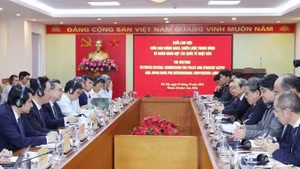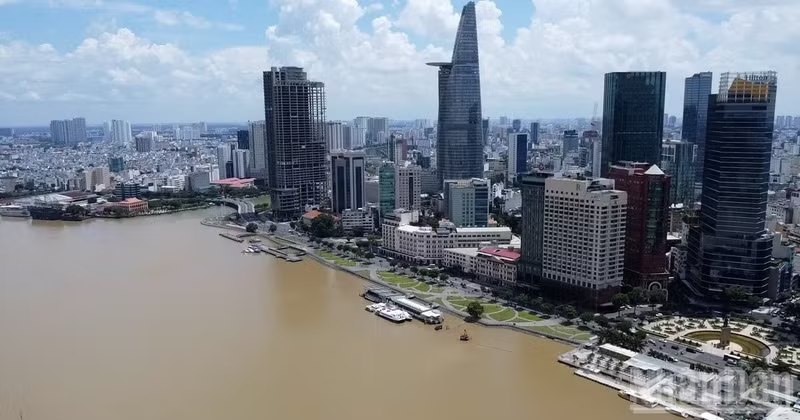
In mid-July 2026, VIFC-HCMC launched an Avisory Council comprising 13 prominent domestic and international experts to provide strategic advice and help connect the centre with international resources.
Since its establishment, VIFC-HCMC’s core objective has been to facilitate foreign investors’ access to and investment in Viet Nam, enabling them to share in the benefits of the country’s economic growth.
However, rather than following traditional models established by other countries decades ago, Ho Chi Minh City aims to develop a new-generation international financial centre.
The centre is envisioned as a platform built on technology, data, innovation and modern financial services, while also allowing new products, capital mobilisation methods and business models to be tested within a controlled environment.
Instead of competing directly with long-established financial centres, the city seeks to create a flexible, highly adaptable ecosystem capable of serving as a hub for regional capital flows. The decisive factor in realising this ambition lies in the institutional framework.
International experience shows that successful financial centres possess institutional frameworks flexible enough to respond to rapidly changing market conditions. Competitiveness should therefore be measured not by size or the number of institutions present, but by the ability to create a regulatory environment that both encourages innovation and safeguards systemic stability.
For international investors, policy stability, transparency and predictability are among the foremost considerations alongside returns. To meet these requirements, Ho Chi Minh City needs to be empowered to pilot special mechanisms, with particular emphasis on regulatory sandboxes for fintech, digital assets, cross-border payments and financial products aligned with international standards.
Current proposals in the draft Law on Special Urban Areas are focused on granting Ho Chi Minh City greater autonomy in key areas, including expanded authority over planning, infrastructure development, bond issuance, policies to attract talent, and the implementation of regulatory sandboxes. These are necessary conditions for strengthening the city’s competitiveness in attracting investment.
However, special mechanisms will only prove effective if they facilitate the flow of capital into the economy. If investors still have to navigate administrative procedures as complex as those currently in place, the policies will struggle to deliver their intended impact.
After around six months of operation, VIFC-HCMC has recorded approximately 20 billion USD in investment commitments from domestic and foreign investors. This is an encouraging sign. However, according to economic experts, the effectiveness of a financial centre should not be assessed solely by the number of participating institutions or the amount of registered capital, but by its capacity to mobilise long-term funding for infrastructure, energy, logistics, innovation and enterprise development.
The decision not to pursue direct competition with long-established international financial centres reflects a pragmatic approach. What Viet Nam needs is a model suited to its own strengths and development conditions, while making the most of its rapid economic growth, digital transformation and strategic geopolitical position in the region.
Building a new-generation financial centre is not a task for the financial sector or Ho Chi Minh City alone. Rather, it forms part of the broader strategy to improve market-economy institutions and diversify the country’s capital mobilisation channels. Once special mechanisms are developed in a coordinated and transparent manner and implemented effectively, the financial centre will be well positioned to serve as a bridge for attracting international capital to support Viet Nam’s national development goals.

![[Infographic] GRDP growth scenarios for 34 provinces and cities in fourth quarter of 2026](https://en-cdn.nhandan.vn/images/nyM650OGFWrOVWc-xajqN-rTZ68Rlmc1fiGJOhBRYHFSa4DhrHNDxEFdnz313Vk5dNJuxdkHglPA3rLeaPeiaUheNuCI723k2lNssd-YLJuKR58epWq7s21lV5WjM-HR2-Qpbi4MwAzqt9wRjL4WjGkfEz7RO9qhcwg8o8LQFK8/grdp-growth-scenarios-for-34-provinces-and-cities-in-q42026-anh-dai-dien.jpg.avif)