
Institutional breakthrough anchoring long-term strategy
Amid continuing fertility decline and rapid population ageing, the 2025 population outcomes provide the institutional basis for a proactive, adaptive, and sustainable population strategy. A key milestone is the 15th National Assembly’s approval of the Population Law, which establishes a coherent legal framework for State management of population issues and marks a fundamental shift from the mindset of “family planning” to “population and development”.
According to Le Thanh Dung, Director of the Population Department under the Ministry of Health, alongside drafting the Population Law, the Department has worked with functional agencies to issue a series of important documents. These include: the amended Ordinance on Population supplementing Article 10 (allowing spouses and individuals to decide on timing of birth, number of children, and spacing between births); a circular defining authority in the population sector under the two-tier local government model; and a report proposing investment policy for the National Target Programme on healthcare, population, and development for 2026–2035.
The Population Law establishes a coherent legal framework for State management of population issues and marks a fundamental shift from the mindset of “family planning” to “population and development”.
Together, these documents form an increasingly complete “legal corridor”, ensuring population work rests on a solid institutional foundation aligned with the country’s sustainable development orientation.
A series of plans and programmes have also been submitted to the Prime Minister for approval, ranging from fertility adjustment and strengthening family planning services to elderly healthcare, serving as vital bases for policy planning in the coming period.
Population communication has been systematically implemented, integrated into major events such as World Population Day (July 11), World Contraception Day (September 26), and Viet Nam Population Day (December 26). These efforts have helped disseminate messages on reproductive rights, improve population quality, and reinforce investment in sustainable development.
An “Outstanding Population Communicator” contest attracted contestants from 11 provinces and cities nationwide, aiming to generate fresh momentum for grassroots population cadres and revitalise communication approaches, bringing policies closer to the people.
In 2025, the country implemented 11 population targets, of which 7 were tailored to each province and city. Many important targets were achieved or exceeded. Average life expectancy reached 74.7 years (surpassing the 74.6 target); the sex ratio at birth stabilised at 111 boys per 100 girls; and total new users of modern contraception exceeded 5.32 million.
Additionally, the rate of pregnant women screened prenatally for four major conditions – Down syndrome (trisomy 21), Edwards (trisomy 18), Patau (trisomy 13), and neural tube defects – reached 57%, well above the 50% target. The rate of young couples receiving premarital counselling and health checks rose by 21.71%, far exceeding the 8% target.
Tackling shortcomings to strengthen effectiveness
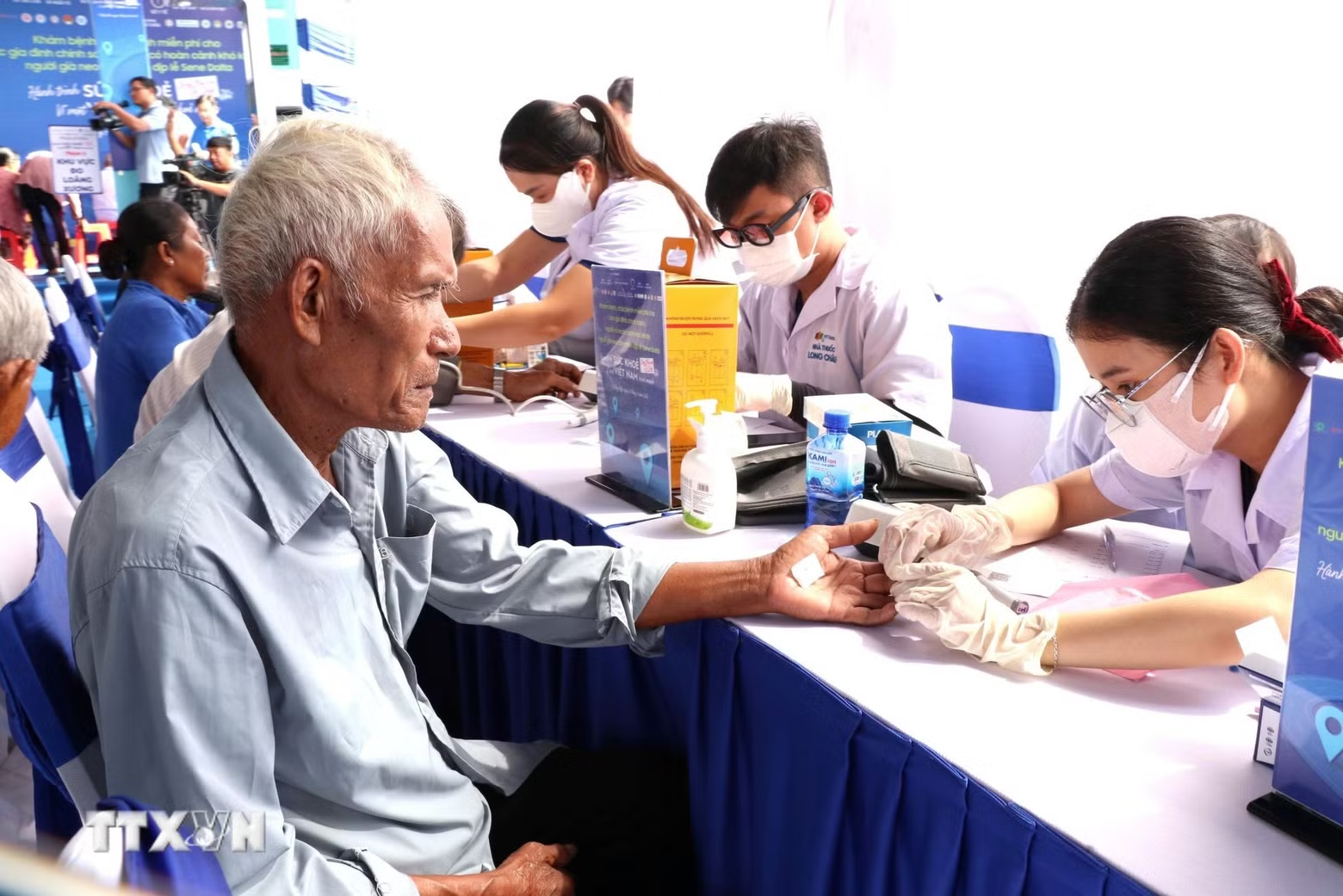
Despite these achievements, population work in 2025 still revealed notable limitations. The total fertility rate reached only 1.93 children per woman, below the 2.1 target; fertility adjustment increased by +0.2, short of the planned +0.3. Some indicators of population quality and ageing adaptation remain low: the rate of newborns screened for five diseases to detect metabolic and endocrine disorders reached only 51% (target 70%); the rate of elderly receiving periodic health checks rose by 6.6%, falling short of the 10% target.
In particular, the target to reduce unintended pregnancies among adolescents and youth lacks sufficient aggregated data, exposing weaknesses in monitoring, reporting, and population data systems. Moreover, information infrastructure, databases, and technology applications in population management remain unsynchronised; funding is limited; and coordination between functional units is sometimes inconsistent. If these “bottlenecks” are not promptly addressed, they risk undermining the effectiveness of policies and slowing the practical implementation of the Population Law.
Placing population at the heart of the sustainable development strategy must not remain a slogan but become the guiding principle for decisive action in the 2026–2030 period.
To meet assigned population targets in 2026 and overcome existing shortcomings, Deputy Minister of Health Do Xuan Tuyen emphasised the priority of developing and issuing decrees and circulars guiding the implementation of the Population Law; deploying the Government’s plan to enforce the Law; and reviewing documents to ensure consistency between central and local levels.
He highlighted the need to secure replacement-level fertility nationwide by 2030 through practical, feasible support policies tailored to budgetary conditions and regional characteristics.
Improving human resource quality in population work under the two-tier local government model is also essential. Amid rapid population ageing, enhancing population quality and elderly healthcare must be central to programmes and projects, particularly in mountainous and remote provinces, to ensure minimum capacity for screening services and elderly care at the commune level.
Synchronised databases connected to the national population database, stabilised organisational structures, and strengthened grassroots cadres are also required.
The Population Law has been adopted, but its true effectiveness will only be proven when policies are implemented in practice, and when every family and individual clearly benefits from them. Placing population at the heart of the sustainable development strategy must not remain a slogan but become the guiding principle for decisive action in the 2026–2030 period.