Vibrant “triple-helix” linkages
The most notable change in the science, technology and innovation ecosystem over the past year has been the completion of the institutional framework at an unprecedented pace. A series of major laws have been passed by the National Assembly, including the Law on Science, Technology and Innovation; the Law on Digital Technology Industry; the Law on Artificial Intelligence; and the Law amending and supplementing a number of articles of the Law on Technology Transfer.
In addition, 17 decrees have been drafted to remove long-standing bottlenecks related to financial mechanisms, intellectual property valuation, ownership and use of research results, autonomy mechanisms for scientific organisations, and opportunities for businesses to access science and technology resources.
At the same time, for the first time, the Government has identified 11 groups of strategic technologies and 35 national strategic products, helping businesses gain clearer investment direction by knowing which sectors are prioritised and which technologies will receive State support.
The digital environment has also been developed in a more integrated manner, with 84 national digital platforms, 21 operational platforms, the National Portal for Science, Technology, Innovation and Digital Transformation Initiatives, the National Digital Architecture Framework, and the National Technology Exchange. These components create a favourable digital corridor for businesses to access technology, experts and data more quickly and transparently.
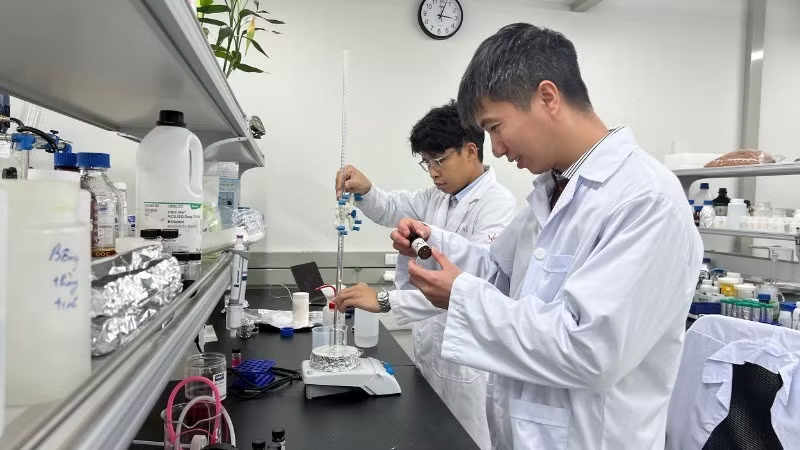
The impact of these new policies has given strong momentum to the science and technology market. The National Key Laboratory for Petrochemical and Refining Technology – KeyLab PRT (Viet Nam Institute of Industrial Chemistry) is a typical example. Reviewing one year of accompanying Resolution 57, Professor Vu Thi Thu Ha, Director of the laboratory, said that 2025 marked a particularly important step forward in effective connectivity between laboratories and businesses.
One major highlight is that Binh Son Refining and Petrochemical Joint Stock Company (BSR) commissioned the implementation of a science and technology task entitled “Co-research on completing technology and pilot production of biodiesel fuel”, aiming towards investment in an industrial-scale manufacturing plant based on indigenous innovation technology.
The ECOAL additive developed by KeyLab PRT has been successfully applied on a trial basis at Tan Thang Cement Plant (TH Group) since 2021, helping reduce coal costs by an estimated 130–170 billion VND (around 4.9–6.5 million USD) each year, and in 2025 it continued to be selected as one of the core technologies in the green and sustainable development strategy of the Balance Life ecosystem.
KeyLab PRT is also connecting with Da Nang Rubber Joint Stock Company to develop advanced and green additives for the production of specialised rubber tyres for export. Notably, three other core technologies that KeyLab PRT has painstakingly researched for more than a decade have been selected by many investors as the central technologies for projects to build high-tech product manufacturing plants in Viet Nam, with total investment capital ranging from 1 to 5 trillion VND (38 – 190.2 million USD).
Resolution 57, together with the target of double-digit economic growth, has created strong incentives for businesses to seek out research organisations that possess core technologies and have the capacity to refine them. When the traditional growth model has reached its limits, enterprises are compelled to shift towards growth driven by innovation and the development of products with high scientific content.
Professor Vu Thi Thu Ha, Director of the National Key Laboratory for Petrochemical and Refining Technology
According to Professor Thu Ha, Resolution 57 and the goal of double-digit economic growth have motivated businesses to turn to research organisations that hold core technologies and can complete technology development. As the traditional growth model reaches saturation, enterprises must transition towards innovation-led growth and the development of products with high scientific content.
In the past, research outcomes from institutes and universities seeking to enter the market had to “fend for themselves”, struggling to cross the so-called “valley of death” due to a lack of sufficiently strong financial resources to complete technology development. However, practical cooperation over the past year has shown that when business resources arrive in a timely manner, in the right place and at the necessary scale, the process of bringing technology into socio-economic development accelerates markedly.
The Viet Nam–Korea Institute of Science and Technology (VKIST) is a specialised research institute operating under international standards. For many years it faced obstacles related to financial mechanisms, technology transfer and the exploitation of intellectual property assets, but in 2025 these bottlenecks were removed.
Associate Professor and Doctor Vu Duc Loi, President of the institute, said that the institute and several businesses and localities are completing the final steps to sign technology transfer agreements for technologies such as rapid testing for certain common cancers, processes for extracting anti-inflammatory active ingredients from hy thiem (Siegesbeckia orientalis) plants, and technology for producing aluminium sulphate from wastewater generated during aluminium production. The institute considers these contracts to be direct outcomes of the new legal corridor created by instruments such as Resolution 57, the Law on Science, Technology and Innovation, and Resolution No. 193/2025/QH15.
The vibrant “triple-helix” linkage among research institutes, universities and businesses has helped the implementation of Resolution 57 quickly yield tangible results and become more closely aligned with the development needs of each sector and locality.
Professor and Doctor Tran Tuan Anh, Vice President of the Viet Nam Academy of Science and Technology
According to Professor and Doctor Tran Tuan Anh, Vice President of the Viet Nam Academy of Science and Technology, many ministries, sectors and localities have implemented innovative models, notably the linkage model among research institutes, universities and businesses. The business community, research institutes and universities have participated very proactively, with enterprises increasing investment in research and development (R&D), placing orders for research tasks and accompanying the deployment of new products. These dynamic “triple-helix” linkages have helped the implementation of Resolution 57 quickly produce concrete outcomes and align more closely with the development needs of each industry and locality.
Accelerating targets for the year ahead
A clear movement after one year of implementing Resolution 57 is a shift in awareness of the role of science and technology, leading to changes in working methods. This forms an important foundation for deeper progress in the years to come.
Nguyen Huy Van, Deputy General Director of Traphaco Joint Stock Company, noted that the spirit of cooperation among stakeholders has changed markedly. Previously, businesses sought out scientists; after the introduction of new policies, four research institutions proactively approached the company to discuss cooperation, with a shared view of developing products to completion rather than stopping at project acceptance as before.
The company itself has also adapted by establishing an “open” laboratory, sharing equipment with scientists from institutes and universities. Under the new mechanism set out in Decree No. 263/2025/ND-CP, the company is building a model to invite scientists to work directly within the enterprise to jointly develop products, with experts paid under specialist remuneration regimes. This model has received support from several research institutes and universities in the medicinal materials field, which are ready to cooperate in the near future.
Research institutions and businesses have identified 2026 as a period of acceleration after the institutional foundations have been completed. In addition to continuing to accompany businesses in large-scale projects that both commercialise technology and reinvest in new research, several enterprises and research institutes said they will apply new provisions under Decree No. 249/2025/ND-CP to hire foreign experts to develop strategic technologies and promote the commercialisation of research results.
In 2026, the Ministry of Science and Technology stated that it will focus on four groups of tasks, with an overarching emphasis on creating an environment and incentives for businesses to become the centre of technological innovation. These include: continuing to improve the institutional framework for science, technology, innovation and digital transformation; strongly implementing the programme to develop 11 strategic technologies; strengthening activities to support businesses in technological innovation; and developing data infrastructure and digital platforms to serve enterprises.