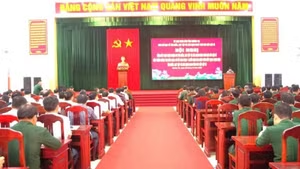
In the past, Xuan Truong was a revolutionary land that gave birth to leaders of the Party and the country, notably late General Secretary Truong Chinh. With a proud and heroic historical legacy and the patriotic tradition of earlier generations, Xuan Truong today is stepping into the nation’s era of rise with a new sense of purpose and a new stature.
Speaking to the central press delegation, the Secretary of the Xuan Hung Commune Party Committee said that, in line with guidance from the Party Central Committee and General Secretary To Lam, the merger was intended to bring governance closer to the people and improve public services. He added that since the consolidation, Xuan Hung’s economic picture has shifted towards more specialised development, with higher efficiency.
Vu Truong Khanh, Chairman of the Xuan Hung People’s Committee, said the commune has restructured agriculture by mechanising “linked-field” production and moving livestock and aquaculture towards farm-scale operations. It now has 15 large-field models spanning nearly 400 hectares. Xuan Hung has also developed 19 products under the One Commune One Product (OCOP) programme.
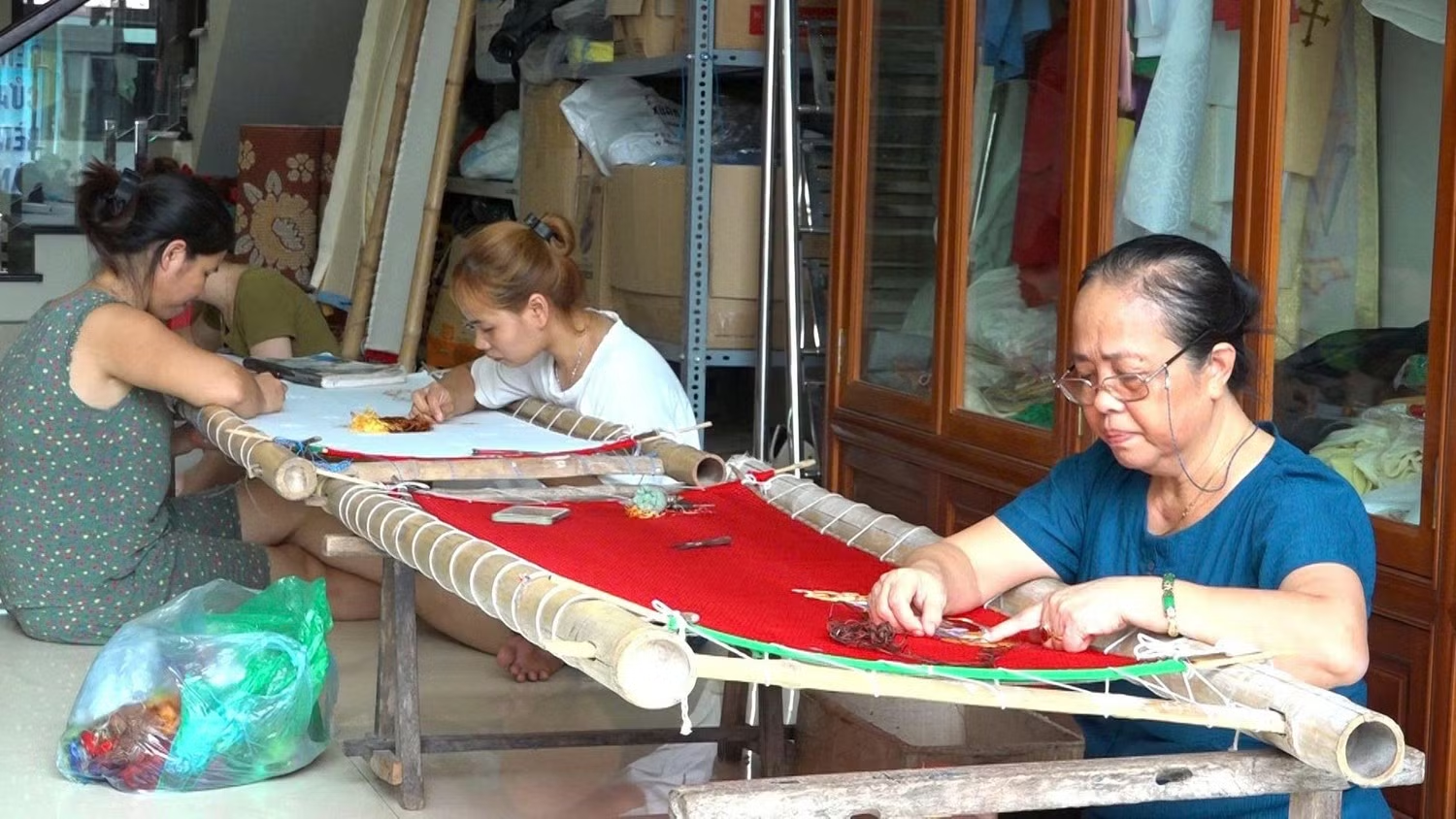
Xuan Hung has a diverse structure and has grown strongly in industry, handicrafts, and services. The commune is home to traditional craft villages in inland waterway transport, forest-product processing, food processing, bamboo and rattan weaving, embroidery and lace-making, and handicrafts; many products are finely made, of high quality and meet export standards.
People from Xuan Hung work and do business in many places across the country. Notable examples include Nam Cuong Group, the “5-star” group, and CC1 Holdings, along with many other enterprises with total assets in the thousands and tens of thousands of billions of VND.
Tran Van Vy, Secretary of the Commune Party Committee, said: “Xuan Hung Commune is not yet rich, but Xuan Hung people are rich.” With such strong momentum among the people — capital, investment experience, and decades of development — communal leaders are calling on successful individuals to return and invest in their hometown, helping create jobs and achieve the goal of both “prosperous people and a prosperous commune”.
Xuan Hung is facing intertwined difficulties and opportunities for transformation. Just six months after the consolidation, all socio-economic indicators have met and exceeded the targets assigned by the province. Estimated budget revenue for 2025 is 72 billion VND, including 27 billion VND in regular revenue, equal to 123% of the estimate.
Returning to Xuan Hung these days, the emulation spirit of “celebrating the Party and celebrating Spring” is rising across hamlets and villages; Party flags and national flags fly proudly. Every village in the commune is clean and well-kept, ready to welcome the new Spring.
Sharing with the press delegation, Vu Truong Khanh, Chairman of the Commune People’s Committee, said: “The commune has now completed master planning and detailed planning for industrial clusters, craft-village industrial clusters, and concentrated residential areas. The Communal People’s Committee has approved investment policy for 10 construction projects, including six school works, three headquarters and public works, and one project to upgrade internal field roads.”
Holding the political report of the communal party congress, it is easy to see the goals of being “close to the people, for the people” pursued by the Party organisation and the commune authorities. These are goals many localities are striving for, yet Xuan Hung has already reached them. For example: 100% of residents use clean water; 100% live in cultural and model residential areas; the rate of solidly built classrooms is 100%; and the share of the population covered by social insurance and health insurance is close to 100%.
These figures show Xuan Hung’s aspiration to rise. Through decisions that reorganise space and reshape development drivers, the ommune aims to mobilise all potential strengths and advantages, and move quickly to make Xuan Hung an industrially modern commune by 2030, with industrial and service output reaching 3,200 billion VND.
What impressed us most on this visit was a relatively young and dynamic leadership team, well trained and already “tested” and tempered through their work. With a two-tier government built to be “close to the people and alongside the people”, and with dreams and aspirations to rise, this young leadership collective will remain united and deliver a comprehensive victory in implementing the Resolution of the 1st Xuan Hung Communal Party Congress (2025–2030 term), together with Ninh Binh Province entering the nation’s era of rise.