Northern region to experience cold spell
Viet Nam's northern and north-central regions will experience a cold spell from the evening and night of October 4, according to the National Centre for Hydro-Meteorological Forecasting.
#climate change
Viet Nam's northern and north-central regions will experience a cold spell from the evening and night of October 4, according to the National Centre for Hydro-Meteorological Forecasting.
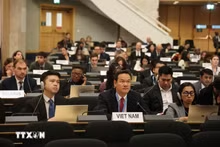
Viet Nam has called for greater effectiveness of the UN Human Rights Council (UNHRC) in protecting and promoting human rights amid growing global challenges, including conflicts, humanitarian crises, climate change and emerging technologies.
In the global race to meet climate change targets, the world continues to face major challenges in securing finance. The 31st Conference of the Parties to the United Nations Framework Convention on Climate Change (COP31), to be held in November, will prioritise securing climate finance, promoting adaptation measures, and supporting countries suffering the heaviest losses.
The Vietnamese Government has issued Resolution 235/NQ-CP approving the Implementation Agreement on carbon credits collaboration under Article 6 of the Paris Agreement on climate change between the Vietnamese and Singaporean governments.
The Government has issued Resolution No. 208/NQ-CP, adopting an action programme to implement the 14th Party Central Committee's Conclusion No. 75-KL/TW on environmental protection and proactive climate change response in the new era.
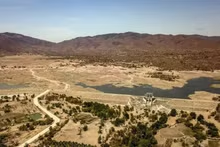
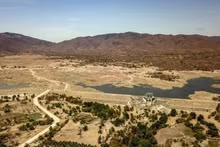
As El Niño develops and is forecast to intensify during the second half of 2026 and continue into early 2027, the risks of prolonged heatwaves, below-average seasonal rainfall and declining water resources are expected to rise, leading to severe drought and saltwater intrusion, particularly in the South Central Coast, the Central Highlands and the Mekong Delta. This calls on management agencies, local authorities and communities to put adaptation measures in place at an early stage.
Protecting the environment and adapting to climate change are among the key pillars of Viet Nam’s new development model, Party General Secretary and State President To Lam said, stressing that investment in the environment and climate is an investment in sustainable development, public health, economic competitiveness and the nation’s future.
Unusual global climate and weather patterns necessitate an urgent improvement in forecasting capabilities. This also creates significant challenges for the meteorological sector in providing accurate, complete, and timely bulletins, forecasts, and warnings to effectively support disaster prevention and mitigation efforts.
Amid increasingly extreme climate conditions, the agenda of the 31st Conference of the Parties to the United Nations Framework Convention on Climate Change (COP31) continues to draw significant global attention. At the forefront is the urgent need to find effective solutions to save island nations facing the risk of disappearance.
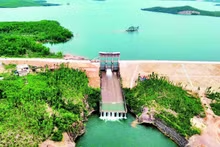
In response to the need to ensure the safety of irrigation works, proactively cope with natural disasters, and serve socio-economic development amid increasingly complex climate change, Quang Tri Province has in recent years focused resources on upgrading reservoirs, contributing to stabilising production, ensuring livelihoods, and building sustainable new-style rural areas.
Viet Nam is among the countries most vulnerable to climate change. To respond, the Government has issued the National Climate Change Adaptation Plan for the 2021 - 2030 period, with a vision to 2050 (Decision No. 1422/QD-TTg dated November 19, 2024). However, these plans remain largely at the policy level and have yet to receive adequate investment for specific adaptation activities.
In the context of a global economy shifting strongly towards greening, digitalisation, and low emissions, Viet Nam has many new development opportunities but also faces numerous challenges. This requires appropriate mechanisms and policies to enhance adaptability and reduce pressure from climate change and environmental pollution in socio-economic development.
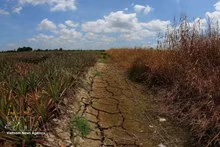
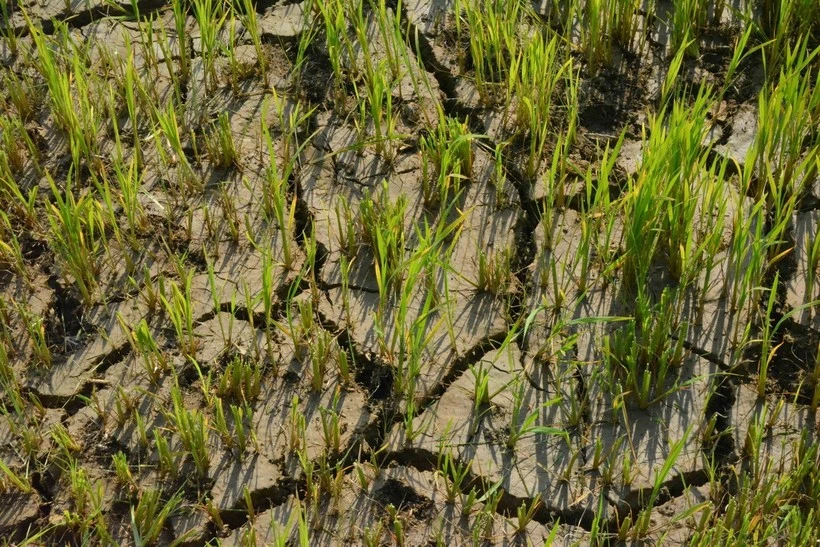
Climate change is increasing drought, reducing water resources, and intensifying saltwater intrusion in many parts of the country, especially the South Central Region, the Central Highlands, and the Mekong Delta. Therefore, applying advanced, water-saving irrigation technologies for upland crops to help efficient and sustainable production while reducing pressure on water use has become a top choice.
The Ministry of Agriculture and Environment has issued the national action plan on combating desertification through 2030, with a vision to 2050.
In 2025, climate change has become more extreme and natural disasters have become more frequent; many rivers continue to be polluted, and the sky in major cities has been covered in a layer of fine dust smog on many days. Meanwhile, green development has been becoming a mandatory trend. These intertwined challenges require higher levels of operational capacity and action.
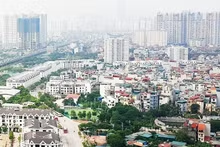
Urbanisation in Viet Nam is gathering pace, but it also brings a host of challenges, including overloaded infrastructure, environmental pollution, heightened disaster risks and climate change. This reality underscores the urgent need to renew thinking and reform planning and governance approaches in urban development.
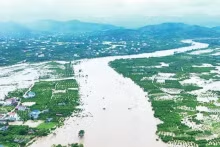
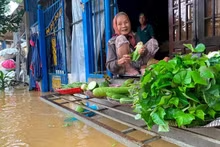
The recent spell of torrential rain and flooding that swept across the central region and the Central Highlands caused extensive damage. Persistent rainfall, far exceeding safety thresholds, led to rapidly rising floodwaters on already saturated ground, submerging many areas in deep water within a short time.
As a locality frequently hit by natural disasters, Hue City is accelerating the application of science and technology, improving reservoir operation procedures and strengthening early warning capacity, with the aim of building an urban area more resilient to extreme storms and floods.
From late October to November 2025, the cities of Hue and Da Nang have experienced consecutive historic floods, causing two World Cultural Heritage sites, the Complex of Hue Monuments, and Hoi An Ancient Town to be submerged in water for a long time, leading to some serious damages.
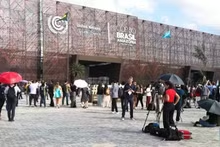
The 30th Conference of the Parties to the United Nations Framework Convention on Climate Change (COP30) in Belem, Brazil, is entering its most difficult stage, with negotiations running late into the night in an effort to overcome obstacles.