“Monitoring today, protecting tomorrow”
This is the theme of this year’s World Meteorological Day (March 23), mentioned by United Nations Secretary-General António Guterres in his message to all nations. He emphasised, “Forecasting capabilities help save lives, especially in the context of climate chaos with record-breaking heatwaves, longer droughts, rising sea levels, and increasingly frequent extreme disasters. Accurate and reliable forecasting science is our first line of defence…”
A report by the World Meteorological Organization (WMO) showed that all economic decisions, infrastructure investments, planting plans, health, water and energy management plans, and adjustments to global supply chains depend on a global meteorological observation and forecasting framework.
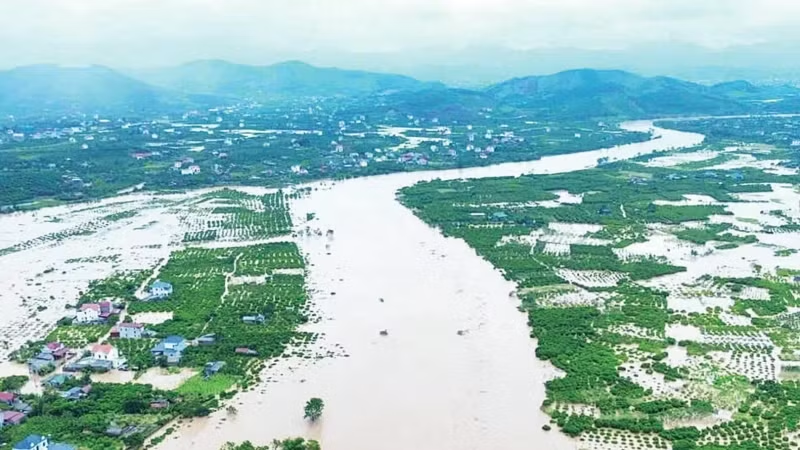
At the World Economic Forum, business leaders unanimously identified extreme weather events as the leading long-term risk. Extreme weather-related hazards have caused recorded economic losses of up to 4.3 trillion USD between 1970 and 2021, and claimed nearly 2 million lives worldwide. This demonstrates that early warning is a vital necessity for all aspects of society.
Earth monitoring is more important than ever in tracking the impacts of rapidly unfolding climate change, including rising land and ocean temperatures, melting ice and glaciers, and rising sea levels. It forms the basis of meteorological and climate information, which is essential for economic development and protecting the communities.
According to the World Meteorological Organisation, significant gaps remain in the global observation system—on land, in the ice sheet, and in the ocean—undermining the effectiveness of action. Investing in observation networks is not a cost to taxpayers, but an investment in economic security, long-term climate resilience, and a bridge between nations and generations.
Human resources and technology challenge
Many advanced technologies have been applied in the meteorological and hydrological sector, notably: Artificial intelligence (AI) in forecasting storm trajectories and monitoring; development of online warning systems; real-time disaster monitoring and warning systems at the village and commune level; FEWS tools for forecasting floods and upstream Mekong River water resources; The MIKE model is used to calculate floods and saltwater intrusion in the Mekong Delta…
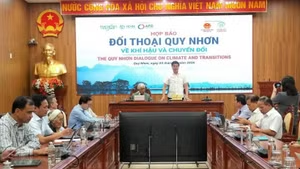
According to Deputy Minister of Agriculture and Environment Le Cong Thanh, the Ministry is currently implementing several important directions to modernise the meteorological and hydrological sector and enhance early warning capabilities for natural disasters.
The focus is on promoting digital transformation in the meteorological and hydrological field, building large databases on meteorology, hydrology, water resources, and natural disasters; developing a modern digital forecasting system; and strengthening connectivity and data sharing between management agencies, research institutes, technology companies, and international organisations. A key direction is to deliver natural disaster forecast and warning information to the public as quickly and easily as possible, through digital platforms, mobile applications, and multi-channel communication systems.
Implementing the project on modernising the Meteorological and Hydrological Sector by 2025 and the 2026-2030 period, in conjunction with the implementation of the national meteorological and hydrological station network plan for the 2021-2030 period, with a vision to 2050, the Ministry of Agriculture and Environment has reviewed and assessed the current state of monitoring equipment; studied management and monitoring methods for monitoring facilities; built a centralised management and monitoring system for the entire national meteorological and hydrological station network; and researched the application of digitising monitoring records...
The meteorological and hydrological sector has focused on four key tasks: Research and development, mastering core technologies, integrated forecasting, and AI integration; building a smart monitoring system with real-time connectivity; processing and analysing big data; and transmitting and disseminating information.
To achieve this, the meteorological and hydrological sector needs more attention to overcome current difficulties and challenges, namely the limited and weak number of scientific and technological human resources; the lack of a synchronised and interconnected observation network, the absence of open data standards; and the lack of advanced and modern technological equipment...

![[In Pictures] Bridge columns and underpasses in Ha Noi begin to turn green](https://en-cdn.nhandan.vn/images/nyM650OGFWrOVWc-xajqN-rTZ68Rlmc1fiGJOhBRYHH_N-Xs0TE8Psnfce7ORTs-KVfoJaEblqjNufFrgeF3e2xFkGtLQVaXm04VcmMKBEkANUyiOkpz4zAuIKgydVrrfBxmGez0E_YJIag0u_Uil0E7jpuJXsIxeMmGjoY1-W4/1791863309074-2994714492692222878-2994714492692222878-adb9ff3f4175c70066ed8bb80cfbead9.jpg.avif)