Against the backdrop of global efforts to address climate change, COP31 is widely seen as a pivotal event—not only in terms of emissions reduction commitments or energy transition, but also for the very survival of nations on the frontlines of climate change.
In island nations such as Tuvalu, Kiribati and Maldives, rising sea levels, increasingly severe storms, dwindling freshwater resources and deteriorating infrastructure are steadily eroding the foundations of life. Some islands even face the prospect of complete submersion, raising profound legal questions as to whether these entities can continue to be recognised as states if their physical territory disappears.
At international forums, many argue that, traditionally, statehood is defined by core elements such as a permanent population, a defined territory, an independent and effective government, and the capacity to enter into international relations. In practice, the existence of a state is not entirely negated if certain elements are weakened—for instance, in cases where an effective government is absent. However, the challenges posed by climate change are fundamentally different, and the potential loss of territory due to rising sea levels is unprecedented in both scale and severity.
While awaiting clearer adjustments from the international legal system, island nations are actively seeking pathways forward. Tuvalu has signed a treaty with Australia to safeguard its statehood despite the impacts of climate change. Australia has also committed to accepting Tuvaluan citizens who wish to relocate and begin new lives on safer ground.
At the same time, Tuvalu is pursuing an unprecedented approach—effectively “digitising itself.” By moving government services online and creating a digital representation of its territory while preserving cultural heritage on digital platforms, the country hopes to maintain its national identity. The concept of becoming a “digital nation” reflects remarkable creativity, yet also raises profound concerns. While online cultural preservation may help sustain identity, it can hardly replace historical memory or the deep, spiritual connection between people and their homeland.
In Kiribati, the government has proactively prepared for population relocation, even purchasing land abroad as a last-resort solution to secure the future of its people. Meanwhile, Maldives has opted for technical solutions, experimenting with elevating islands to counter rising sea levels.
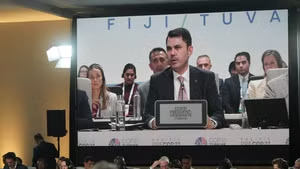
Even countries with relatively more favourable conditions, such as Fiji, are facing rising seas and shifting weather patterns, forcing communities to relocate. Flooding, disease and economic pressures are becoming part of daily life.
Climate change is producing consequences that are difficult to quantify. Yet the situation facing island nations highlights a profound paradox: those countries that contribute least to greenhouse gas emissions are bearing the heaviest burden of its impacts. This paradox underscores the urgent need for climate justice and raises expectations for COP31, which is scheduled for November 2026 in Turkey, to deliver stronger commitments, clearer accountability mechanisms, and, crucially, to ensure that the voices of the most vulnerable nations are not overlooked.