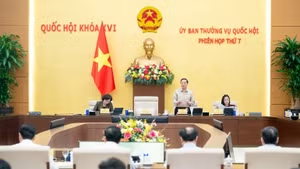
Resolution 66 makes clear that law-making and law enforcement must be fundamentally reformed in order to create a strong impetus for the country’s rapid and sustainable development.
From “thinking beyond the framework” to applying flexible mechanisms
One of the solutions set out in Resolution 66 is to renew legislative thinking and steer law-making in a way that not only meets the requirements of State management, but also encourages innovation, unleashes productive capacity, and unlocks all resources for development. A number of strategic and breakthrough decisions, including some without precedent in legislative work, have already been issued.
According to Nguyen Quoc Hoan, Head of the Department for Legal Normative Document Development under the Ministry of Justice, removing institutional bottlenecks in order to trigger breakthrough development requires “thinking beyond the framework” and boldly applying flexible mechanisms in law-making. In practice, the National Assembly has recently adopted important resolutions creating a special legal framework for law-making and law enforcement, allowing for more flexible and exceptional mechanisms to improve policy quality and attract resources, especially high-quality human resources for the legal sector. At its ninth session, the 15th National Assembly passed Resolution No. 206/2025/QH15 on special mechanisms for addressing difficulties and obstacles caused by legal provisions.
According to National Assembly deputy Nguyen Thi Viet Nga, Deputy Head of the Hai Phong delegation, one of the most visible and breakthrough changes following the implementation of Resolution 66 has been a shift in the approach to law-making. “Many laws have granted greater initiative to localities and grassroots authorities, together with clear mechanisms for oversight, post-audit, and accountability. This approach both encourages local dynamism and creativity and helps maintain legal discipline and order,” she noted.
The revised Law on the Capital, passed at the first session of the 16th National Assembly, is a typical example. Its core lies in establishing a system of sufficiently strong, open, and flexible special mechanisms to enable Ha Noi to make a breakthrough in the new era. Notably, the city’s People’s Council is authorised to proactively decide on the application of legal provisions more favourable to the capital’s development where there are differences between the Law on the Capital and legal documents issued later.
Also at its first session, the 16th National Assembly adopted a resolution on special mechanisms and policies to deal with land-law violations committed by organisations and individuals before the 2024 Land Law came into force, while also providing further solutions to remove obstacles facing long-stalled projects.
Unlocking resources to achieve growth goals
Associate Professor Dr Tran Hoang Ngan, a National Assembly deputy from Ho Chi Minh City, said that thanks to Resolution 66, many laws and resolutions have been issued in a timely manner to resolve emerging obstacles, clearly demonstrating the National Assembly’s commitment to accompanying institutional reform and the country’s development needs.
For Ho Chi Minh City, the National Assembly’s timely issuance of policies such as Resolution No. 98/2023/QH15 and Resolution No. 170/2024/QH15 has given the city a solid institutional foundation for rapid and strong development. “All of these institutions have helped speed up the implementation of urban railway investment projects in Ho Chi Minh City and save time costs. That is what removes the bottlenecks. Stalled projects, unfinished bridges, and muddy roads have all been brought back to life and pushed ahead quickly,” Ngan noted.
In Hai Phong, the National Assembly’s issuance of Resolution No. 226/2025/QH15, featuring 41 pilot mechanisms, has opened up a new “institutional space” for the city. Particularly notable is the Free Trade Zone, with its exceptional incentives ranging from taxes and visas to investment procedures, which not only create a competitive advantage but also position the city as a destination of regional stature. In 2025, Hai Phong’s GRDP growth reached 11.81%, while the size of its economy approached 30 billion USD, ranking third nationwide.
These results are evidence of the supporting role of institutions. Deputy Prime Minister Le Tien Chau affirmed that open and appropriate institutions will serve as both a powerful driver and a major resource for socio-economic development. He stressed that thanks to the special institutions prioritised by the central authorities, Hai Phong has maintained double-digit growth for 11 consecutive years, an achievement unmatched by any other locality. Owing to stronger decentralisation and delegation of authority, the city was able to establish more than 10 industrial parks in just one year, thereby unlocking a large amount of labour potential.
For enterprises and major corporations, this strong wave of institutional reform has paved the way for new development models. According to Nguyen Nhu So, Chairman of the Board of Directors of DABACO Viet Nam and a Member of the National Assembly’s Committee for Science, Technology, and Environment, Resolution 66 has helped create a more open business environment, encouraged enterprises to invest more heavily in science and technology, and enabled them to mobilise capital for focused investment that generates greater value, enhances competitiveness, and lowers costs while maintaining quality.
To realise the goal of double-digit growth, many plans are being formulated and many solutions will be rolled out. But the support of institutions will continue to serve as the vital current linking and unlocking resources for the country’s sustainable development.
![[Infographic] Key points from General Secretary and President To Lam’s opening remarks at the 14th PCC’S 4th plenum](https://en-cdn.nhandan.vn/images/j0QNt7m_5iy1OXpnUKiwG61aYhTv_B140GWhfriF26JwZbNNJ8LWetfvXUhz4Az6/1-8220.jpg.avif)