As the 2026 dry season peak sets in, forest protection activities are being carried out with strict discipline. Here, authorities, functional forces, and local residents stand united to preserve the endless green of their homeland…
The most effective forest fire prevention measure
Forest fire prevention and control are often associated with images of high-capacity pumps, siren-blaring water tankers, or massive firebreaks winding through the forest core. However, in the vast U Minh Ha forest, the most effective and enduring preventive measure stems from the awareness of residents living in the buffer zone.
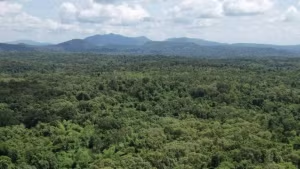
U Minh Ha Forestry One Member Limited Liability Company is currently managing and protecting more than 23,000 hectares of forest land, mainly planted with melaleuca and hybrid acacia under intensive cultivation. This area also accounts for over 50% of the fire-prone forest land in Ca Mau. Yet, over the past five years, no forest fire has occurred in the area under its management.
This achievement, as in previous years, has been made possible by early action from the very beginning of 2026. Forest protection forces began their journey of “going door to door, house to house”. They approached farmers not with empty reports, but through subtle and engaging communication during awareness sessions, through everyday conversations.
Huynh Minh Nguyen, Secretary of the Party Committee of Khanh Lam Commune, concluded: “Thanks to close coordination with local Party committees and authorities in promoting awareness, farmers in forest areas now clearly understand that contracted production forests are their own assets. Any negligence leading to fire would wipe out all their hard-earned results.”
Ca Mau currently has more than 148,000 hectares of forestry land, including over 45,800 hectares facing a very high fire risk. The “hottest” area is the U Minh Ha National Park, with more than 8,500 hectares of special-use forest associated with a freshwater wetland ecosystem.
Ngo Van Khang, Head of the Forest Protection Management Division of U Minh Ha National Park, shared that before the dry season began, the unit proactively coordinated with U Minh and Tran Van Thoi Forest Protection Departments and the authorities of Khanh An, Khanh Lam, and Da Bac Communes to organise numerous community meetings. Through these meetings, nearly 1,000 households in the buffer zone voluntarily signed commitments to join hands in protecting the forest.
At the same time, 11 coordination regulations between forest owners and local authorities were signed to implement fire prevention and control measures in a synchronised manner. Pham Van Ngot, who owns nearly 100 hectares of forest land combined with tourism activities in Da Bac Commune, expressed: “My family considers forest protection as safeguarding our livelihood, preserving clean air, and sustaining a source of life passed down for generations.”
According to Tran Cong Hoang, Director of U Minh Ha National Park, the park has proactively established 13 teams and guard posts, and mobilised 13 pump units in high-risk areas. Rapid response teams continuously conduct careful inspections of people entering the forest to collect honey in order to prevent risks from afar.
“The quiet presence of forest protection forces brings a sense of peace to the villages. It creates an invisible green wall in the hearts of the people…,” remarked veteran farmer Tang Van Thang, owner of 14 hectares of forestry land in Khanh An Commune, with pride.
A strong pillar of support
Proactive forest protection is not limited to awareness alone but is also reflected in the thorough preparations by the Ca Mau provincial authorities. As early as December 2025, the province approved its plan for forest fire prevention and control during the 2025–2026 dry season.
The overarching objective is to effectively manage existing forest areas, detect incidents early, and respond promptly to minimise damage to people and natural resources. A strong force, along with a comprehensive system of equipment, has been mobilised for round-the-clock duty.
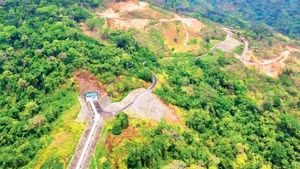
Across the entire U Minh Ha forest area and Bac Lieu Bird Sanctuary, 89 sluices and dams have been closed to regulate water levels and maintain moisture beneath the forest floor. A total of 74 fire watchtowers are in operation, supported by 129 specialised pumps, over 61,000 metres of fire hoses, and more than 100 motorboats for rapid deployment along canal routes.
The core force comprises 75 teams with more than 500 well-trained members, ready to respond at any time. To Hoai Phuong, Director of the Ca Mau Department of Agriculture and Environment, emphasised that meticulous preparation is evident at every station and checkpoint, covering information, command, forces, equipment, and logistics. “In the event of an emergency, in addition to the core forces, we can quickly mobilise more than 1,000 local residents to participate in firefighting,” he noted.
Walking through the vast U Minh Ha forest, one can see that canals have been dredged and cleared. Numerous sluices and dams are tightly closed to maintain moisture in the vegetation layer, prevent heat spread, and store water for firefighting.
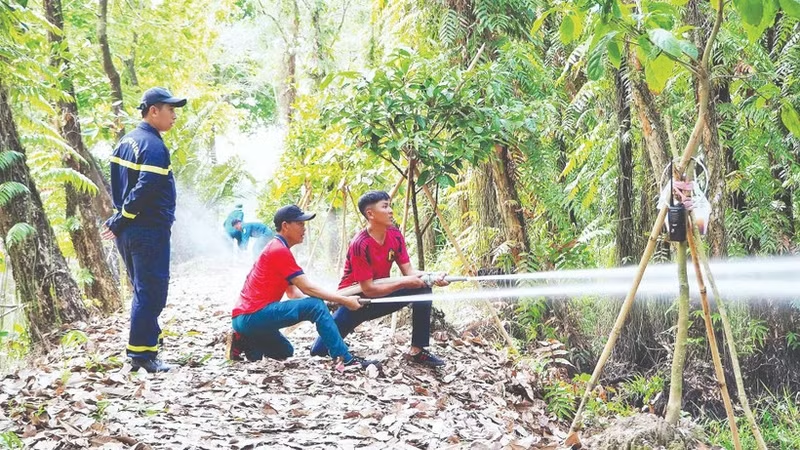
On towering watchtowers, forest protection forces maintain constant vigilance, standing guard 24 hours a day, enduring scorching heat and harsh winds to ensure the safety of tens of thousands of hectares of fire-prone forest in Ca Mau. Below, machinery is inspected and tested daily to ensure immediate readiness upon command.
Regular drills based on the 2025–2026 response plans are also conducted in realistic scenarios, helping to improve coordination effectiveness.
Now, no matter how harsh and challenging the dry season in Ca Mau may be, with deep-rooted love for the forest and a strong sense of responsibility among all sections of society, this green expanse will continue to be preserved in its entirety.