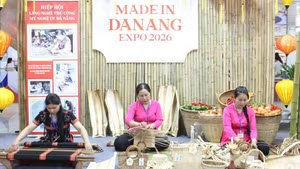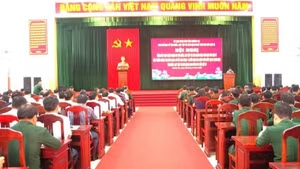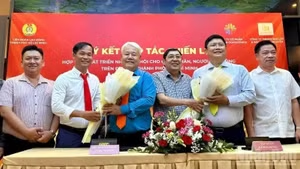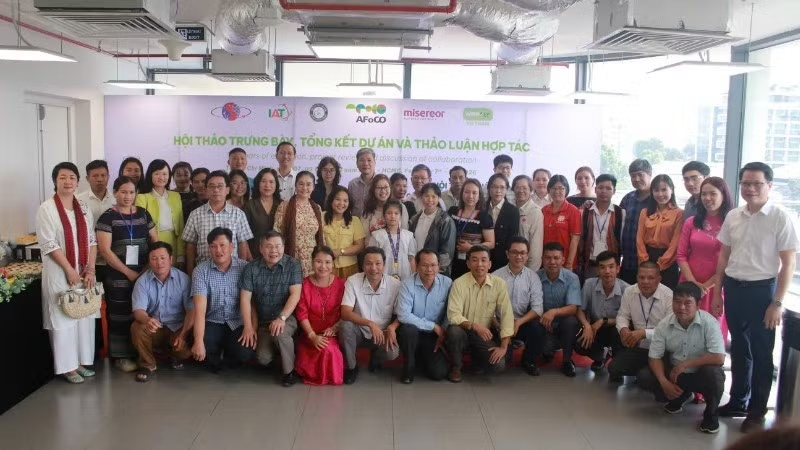
The event attracted more than 100 delegates from central and local ministries and agencies, social organisations, technical support units, and community-based non- timber forest product enterprises (CBNEs). Participants exchanged views on pathways for sustainable livelihoods associated with biodiversity conservation.
Luu Tien Dat, Deputy Head of the Division of Science and Technology and International Cooperation at the Department of Forestry and Forest Protection (Ministry of Agriculture and Environment), said the project on sustainable development of non-timber forest products through improving local livelihoods and linking market for community-based enterprises” (the AfoCo Project) has been implemented from November 2021 to December 2026, with a total budget of 8.5 million USD, including 6.5 million USD from the ASEAN–Republic of Korea Cooperation Fund. The project involves four countries: Cambodia, Laos, Myanmar and Viet Nam.
After more than three years of implementation, the project has gradually completed infrastructure and equipment for forest fire prevention and fighting, including observation towers, operation centres, specialised vehicles and water pumping systems; and has carried out restoration, new planting and management of around 80 ha of forest in participating countries.
In parallel, agroforestry models have also been developed to improve livelihoods and reduce the risk of forest fires caused by human activities. In the field of non-timber forest products, the project focuses on capacity building for community-based enterprises.
According to Assoc.Prof.Dr. Luu Hong Truong, Deputy Director of the Institute of Advanced Technology, developing community livelihoods is a long-term process that requires sustained engagement from multiple stakeholders. Following the recent review phase, the project has continued to receive new funding from Germany and is now entering Phase 3, with expectations of expanding support, consolidating successful models and creating conditions for newer or less experienced community groups.
Truong stressed the need to strengthen linkages between community-based enterprises that are operating effectively and groups that are newly established or facing difficulties. Sharing experience in production, financial management, processing techniques and market organisation is seen as the key to spreading sustainable livelihood models based on non-timber forest products.
At the workshop, delegates also agreed that developing stable livelihoods from non-timber forest products is an important solution to reducing pressure on forest resources. When local people’s livelihoods are secured, biodiversity conservation efforts will have a more sustainable foundation.
A new project phase for 2025–2028 on biodiversity conservation and livelihood improvement for communities living around special-use and protection forests was officially launched within the framework of the workshop. The programme has been implementing in five areas across four provinces: Khanh Hoa, Lam Dong, Gia Lai and An Giang, focusing on communities in forest buffer zones.