From traditional markets to touchscreens
For a long time, preparing for Tet — buying jam, cakes, fruits, and gifts — has been an indispensable tradition. In the past, all families go to the market at dawn, weaving through crowds to select each kilo of jams, each kumquat branch, and each fresh peach blossom. Today, however, everything is different. Instead of jostling in packed flower markets and supermarkets, many people now opt for smarter shopping through e-commerce applications.
According to data analytics platform Metric, online shopping during Tet has surged, with e-commerce revenue reaching approximately 105 trillion VND in the fourth quarter of 2025, up 15% compared with the same period in 2024. Platforms such as Shopee, Lazada, and Tiki have become vibrant “virtual Tet markets” where customers can order anything from fresh peach blossoms to Tet gift baskets. This method not only saves time but also allows consumers to compare prices, use discount codes, and receive home delivery. Notably, the trend of placing orders in advance is becoming increasingly popular. People can order from the beginning of the 12th lunar month, choosing delivery dates a few days before Tet to ensure freshness. Some major brands even allow customers to track their orders in real time, from packaging to dispatch.
“This year I ordered almost all my Tet items via apps. From jams and cakes to fresh flowers and even a new set of bowls and plates, everything was delivered to my door. It saved me a whole day at the market, and the goods were still complete and of good quality,” said Bui Kim Thanh, an office worker in Ha Noi.
At the same time, the way Vietnamese people purchase for Tet 2026 shows a clear shift in consumer behaviour. Instead of widespread spending, many families now focus on essential items such as fresh food, dried goods, and processed products. Consumers are increasingly concerned with the feeling of “buying right”, rather than simply focusing on high discount rates. Demand for products with transparent origins and guaranteed food safety is a top priority, reflecting cautious consuming psychology amid economic uncertainty.
“Spending at this time needs to be carefully calculated, so I choose only items that are truly necessary for my family,” Thanh added, referring to a trend towards more practical and economical consumption.
Meanwhile, many businesses and retail systems are applying artificial intelligence (AI) to analyse market trends, identify popular products, forecast demand, and optimise operational costs.
“In the past, every Tet we mainly relied on the previous year’s sales data to make plan. Now, from about two months before Tet, we proactively use AI to collect data on the search behaviour of customers, understand which product groups and decoration styles are most favoured, and then build a more suitable and effective inventory plan,” said Phi Duong Linh, owner of an online household goods shop in Ho Chi Minh City.
Even “Chung” cake — the indispensable symbol of traditional Tet — has gone online in an impressive way. In the past, families gathered around the fire overnight to cook “Chung” cake, many young families now order them via e-commerce platforms or the social media pages of shops and traditional craft villages.
Tranh Khuc Village (Ha Noi) and Phu Lo Village (Bac Ninh), where are famous for making “Chung” cakes, have utilised social media to promote their products. Customers can place orders via Zalo, Facebook, or e-commerce apps and receive freshly made cakes delivered within 24 hours. Some providers even offer “Chung cake making at home” services, sharing step-by-step videos of making “Chung” cakes, preparing all necessary ingredients, and delivering them to customers who wish to experience the traditional cake making process without having to prepare.
About two months before Lunar New Year, TikTok was also abuzz with the trend of “online Chung cake cooking”. Instead of real “dong” (phrynium placentarium) leaves and glutinous rice, young people created colourful paper Chung cakes, carefully decorated and “cooked” through their phone screens. These clips, often accompanied by cheerful Tet music, attracted millions of views.
“I love Tet so much. I can’t eat much “Chung” cake, but just hearing about it brings back memories. Watching online paper Chung cake cooking is enough to make me excited,” one TikTok user commented.
This trend highlights the creativity of young people and shows how technology is becoming a bridge that helps them to preserve and express their love for traditional Tet values.
Tet in the future
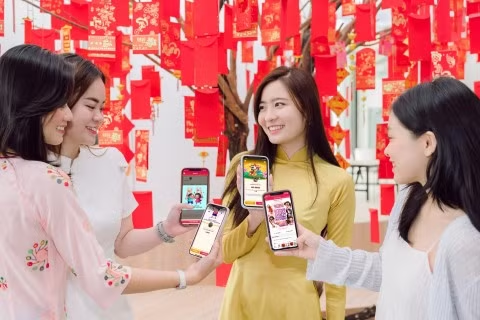
Technology has not only changed shopping but also the way people exchange New Year greetings and lucky money. Giving lucky money — a custom symbolising good fortune at the beginning of the year — has been digitalised in recent years. Instead of preparing new cash, many people now choose to send lucky money online via e-wallets such as ZaloPay, MoMo, or banking applications.
With just a few simple steps — selecting “Li xi”, entering the amount of money, and attaching an electronic card with a personalised message — New Year envelopes can be sent instantly. This method is not only convenient and safe but also avoids cash shortages or the risks of exchanging new money at high fees.
Nguyen Hoang Son, a technology engineer in Ho Chi Minh City, shared: “Last Tet, I sent lucky money to my nephew via ZaloPay, along with an online shopping voucher. He was delighted, and I saved time by not needing to exchange cash.”
Interestingly, many older people are gradually becoming accustomed to digital lucky money. Banks and e-wallet providers have introduced detailed instructions and simplified procedures, enabling elderly users to send lucky money to their children and grandchildren with just a few touches. However, many families still maintain both forms: traditional cash envelopes for those they meet in person, and digital transfers for relatives living far away. The red envelope remains an essential symbol of good fortune, while technology ensures that affection is no longer limited by geographical distance.
Perhaps one of the most profound changes of digitalised Tet lies in how people connect with one another. In the past, Tet was often the only time of year when families reunited. Now, geographical distance is less of a barrier thanks to technology. Video calls via Zalo, Messenger, and FaceTime have become common in families with relatives living far away.
“Last year, I couldn’t return home for Tet, but on Lunar New Year’s Eve and the first day of Tet, my whole family connected via video call. I could still see the feast, hear my parents talking, and watch my nieces and nephews offer New Year greetings. It eased my homesickness,” said Pham Quang Duy, who is currently studying for a master’s degree in Germany.
Due to living abroad, Duy often creates Tet greeting cards to send to his family and friends. These messages are designed carefully and quickly on electronic card applications. Apps such as Canva, PicsArt, or integrated features on Zalo and Messenger allow users to design Tet cards in various styles, from traditional peach blossoms and calligraphy to modern animated effects, background music, and short video clips.
Although technology is becoming increasingly prevalent, the core values of Tet remain unchanged. Technology only plays a role as a tool, helping these values to be preserved and practised more conveniently. Digitalised Tet is therefore not a fleeting trend, but an inevitable step forward, opening a future of modern applications. And one thing is certain: no matter how far technology advances, Tet will be always an occasion for Vietnamese people to rest, recharge, and cherish family and community values.
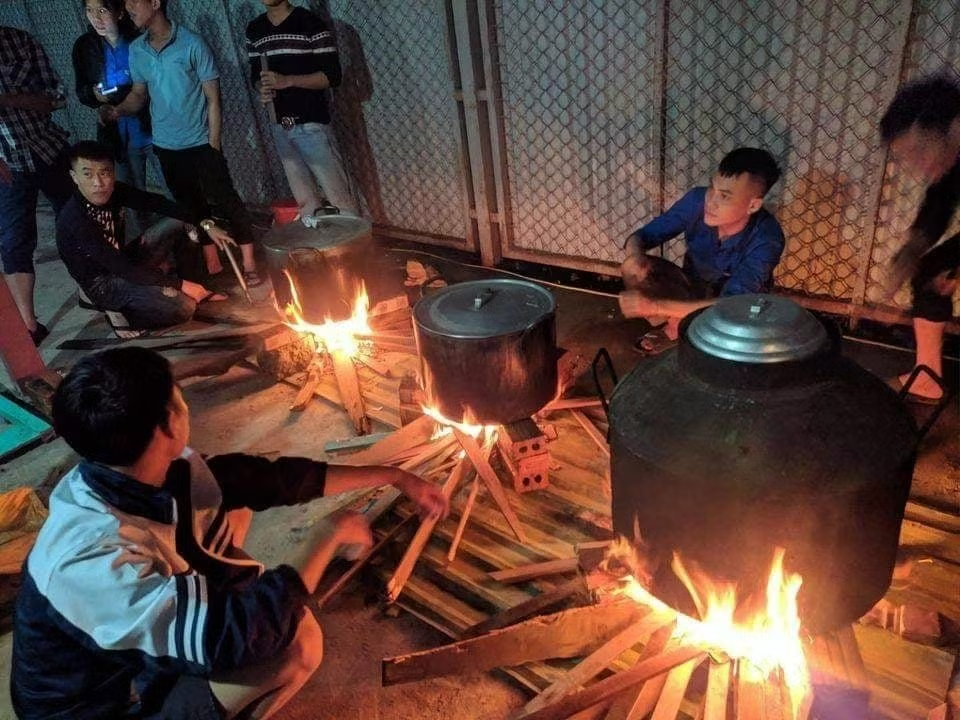
Many families have found a balance between tradition and modernity. They still clean and decorate their homes with peach and apricot blossoms, and make “Chung” cake together, while ordering certain items via apps for convenience. They still gather around the family meal, while also connecting with distant relatives through video calls so that everyone can “come home.”