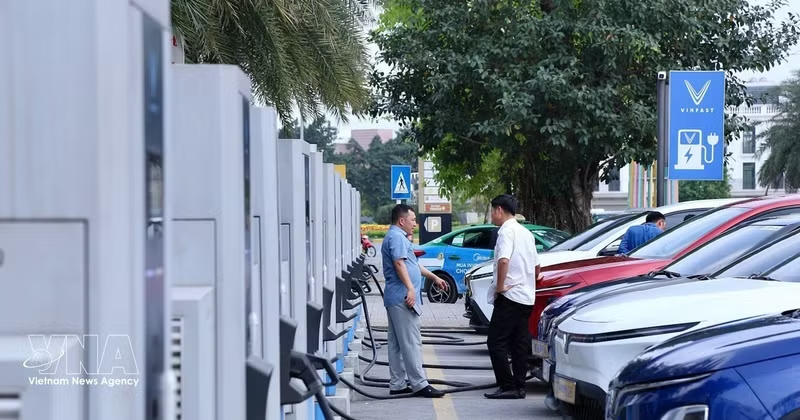
In the commentary, the two authors – Victoria Fanggidae, Executive Director of the Indonesian policy research centre The PRAKARSA, and Yuanda Pangi Harahap, the centre's project coordinator, said Viet Nam has adopted a more comprehensive approach to developing its EV industry by maintaining long-term investment incentives, investing in industrial infrastructure, developing human resources, and gradually building a high-tech manufacturing ecosystem.
They argued that the consistency and predictability of the country’s policies have strengthened investor confidence in making long-term investment decisions.
According to them, Viet Nam has implemented a range of coordinated policies, including long-term corporate income tax incentives, import duty exemptions for components, and land rent reductions, while aligning these incentives with strategies to develop supply chains and train workers. This consistent approach has enabled domestic companies such as VinFast to grow rapidly while attracting increasing foreign direct investment to the EV sector and high-tech industries.
The article also highlighted human resources development as one of Viet Nam's key strengths. The country's vocational training system has been expanded to meet business demand, with a particular focus on priority sectors such as EV, semiconductors, and high-tech manufacturing, helping satisfy the increasingly sophisticated requirements of global supply chains.
Citing the Economic Complexity Index (ECI), the authors noted that Viet Nam has improved its ranking from 69th to 45th over the past decade, reflecting its growing capability to manufacture products with higher technological content and greater added value.
They concluded that Viet Nam's experience demonstrates that natural resources are only one aspect of competitive advantage. More importantly, the country has succeeded in building an industrial ecosystem based on stable policies, a high-quality workforce, and innovation capacity – factors that are strengthening Viet Nam's appeal in the race to attract EV investment across Southeast Asia.