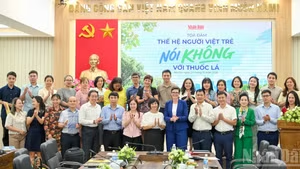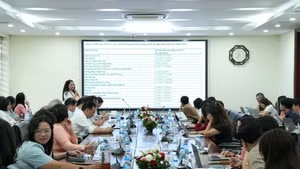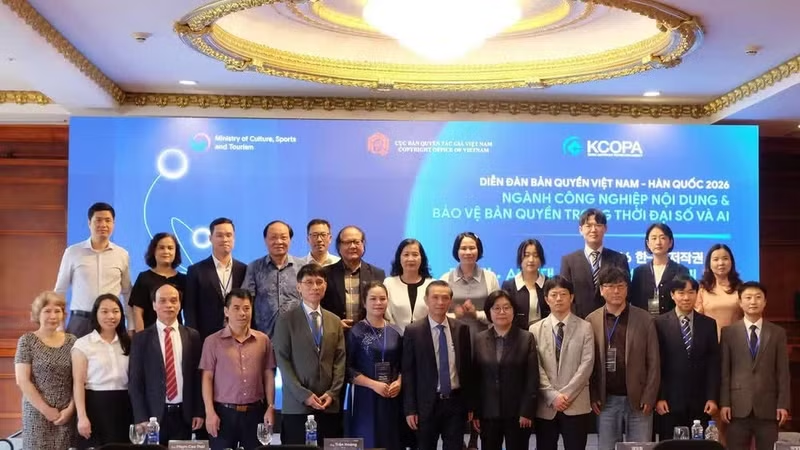
Participating in the Forum were representatives from state management agencies, copyright protection organisations, experts, and businesses in the content industry of both countries.
The Forum was held against the backdrop of the rapid development of digital technology and artificial intelligence, which have a profound impact on the creation, exploitation, and distribution of content. In this era, copyright is not only a legal tool but also a crucial foundation of the creative economy, requiring countries to have effective, transparent, and technologically advanced protection mechanisms.
Speaking at the forum, Tran Hoang, Director of the Copyright Office of Viet Nam, stated that in the new era, copyright is no longer just a legal tool, but has become an essential infrastructure of the creative economy.
When content can be created, copied, and disseminated at almost instantaneous speeds, the value of copyright and related rights needs to be protected effectively, transparently, and in a way that adapts to technology.
Viet Nam has proactively improved its legal system to meet this requirement, with the foundation being the Vietnamese Intellectual Property Law, along with implementing guidelines, especially Government Decree 134/2026/ND-CP dated April 6, 2026, amending and supplementing Decree 17/2023/ND-CP, he said, adding that these regulations have initially addressed emerging issues in the AI era.
At the Forum, delegates exchanged and discussed issues related to copyright protection. Pham Thi Kim Oanh, Deputy Director of the Copyright Office, updated the situation regarding the development and improvement of copyright and related rights laws in Viet Nam, highlighting new and different aspects added to the legal system related to copyright protection.
The Forum was a concrete activity to implement cooperation between Viet Nam and the Republic of Korea in the field of copyright and related rights, contributing to strengthening policy exchanges, sharing management experiences, improving enforcement capacity, and promoting content market connectivity between the two countries. This aims to build a healthy, fair, and sustainable creative environment in the context of digital transformation and artificial intelligence development.