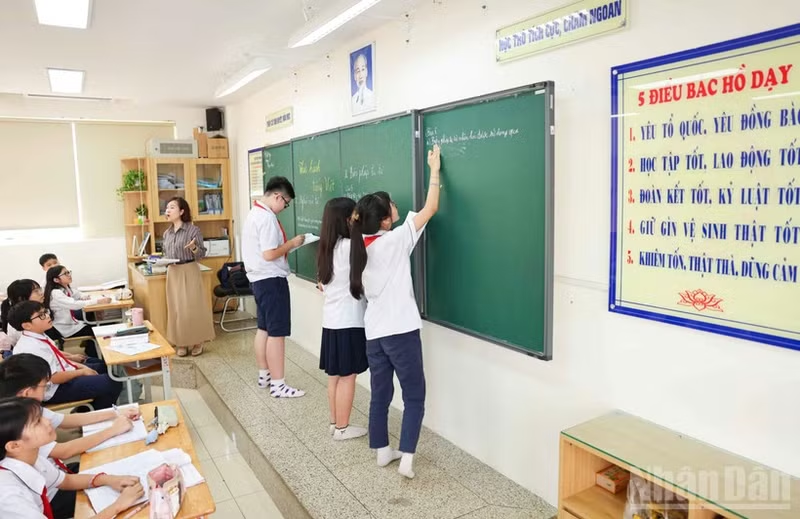
Deputy Prime Minister Le Thanh Long has signed Decision No. 2732/QD-TTg (dated December 16, 2025) to approve the scheme on strengthening foreign-language teaching and learning for 2025–2035, with a vision to 2045.
The scheme reaffirms the Party and state’s policy on foreign-language teaching and learning, and on teaching and learning through foreign languages across all levels of education and training, helping improve the quality of human resource development to meet the demands of international integration, while making proficiency in other foreign languages, alongside English, a competitive advantage for Viet Nam’s workforce.
The scheme’s specific targets are set for three phases: 2025–2030, 2030–2035, and 2035–2045, including the development of foreign-language teaching programmes in general education, vocational education, higher education, and continuing education, as well as programmes for training foreign-language teachers.
According to the scheme, the 2025–2030 phase is geared towards the following goals: developing and implementing programmes to teach the languages of several ASEAN countries; and prioritising programmes for teaching Lao and Cambodia’s national language at education and training institutions with demand and sufficient conditions for implementation, particularly in border communes.
The scheme focuses on developing and piloting optional activities for pre-school children to become familiar with the Chinese, Japanese, and Korean languages; continuing pilots of optional familiarisation programmes in Chinese, Russian, French, German, Japanese, and Korean languages for pupils in Grade 1 and Grade 2; and piloting programmes to teach the Korean and German in general education at education institutions with demand and sufficient conditions for implementation.
It will target stepping up the teaching of foreign languages, the integrated teaching of language and content, and the delivery of subjects and occupations through foreign languages across the national education system, including Chinese, Japanese, and Korean, to meet learners’ needs while being in line with local and institutional conditions.
It also aims to maintain and improve the quality of teaching and learning Russian, French, German, and other foreign languages within the national education system included in the scheme.