Removing “bottlenecks”
The promulgation of the Law on Population is seen as an important step in improving the institutional framework for population work in the new context. However, experience from previous policies shows that without detailed implementing guidelines, laws can easily encounter obstacles in practice.
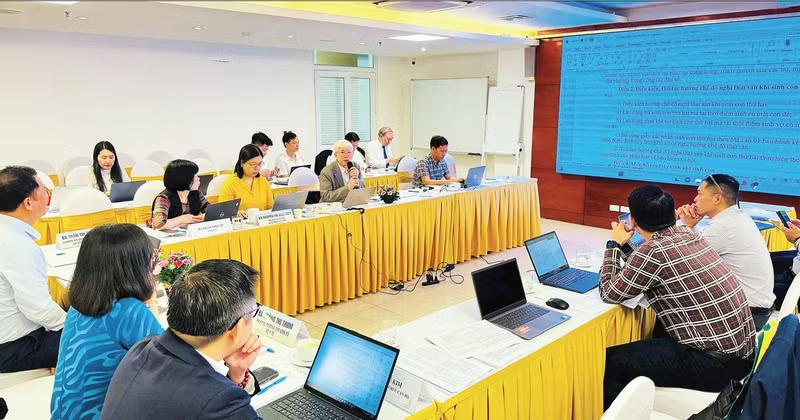
Deputy Minister of Health Do Xuan Tuyen stated: “The draft Decree detailing a number of articles and measures for implementing the Law on Population is structured into seven chapters, proposing solutions to address ‘bottlenecks’ in population work, from adjusting population size and structure, improving population quality, to adapting to population ageing. All these ‘bottlenecks’ indicate that if implementation stops at the level of the Law without specific mechanisms, population policies will struggle to achieve effectiveness. These provisions are designed not to require excessive additional resources, instead making use of existing financial and human resources while directly addressing pressing and persistent issues in population work today.”
The draft Decree detailing a number of articles and measures for implementing the Law on Population is structured into seven chapters, proposing solutions to address ‘bottlenecks’ in population work, from adjusting population size and structure, improving population quality, to adapting to population ageing.
Viet Nam’s population is currently facing a range of challenges, including a sharp and difficult-to-reverse decline in fertility rates in many localities. The fertility rate has dropped from 2.11 children per woman in 2021 to 1.91 in 2024 and approximately 1.93 in 2025. This trend is no longer confined to major urban centres but has spread to areas that previously had higher fertility rates.
Population experts warn that without timely solutions, Viet Nam will exit its “golden population” period by 2036. The labour force is expected to begin declining by 2044, potentially leading to negative population growth by 2050.
These figures highlight significant long-term pressure on economic growth and social welfare. In addition, the gender imbalance at birth remains high and persistent. The sex ratio at birth in 2024 stood at 111.4 boys per 100 girls, far exceeding the natural balance threshold. If this situation is not addressed, Viet Nam could face a surplus of around 1.5 million men of marriageable age by 2039.
Rapid population ageing is also placing considerable strain on the healthcare system, social security, and the labour market. Viet Nam officially entered the ageing phase in 2011 and is projected to become an aged society by 2038. Meanwhile, population quality remains below development requirements, particularly in remote and disadvantaged areas, where the rates of prenatal and newborn screening remain low.
From “orientation” to “action”
Dr Le Thanh Dung, Director General of the Population Department under the Ministry of Health, noted that one of the most notable new features of the draft Decree is the concretisation of major policies into provisions that can be immediately applied in practice.
First is financial support for childbirth. Under the draft, a subsidy of two million VND per birth is proposed, targeting groups that require encouragement, such as women who have two children before the age of 35 or those living in areas with low fertility rates.
In addition, the Decree stipulates support for prenatal and newborn screening, contributing to improving population quality from the earliest stages of life.
Notably, for the first time, policies on elderly care will be specified, including models such as elderly care clubs and day-care centres. These measures not only help reduce pressure on the healthcare system but also align with Vietnamese family conditions and cultural practices.
At the same time, stronger measures are proposed to reduce gender imbalance at birth, including stricter sanctions and enhanced control over sex selection practices.
Overall, the policy system outlined in the draft Decree is comprehensive, covering population size, structure, and quality.
One of the key breakthroughs in the draft is its focus on population collaborators, who are the core force directly implementing policies at the grassroots level. Currently, there are more than 136,000 population collaborators nationwide, but their allowances remain low and inconsistent across localities. The draft therefore proposes a remuneration level ranging from 0.3 to 0.5 of the base salary, ensuring nationwide consistency and improving their livelihoods.
At the same time, the Decree clarifies financial mechanisms and establishes appropriate decentralisation between central and local levels. For disadvantaged localities, the central budget will provide support to ensure consistent policy implementation, while also encouraging the mobilisation of social resources and enabling businesses, organisations, and individuals to participate in population work.
The draft also clearly defines the responsibilities of ministries, sectors, and localities; promotes decentralisation and delegation of authority alongside inspection and supervision; and accelerates the application of digital technology and digital transformation in population management. The development of a unified population database is expected to enhance management efficiency, reduce administrative procedures, and improve transparency.
The approach to drafting the Decree also emphasises ensuring gender equality, human rights, and citizens’ rights in line with the requirements of population policy in the new period.