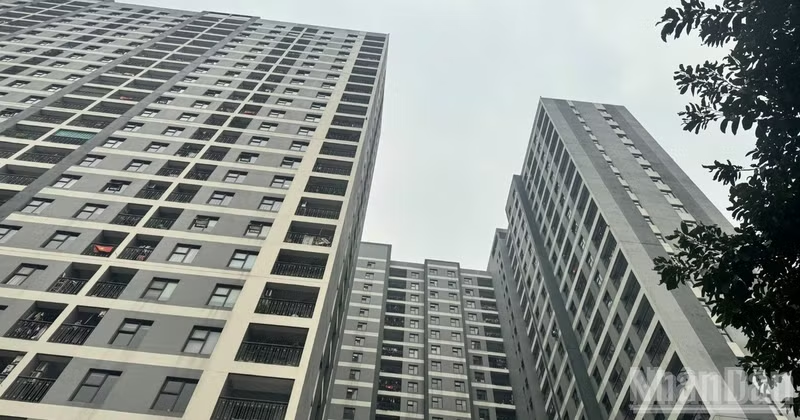
Specifically, Cushman & Wakefield’s Ha Noi MarketBeat Q2/2026 Real Estate Market Overview Report (NYSE: CWK) shows that the capital’s housing market continued its rebalancing process in the first half of 2026.
The apartment segment continued to be the main driver of Ha Noi’s housing market, although both supply and demand slowed amid a widening gap between available products and buyers’ actual housing needs. New supply remained concentrated mainly in the high-end and luxury segments, while affordable housing was almost absent from the market, adding further pressure on overall prices and people’s affordability.
Speaking to a reporter from Nhan Dan Newspaper, Le Hoang Lan Nhu Ngoc, Senior Director and Head of Strategic Consulting at Cushman & Wakefield Viet Nam, said that Ha Noi’s housing market has been entering a more selective phase of development, in which both developers and buyers are placing greater emphasis on product quality, legal transparency, and the ability to generate sustainable long-term value.
According to Ngoc, as Ha Noi continues to implement a polycentric urban development model while strengthening its transport connectivity infrastructure, particularly urban railway lines, we expect suburban areas to become the main growth driver for future housing supply. This shift will contribute to the formation of a more sustainable market structure, although affordability remains a key challenge, particularly in the apartment segment, as new supply continues to be concentrated mainly in high-end and luxury products.
Statistics show that Ha Noi’s apartment market entered a more selective development phase in Q2/2026, reflected in a decline in supply and a restructuring of the product mix. Total new-launch supply reached approximately 11,000 apartments in the first six months of the year, nearly 4,700 of which were recorded in Q2, indicating a more cautious approach from developers. New supply continued to be concentrated in areas outside the city centre, with 44% located on the central fringe and 48% in suburban areas, while the remainder was in the western area.
This trend reflects the shift towards peripheral areas, driven by limited inner-city land availability, rising development costs, and the orientation towards a polycentric urban planning model with nine growth poles instead of concentrating on the urban core. In terms of segment structure, the market remained imbalanced, with the luxury segment accounting for more than 52% of new supply, while the affordable segment was almost absent, indicating that current supply is not meeting actual housing demand. Newly launched projects were mainly those with completed legal procedures, developed by reputable developers, integrated with a diverse range of amenities and accompanied by attractive sales policies, reflecting a trend towards higher development standards and reinforcing the market’s more selective phase.
Similar to supply, market demand also reflected a more selective development trend. In the first six months of 2026, Ha Noi’s apartment market recorded approximately the sale of 9,700 units, with nearly 4,600 units sold in Q2 alone. The decline in transactions was partly attributable to the supply structure, with luxury and high-end segments accounting for approximately 72%, further widening the supply-demand mismatch.
At the same time, investor sentiment became more cautious, with a tendency to delay decisions amid high lending interest rates and Ha Noi’s implementation of a new planning scheme based on a polycentric model with nine urban centres and nine growth poles, rather than concentrating on the urban core. This development shows that the market is entering a phase of screening in both products and capital flow, with demand increasingly focused on projects with strategic locations, clear legal status, and long-term growth potential.
The average primary selling price in Q2/2026 reached approximately US$4,659 per square metre, up 19% quarter on quarter and 36% year on year. This increase was mainly driven by the structure of new supply, with more than 72% of newly launched products belonging to the high-end and luxury segments. Meanwhile, the affordable apartment segment continued to be absent from the market, resulting in a shortage of products suitable for mass-market customers and thereby maintaining considerable pressure on affordability.
Regarding apartment supply, in the medium and long term, the market is expected to adjust towards a more sustainable direction, reducing speculation and increasing the proportion of products serving actual housing demand. Under Ha Noi’s General Planning with a 100-year vision — which focuses on population decentralisation and the development of nine central urban areas and nine growth poles — housing supply will expand in suburban areas. Therefore, suburban areas are expected to lead apartment supply in the future.
Regarding apartment prices, in the short term, selling prices will continue to rise due to a shortage of affordable apartments, while new supply is mainly concentrated in the high-end and luxury segments. In the long term, prices are expected to diverge: inner-city areas (CBD) will continue to see price increases due to limited land availability, while suburban areas will maintain more affordable price levels thanks to abundant supply.