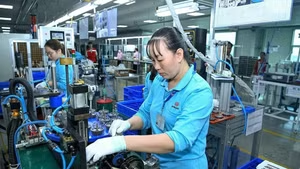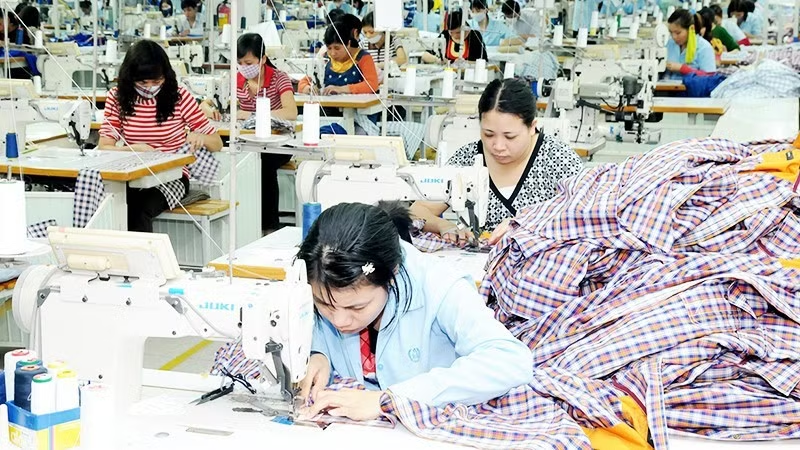
Despite the impact of reciprocal tariffs imposed by the US, Luu Tien Chung, General Director of Bac Giang Garment Joint Stock Company, said that in 2025 the company’s export turnover still increased by around 10% compared with the previous year, focusing on high-end jacket lines for the Japanese, European, and US markets.
Foundations for medium-term growth
Corporate performance also reflects the broader positive trend in Viet Nam’s import–export activities. According to the General Department of Customs, the country’s total merchandise import–export turnover in 2025 is estimated at 920 billion USD, up 16.9% year on year, the highest level ever recorded. Of this, exports posted impressive growth, estimated at 470.59 billion USD, up 15.9% compared with the previous year, contributing to a trade surplus of more than 21 billion USD.
The recovery and growth momentum of the economy has also spread strongly to the services sector, particularly tourism. According to statistics, in 2025, alongside the robust recovery of domestic tourism, the number of international visitors to Viet Nam is expected to exceed 21 million arrivals, the highest level ever, making an increasingly significant contribution to gross domestic product (GDP) growth, creating jobs, and stimulating domestic consumption.
Assessing the economic picture in 2025, Dr Le Duy Binh, Director of Economica Viet Nam, noted that economic growth has also been underpinned by several other important pillars of aggregate demand, creating a relatively comprehensive recovery picture. Public investment has continued to play a “locomotive” role, with total investment capital rising sharply in absolute terms, while disbursement progress has improved markedly, contributing to infrastructure development, activating related sectors, and generating spillover effects across the entire economy.
Private investment has also shown encouraging signs amid a stable macroeconomic environment and strengthened support policies. The launch of new projects and the operation of several large-scale projects, together with an increase in the number of newly established and reactivated enterprises, indicate that confidence within the private sector is gradually being restored.
Domestic consumption has continued to recover positively, from households to businesses, becoming an important driver supporting growth, especially in a context of continued global economic uncertainty. Rising consumption not only reflects improved incomes and market confidence but also provides support for the domestic services and manufacturing sectors.
Notably, alongside traditional drivers, the economy is gradually shifting towards new growth engines such as green growth, the digital economy, and innovation-based growth models. These factors have begun to take shape and have been promoted in recent times, and they are expected to become the main drivers of the economy in the future.
Entering 2026, Viet Nam’s economic growth prospects continue to be viewed positively, as the stable macroeconomic foundations established in 2025 provide important policy space, while traditional growth drivers such as exports, investment, and consumption are expected to maintain their recovery momentum.
At the same time, the global economic environment shows signs of improvement, with Viet Nam’s key export markets expected to grow more strongly, thereby supporting foreign trade and domestic production. Investment inflows into Viet Nam are also forecast to continue rising, driven by efforts to improve the business and investment environment, accelerate institutional reforms, and strengthen investor confidence.
Many factors affecting the sustainability of growth
However, the expert also cautioned that as the economy enters a development stage characterised by a larger scale and higher growth targets, a growth model heavily reliant on labour, capital, and natural resources is increasingly revealing its limitations. The transition to a growth model based on productivity, science and technology, and innovation has become an urgent requirement but also poses significant short-term challenges.
In addition to external risks such as trade volatility, geopolitical instability, and policy shifts in major economies, the domestic economy continues to face constraints related to labour productivity, workforce quality, and enterprises’ innovation capacity.
Nguyen Ba Hung, Chief Economist of the Asian Development Bank (ADB) in Viet Nam, observed that although key growth drivers such as import–export activities, public investment, and foreign investment continue to play a leading role, the growth picture still contains notable bottlenecks that need to be addressed to create stronger momentum for a breakthrough.
In particular, domestic private investment has yet to recover commensurately with its potential, reflecting enterprises’ cautious sentiment in the face of high compliance costs and barriers within the business environment. Domestic consumption, while maintaining a stable trend, has not yet reached the expected growth level, underscoring the need for coordinated solutions to stimulate domestic demand. For consumption to truly become a strong growth driver, there must be a harmonious combination of expanded public-sector consumption in essential areas such as healthcare and education, and measures to promote private-sector consumption. More importantly, policies need to focus on job creation, income growth and strengthening public confidence in future financial security.
Regarding solutions to achieve double-digit growth targets, Nguyen Ba Hung stressed the need to continue making strong improvements to the business environment, creating favourable conditions for enterprises by shortening timeframes, reducing compliance costs, and ensuring fair competition.
This approach not only promotes business development but also protects consumers and supports the achievement of environmental and social objectives. In addition, it is essential to develop a cohort of large domestic enterprises with strong competitiveness. In this regard, the role of the Government is to create a favourable environment, while competition and the maintenance of sustainable success in international markets must ultimately depend on the capabilities of the enterprises themselves.
During the 2026–2030 period, the Party and the State have set a target of maintaining double-digit economic growth (around 10%), thereby laying the foundations for Viet Nam to join the group of upper-middle-income countries by 2030 and move towards the goal of becoming a high-income country by 2045.