Linkages between households and cooperatives and enterprises not only help farmers feel secure in production but also raise incomes and stabilise livelihoods.
Benefits from production linkages
Van Phuc Craft Village is regarded as a model example of effective production linkages in Ha Noi. Strong linkages among weaving households, enterprises, and associations play a decisive role in enhancing competitiveness and preserving the traditional value of Van Phuc silk. At present, Van Phuc has around 300 households engaged in weaving and trading silk products, offering a wide range of items that are favoured by both domestic and international customers.
Nguyen Thi Tam, owner of the Trieu Van Mao silk weaving establishment, shared: “Before joining production linkages, our family’s production constantly faced shortages of raw materials, with unstable prices making it difficult to maintain product quality. In addition, each weaving household selected, processed, and dyed silk in their own way, resulting in inconsistent designs and quality, as well as unhealthy competition among households. After joining production linkages, my family and many other producers have effectively solved the raw material issue, standardised techniques and synchronised product designs.”
Nguyen Van Hung, Chairman of the Van Phuc Silk Weaving Craft Village Association, said: “To address the problems of raw material supply and product quality, the association has taken the lead in purchasing silkworm materials from Da Lat (Lam Dong), then distributing them to weaving households in the village. Thanks to this linkage, the village’s raw materials have been stabilised, product quality has become uniform and met high standards, helping Van Phuc silk maintain its reputation in the domestic market and expand exports.”
In production activities, production linkages not only generate profits for enterprises and farmers but also increasingly demonstrate their advantages in addressing the issue of bumper harvests accompanied by falling prices.
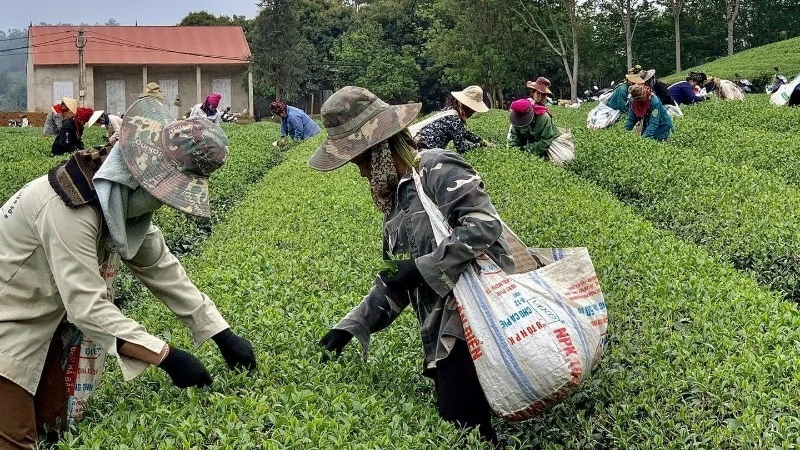
Thu Dan Tea Limited Liability Company in Binh Thuan Commune (Son La) is known not only for owning a four-star OCOP tea brand but also for successfully organising production linkages. With 320 ha of tea plantations and a large-scale tea processing factory (including 20 ha of self-cultivated land and 300 ha linked with 300 farming households), Thu Dan tea is generating high profits for local people.
Company Director Pham Van Doanh said: “To ensure uniform quality, the company has provided 1.5 million seedlings free of charge to expand an additional 100 ha of tea raw-material areas. As a result, each year the cooperative supplies around 2,000 tonnes of fresh tea leaves and 350 tonnes of dried tea to the market. Thanks to close linkages from production to processing and consumption, Thu Dan tea products always maintain stable quality and high value.”
Creating long-term interest alignment
According to the Ministry of Agriculture and Environment, there are around 4,700 cooperatives nationwide participating in value-chain linkages. In agriculture, nearly 40% of agricultural cooperatives are engaged in chain-based production linkages. Data show that the collective economy and cooperative sector have seen positive changes in both quantity and quality; effective operations have contributed to raising incomes, improving living standards, implementing poverty reduction, promoting the new rural development movement, and fostering local economic development.
Duong Gia Dinh, Chairman of the People’s Committee of Binh Thuan Commune, Son La Province, assessed that the Thu Dan linkage model is exemplary in sustainable agricultural development. Enterprises purchasing raw materials, providing technical guidance and controlling quality help farmers feel secure in production, increase productivity, and contribute to building the Binh Thuan tea brand while boosting the local economy.
Van Phuc Silk Village not only organises production and business activities effectively but also integrates them with tourism and services. When visiting Van Phuc, in addition to observing production and business operations, visitors and consumers can experience the silk-making process firsthand, thereby gaining confidence when purchasing craft village products.
Nguyen Dinh Hoa, Deputy Director of the Ha Noi Department of Agriculture and Environment, said: “The city has adopted and continues to implement policies to expand and replicate production linkage models. At the same time, it has directed localities to plan land use, protect the environment, support skills transmission, promote trade, advertise products, connect raw-material zones, and develop tourism linked with craft villages.”
To ensure the effectiveness of linkage chains, the government has introduced solutions to support localities in managing raw-material zones, applying standardised techniques, accessing markets, and building brands. Enterprises are encouraged to invest in agriculture, particularly in high value-added fields, through incentives related to credit, taxation, land, and product off-take mechanisms. Mechanisms are created to connect enterprises, cooperatives, and farmers, enabling risk-sharing and improving productivity and product quality. At the same time, projects are developed to support training, technology transfer, and management capacity building for both producers and enterprises.
Production linkages are a key factor in economic development. What remains for cooperatives is to proactively innovate organisational structures and operating methods towards efficiency, sustainability, and compliance with the 2023 Law on Cooperatives, thereby promoting agricultural economic development. This includes optimising added value in production and creating strong linkages and long-term benefits among stakeholders participating in the linkage chains.
According to the Ministry of Agriculture and Environment, the ministry is implementing a pilot project to develop standard-compliant agricultural and forestry raw-material zones serving processing and consumption for the 2021–2025 period. After three years of implementation, the area of raw-material zones linked with enterprises for consumption has reached 103,884 ha (accounting for 62.28% of the total raw-material area), an increase of more than sixfold compared with the period before the project was launched.