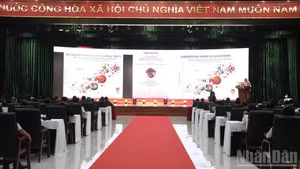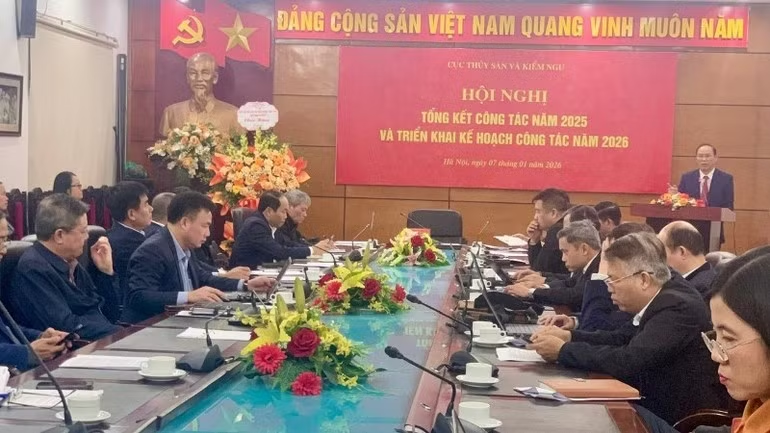
Speaking at a conference reviewing 2025 performance and outlining tasks for 2026 on January 7, Luan said the sector will continue to reduce capture fisheries while expanding aquaculture in a sustainable, climate-resilient manner to enhance competitiveness, with a strong focus on shifting from a production mindset to a fisheries economy and from single-value growth to integrated multi-value development.
Early and proactive preparations are underway to secure raw material supplies for exports in 2026, he said, adding that the department will coordinate with localities to organise solution-oriented meetings from the beginning of the production season, focusing on key farmed species and promising new ones to ensure sustained growth.
According to the Department of Fisheries and Fisheries Surveillance, total seafood output in 2025 reached 9.95 million tonnes, up 3% from 2024. Capture fisheries accounted for 3.83 million tonnes, equivalent to 99.8% of the 2024 level, while aquaculture output reached 6.1 million tonnes, up 5.1%. Seafood export turnover was estimated at over USD 11 billion, an increase of 12.7% year on year.
According to Deputy Director General Pham Quang Toan, alongside production expansion, the sector will strengthen environmental monitoring and early warning systems, tighten disease control, expand high-tech and recirculating aquaculture, reduce emissions, and improve water-use efficiency.
Food safety controls will also be tightened across the entire value chain to meet both domestic consumption and export requirements.
The sector will closely monitor weather conditions and market developments to provide timely guidance for aquaculture production. Priority will be given to key species such as black tiger shrimp, whiteleg shrimp and pangasius, developed in concentrated production zones linked to spatial planning and synchronised infrastructure.
Efforts will also be stepped up to promote industrial-scale marine farming, offshore aquaculture, new-material cage farming, and the cultivation of seaweed and molluscs under a green economy model.
The sector will further intensify the shift from a production-oriented approach to a fisheries economy, and from single-value growth to integrated multi-value development. This will involve restructuring production, developing markets, building product brands, and creating distinctive products linked with other sectors to form value chains that elevate seafood products.
Particular attention will be paid to gradually integrating emerging market requirements such as the circular economy, animal welfare, emissions reduction, and environmental and social responsibility in aquaculture.