Improving institutions
2025 is considered a year of triumph for the health sector in building and improving institutions: from concretising the Party's viewpoints and guidelines to the overall development strategy of the sector and development strategies of specific sectors and planning of the health sector; many policies and legal documents aim to address shortcomings and obstacles such as procurement, bidding, health insurance settlement, licensing of drug circulation, medical equipment and supplies, prices of medical examination and treatment services, etc.
As of December 20, 2025, the Ministry of Health has advised on or issued, within its authority, a range of important documents, including Conclusion No. 149-KL/TW of the Politburo (April 10, 2025) on strengthening the implementation of Resolution No. 21-NQ/TW of the 12th Party Central Committee on population work in the new situation; Resolution No. 72-NQ/TW of the Politburo (September 9, 2025) on breakthrough solutions to strengthen the protection, care and improvement of public health; and Directive No. 52-CT/TW of the Secretariat (October 3, 2025) on implementing universal health insurance in the new period. In addition, 11 decrees and two resolutions of the government and four decisions of the Prime Minister on health have been issued.
The 10th session of the 15th National Assembly passed the Law on Population; the Law on Disease Prevention; a resolution on special mechanisms and policies to create breakthroughs in protecting, caring for, and improving public health; and a resolution approving the investment policy for the National Target Programme on Health Care, Population and Development for the 2026–2035 period. The Law on Disease Prevention is a comprehensive legal foundation at a time when the country continues to face a dual burden of infectious diseases and the alarming rise of non-communicable diseases such as cancer, cardiovascular disease, diabetes, chronic obstructive pulmonary disease, and mental health disorders, as well as inadequate nutrition that limits physical development and stature of the Vietnamese people. Similarly, the Law on Population is an important legal tool that institutionalises the shift in population policy from family planning to population and development.
A major highlight was the Politburo’s issuance of Resolution No. 72-NQ/TW (September 9, 2025) on breakthrough solutions to strengthen the protection, care, and improvement of public health. According to Minister of Health Dao Hong Lan, the Resolution No. 72-NQ/TW has strategic, comprehensive, and long-term significance, with a strong action-oriented nature with many additional and enhanced policies, concretising previous guidelines and outlining breakthrough tasks and solutions to remove bottlenecks and practical difficulties.
Building a healthcare foundation for each citizen
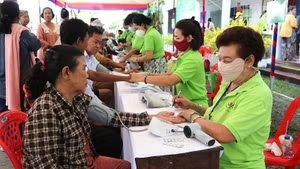
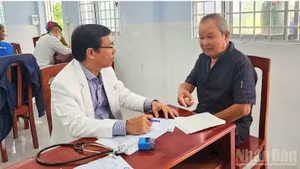
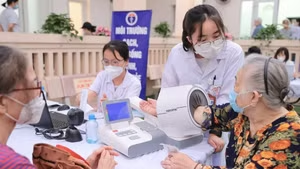
An important policy in Resolution No. 72-NQ/TW and other legal documents issued in 2025 is the shift in focus from “treatment” to “prevention”. Accordingly, people will receive comprehensive healthcare to improve intellectual and physical health, and stature; the health sector will manage health across the life course; preventive and grassroots healthcare will be the foundation; and people will have access to quality health services and comprehensive health management at commune-level health stations. The Ministry of Health is building and implementing concrete measures to ensure that grassroots and preventive healthcare are adequately invested in three factors: human resources; facilities, medicines, supplies, and medical equipment; and financial mechanisms. During the 2025–2030 period, at least 1,000 doctors will be rotated or assigned to work at commune-level health stations on a fixed term each year. Permanent doctors at commune-level health stations will be added so that each commune-level health station has at least four to five doctors by 2027, and has a full number of doctors in line with its functions and tasks by 2030.
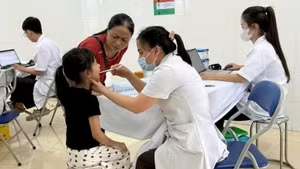
Another major guideline being urgently finalised and soon implemented is universal periodic health check-ups from 2026. People will receive free periodic or screening health examinations at least once a year and will be issued electronic health records to manage health throughout their lives. Examination and screening results will be updated in electronic health records, enriching personal health data and ensuring synchronisation in line with the government’s Project 06 on population data development, digital identification, and authentication.
According to reports by the Ministry of Health, in 2025 the sector achieved all three out of three key targets of the socio-economic development plan assigned by the National Assembly and met eight out of nine targets assigned by the government for the sector and field.
According to reports by the Ministry of Health, in 2025 the sector achieved all three out of three key targets of the socio-economic development plan assigned by the National Assembly and met eight out of nine targets assigned by the government for the sector and field.
Currently, basic health indicators and access to health services still differ between regions and localities; grassroots healthcare has not fully provided primary healthcare services; preventive healthcare has not received adequate investment, failing to meet requirements on disease prevention and control; and the protection of living environments, regularly practising to improve health, food safety, and nutrition, has not received sufficient attention.
This reality requires the health sector to continue improving institutions and effectively implementing legal provisions on protecting, caring for and improving public health; timely removing obstacles and difficulties to meet practical requirements; and effectively implementing the national target programme on healthcare, population, and development; continuing to rearrange and streamline the health system effectively, ensuring timely linkage and support among professional levels of the health system.
Apart from improving the quality of medical examination and treatment at all levels and developing modern and specialised medical centres, the health sector will focus on enhancing forecast capacity, surveillance, and early pandemic detection, with timely and effective control of outbreaks, to ensure health security and respond to public health emergencies; effectively implementing programmes to improve intellectual capacity, physical fitness, stature, and life expectancy of the Vietnamese people, the national nutrition strategy, and school healthcare programmes; building safe and healthy community, school, and workplace models; and promoting a nationwide movement for proactive health care and the development of a health-conscious culture among the people.