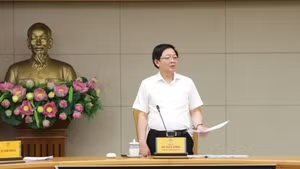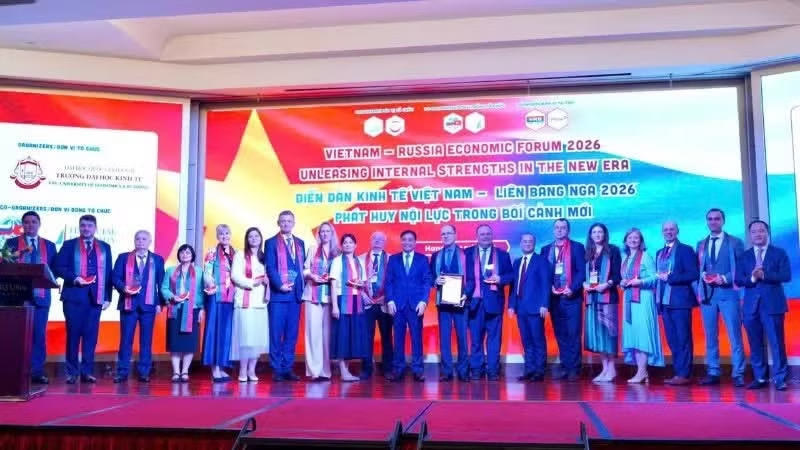
Speaking at the forum, Nguyen Minh Vu, Permanent Deputy Minister of Foreign Affairs, emphasised that in the context of profound global changes, the Viet Nam–Russia Federation cooperation needs to be approached in a new way, shifting from traditional cooperation to one based on innovation, science and technology, and sustainable development.
According to the deputy minister, education and science are not only important areas of cooperation but also strategic pillars that enable both countries to enhance internal capacity, train high-quality human resources, and adapt to the rapid changes of the global economy. At the same time, he highlighted the need to strengthen practical and implementable cooperation mechanisms, closely linking policy, research, and market to generate long-term value for both sides.
Assoc Prof, Dr Dao Thanh Truong, Vice President of Viet Nam National University – Ha Noi, noted that in the context of implementing major policies of the Party and state on science, technology, and education, the organisation of forums serves as an important bridge between the state, academia, and enterprises, thereby contributing to transforming knowledge into concrete development solutions.
The Gennady Bezdetko, Ambassador of the Russian Federation to Viet Nam, also affirmed the importance attached by the Russian side to strengthening comprehensive cooperation with Viet Nam, particularly in foundational areas such as science, education, energy, and finance.
He pointed out that in a world increasingly moving towards multipolarity and intensifying competition, enhancing cooperation based on knowledge, technology, and innovation will be key to improving competitiveness and achieving sustainable long-term development for both countries.
At the forum, Vietnamese and Russian scholars presented in-depth studies and analyses focusing on core issues of growth and bilateral cooperation.
In the field of finance and payments, the forum raised a strategic issue of how to enhance financial autonomy in the context of a volatile global financial system. Experts proposed promoting bilateral payments in local currencies (VND – RUB), establishing financial clearing centres, and developing specialised financing instruments for major cooperative projects.
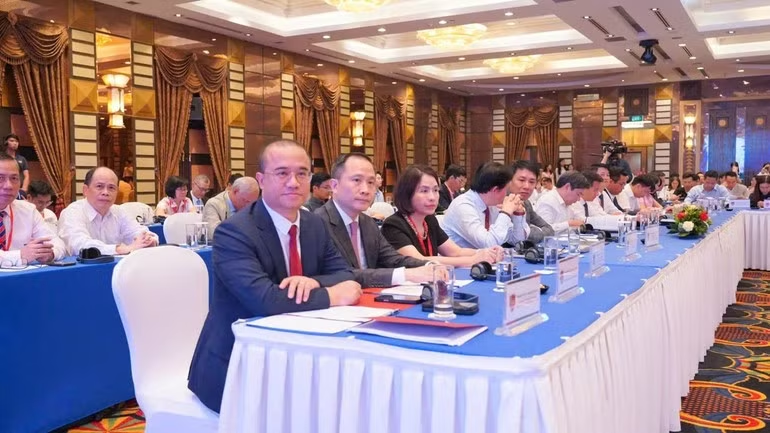
Science, technology, and innovation are considered core pillars of endogenous growth. A notable highlight is the shift from a resource-based cooperation model to one based on knowledge and technology. Specifically, the “co-creation of technology” approach between Viet Nam and the Russian Federation is seen as a strategic direction, enabling both sides to not only receive but also jointly develop new high value-added technologies.
In the field of energy and green transition, Assoc Prof, Dr Konstantin Simonov from the Russian Federation proposed promoting cooperation in renewable energy projects such as wind and solar power, while building green value chains and national branding associated with sustainable development. Dr Nguyen Thi Anh Tuyet from Viet Nam National University – Ha Noi, highlighted energy transition and opportunities for Viet Nam–Russian Federation cooperation in establishing a “sustainable energy corridor” between the two countries to ensure energy security.
In addition, logistics and infrastructure connectivity were identified as prerequisites for promoting bilateral trade. Finally, human resource development was recognised as a decisive factor for the sustainability of long-term cooperation.