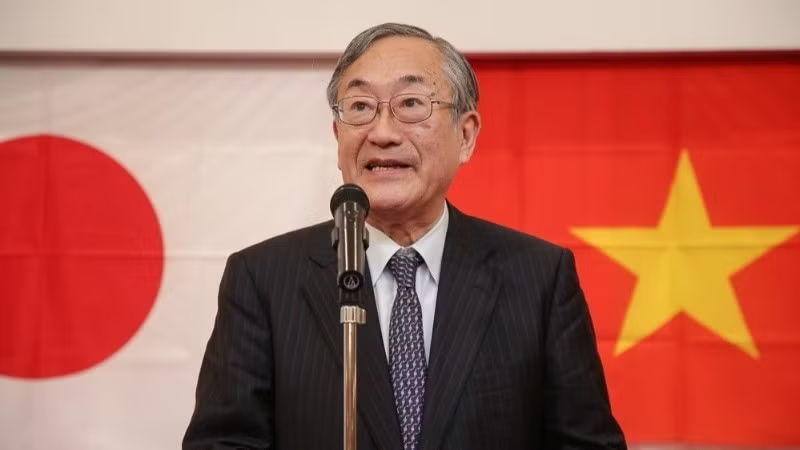
Over decades of close engagement with Viet Nam, Professor Furuta Motoo has not only earned a reputation as a leading scholar in Vietnamese studies but has also left a lasting mark as the first foreign rector of Viet Nam National University, Ha Noi, helping to lay the foundations for a higher education model that bridges knowledge between the two countries. In this role, he has contributed to building an international academic environment where the spirit of openness, innovation, and sustainable development is nurtured through every training programme, research project, and generation of students.
After 10 years at the helm of the Viet Nam Japan University (2016–2026), Professor Furuta Motoo will conclude his tenure as rector in mid-April 2026. His association with the university will enter a new phase in a different capacity.
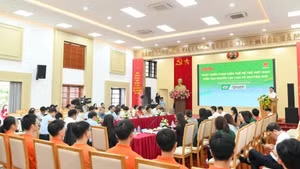
To commemorate this milestone, on the morning of March 24, Professor Furuta Motoo delivered his final lecture entitled “My 50-Year Journey in Vietnamese studies: From the past to the future.”
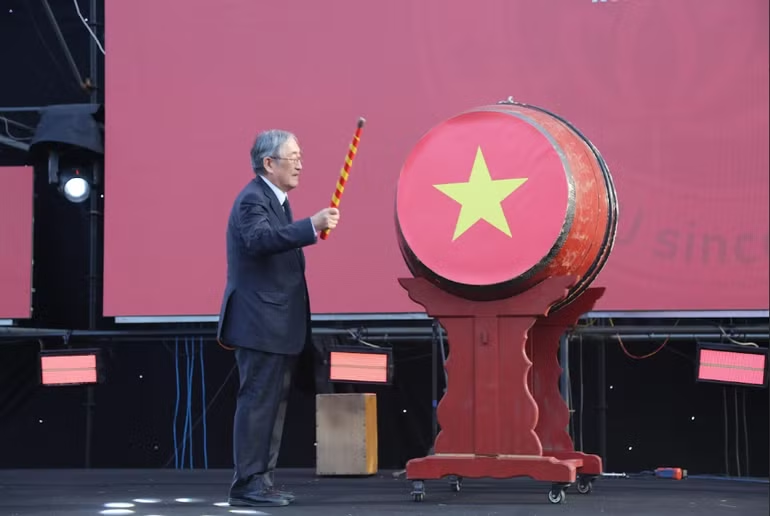
Multiple approaches to studying Viet Nam
Out of deep respect and affection for Viet Nam, Professor Furuta Motoo chose to deliver his lecture in Vietnamese. In it, he reflected on more than 50 years of studying the country — from an overseas scholar to someone profoundly connected with Viet Nam.
Throughout this journey, he adopted various approaches to understanding and researching Viet Nam:
“I chose Viet Nam to understand the world. The appeal of the banner of national liberation and socialist construction raised in Viet Nam was also a powerful motivation behind this choice. ‘Choosing Viet Nam to understand the world’ became my fundamental approach to Viet Nam. I have always examined Viet Nam’s issues within the broader context of international and world history, rather than viewing them as matters of a single nation.”
Over time, however, his approach evolved as he lived and experienced life in Viet Nam for an extended period.
“I realised that my earlier image of Viet Nam was highly subjective and far removed from reality. This forced me to significantly revise my perception of the country. I began to feel that my research needed to carry a stronger ‘Vietnamese flavour’. If area studies is about identifying the distinctive characteristics of each region, then after many years in Viet Nam, I have become an area studies scholar specialising in Viet Nam,” he said.
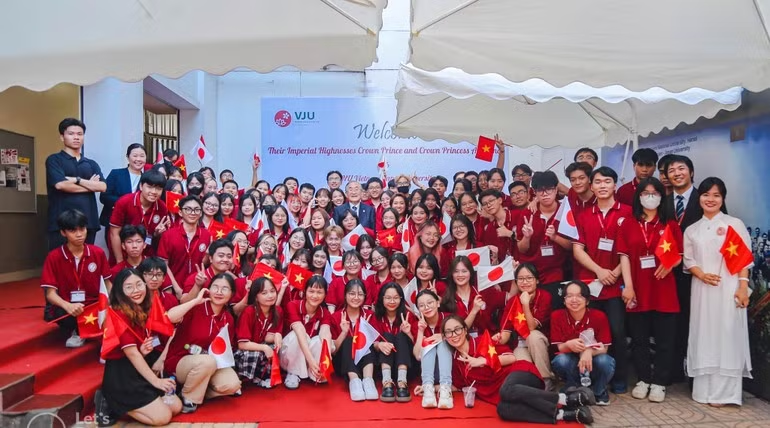
Through these experiences, his approach came to be defined as “looking outward to the world while remaining grounded in Viet Nam’s realities.” This perspective is clearly reflected in his research works Viet Nam in World History, which portray how Viet Nam has sought to position itself regionally and globally across different historical periods — how it has thought, expressed universal values of regional and global civilisation, and asserted its own unique identity.
More than an academic lecture, Professor Furuta Motoo’s reflections told the story of Viet Nam through the lens of a Japanese scholar who has devoted deep affection and profound understanding to the country’s history, people, and way of life.
“Viet Nam is my first love”
Professor Furuta Motoo shared: “Viet Nam is my first love, and I have remained loyal to that first love for more than half a century. One could say that I am a foreign scholar ‘made in Viet Nam.’”
Before hundreds of lecturers and students attending the lecture, he spoke of this “first love” with sincerity and deep emotion after more than 50 years of attachment.
Viet Nam is my first love, and I have remained loyal to that first love for more than half a century. One could say that I am a foreign scholar “made in Viet Nam.”
Professor Furuta Motoo
Professor Furuta graduated from the University of Tokyo in 1974 and obtained his PhD in 1990. Fluent in Vietnamese, he is one of Japan’s foremost scholars in Vietnamese studies.
In 2016, he became rector of the Viet Nam Japan University, the first foreign head of a member institution of Viet Nam National University, Ha Noi. He has made significant contributions to fostering an international learning environment, expanding academic exchange opportunities, and providing scholarships for students.
In this capacity, Professor Furuta has continuously worked to realise the vision of developing the Viet Nam Japan University into a leading research university in Viet Nam and the region, grounded in a philosophy of liberal education, sustainable science, and a spirit of innovation. Guided by his commitment to a “learner-centred” approach, he has placed particular emphasis on building an international academic environment, expanding exchange opportunities, and supporting student scholarships.
He has repeatedly donated prize money and royalties from his research works to fund scholarships, encouraging generations of students at the Viet Nam Japan University in their academic pursuits.
Professor Furuta Motoo also serves as Chairman of the Japan–Viet Nam Friendship Association, making significant contributions to strengthening people-to-people ties between the two countries, while remaining a respected scholar in Vietnamese studies.
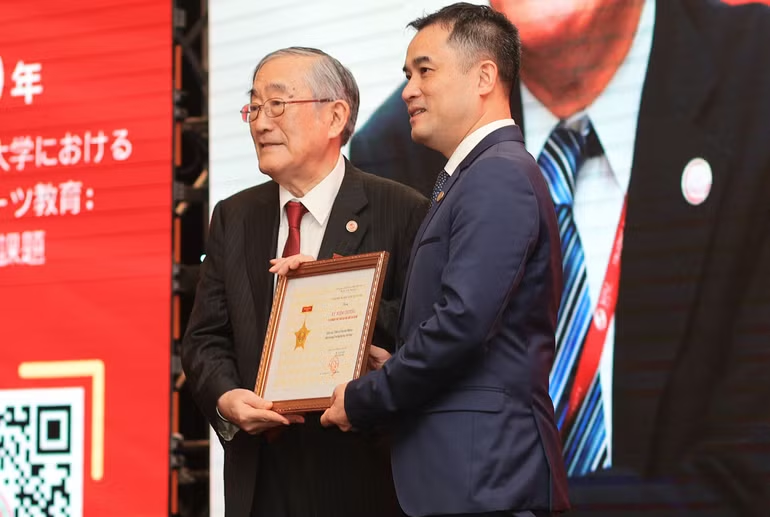
At a ceremony held by the Viet Nam Japan University on the morning of March 24 to honour him, Professor Vu Minh Giang, Chairman of the Scientific and Training Council of Viet Nam National University, Ha Noi, expressed deep appreciation for Professor Furuta’s quiet yet immense contributions to Vietnamese studies and to Viet Nam–Japan relations.
He also shared memorable recollections of nearly 40 years of friendship with his distinguished Japanese colleague, Professor Furuta.
Professor Furuta Motoo’s contributions have been recognised with numerous prestigious honours, including an Honorary Doctorate from Viet Nam National University, Ha Noi (2003), the State Prize for Science and Technology (2012), the Friendship Order (2013), the Bao Son Prize (2024), and most recently a certificate of merit from the Embassy of Japan in Viet Nam (2025).