For many, Tet is a peaceful pause after a year of hard work, a reunion meal, the laughter of togetherness, and the quiet hope that begins to take root as the old year closes. Yet somewhere amid the vibrant colours of spring filling streets and alleyways, there are still people who startle when Spring knocks at their doors.
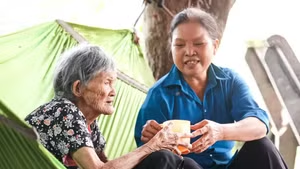
For them, Tet brings not only the warmth of the season, but also quietly awakens lingering worries that have not faded with the passing year. They are the poor, the disadvantaged, those for whom Tet is not merely something to look forward to, but also a silent “fear”.
How could they not be afraid, when Tet is drawing near and the family is still struggling each day to make ends meet? Some endure chronic illness, with meagre meals, their medicine counted pill by pill. Others work all year round, yet when Tet arrives, they still cannot afford bus tickets for the whole family to return home, let alone small lucky money envelopes to send New Year wishes to grandparents or to bring smiles to children at the start of the year.
They fear Tet because of a sense of self-consciousness, of embarrassment before their ancestors when the spring feast is not as abundant as their neighbours’. They feel for their children who have no new clothes for Tet, and their hearts ache when their modest homes lack peach blossoms, apricot branches or kumquat trees, as if Spring has arrived outside the alley but hesitates at their doorstep.
For the poor, Tet is not merely a few days of rest; it is when deprivation becomes most visible. While streets and villages bustle with shopping and reunions, many quietly calculate every expense: rent due after Tet, second-semester tuition fees for their children, medical bills, and the bus ticket home. Small costs that accumulate into heavy worries each time spring returns.
There are migrant workers who quietly remain in cities and industrial zones during Tet, not because they do not miss home, but because they cannot afford to return. Staying behind, they must overcome homesickness, saving every Vietnamese dong possible to provide their families with the fullest Tet they can manage in their own way, sharing simple New Year meals together to ease the loneliness of being far from home. Some avoid seemingly kind questions about income or living conditions, as each inquiry inadvertently touches the widening gap between aspirations and reality. Tet, therefore, is not only a family reunion, but also a moment for society to reassess its compassion and responsibility towards those in need.
When speaking of the poor and Tet, one cannot forget the story of Spring 1962. At the sacred moment of Lunar New Year’s Eve, President Ho Chi Minh visited poor families in the capital. Seeing Nguyen Thi Tin still carrying water for hire on the last night of the year to earn money for rice, he was moved to say: “If I do not come to your home, whose home should I visit?” That simple remark was not only an expression of compassion but also conveyed a profound philosophy: a ruling Party and its leaders must always place the people’s interests above all, especially caring for the poor and disadvantaged. In Ho Chi Minh Thought, compassion does not stop at sympathy, it should be translated into action and policies centred on people.
He once cautioned that if people remain poor, it is the Party’s fault; if the people are hungry, cold, uneducated or ill, the Party and Government are at fault. His words remain fully relevant today, reminding us that caring for the poor is not merely social policy, but a moral yardstick and the essence of a State of the people, by the people, and for the people.
Guided by that thought, throughout every stage of national development, the Party and State have consistently identified social security and care for the people, especially the poor and vulnerable, as both a goal and a driving force of sustainable development. Ensuring Tet for policy beneficiaries, the poor, and disadvantaged has become a major and sustained policy priority.
“Ensuring that no poor person is left without Tet and that everyone can welcome a joyful Spring, leaving no one behind” is not merely a slogan, but is implemented through coordinated action across the political system. From the grassroots level, the most difficult circumstances are promptly identified, with timely and practical support delivered to the right people at the right time, ensuring that the Party and State’s concern extends beyond policy to every household and individual.
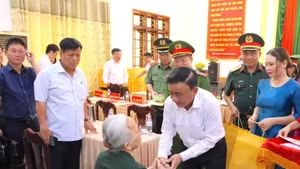
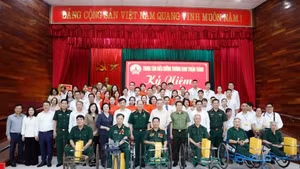
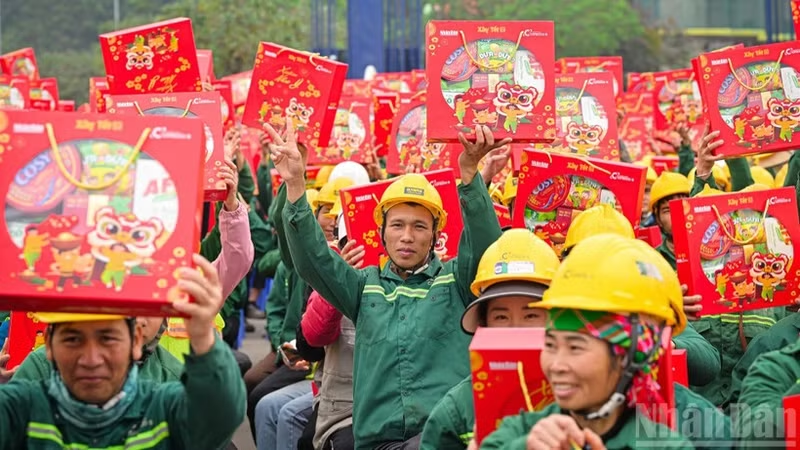
From the central authorities to localities, visits, gifts, and assistance for the poor, people with meritorious service, disadvantaged workers, and students far from home are organised early and widely each Tet season through initiatives such as the “For the Poor” Fund, “Spring for Children”, “Loving Spring – Reunion Tet”, “Tet Close to Home”, and “Spring Coach Trips”. Though modest in material value, these gifts carry sincere care and respect.
The Vietnamese tradition of mutual support and compassion continues to be strongly awakened and illuminated, connecting kind hearts across communities. Many localities not only provide gifts but also offer free medical check-ups, repair homes and arrange transport for low-income workers to return home for Tet. Even when heavily affected by natural disasters and floods, many enterprises and entrepreneurs, despite their own difficulties, willingly join hands with the Party and State to care for the poor and vulnerable. That is how Tet becomes a festival for all households, allowing Spring to spread from nature into people’s hearts.
Bringing Spring to every home means more than delivering Tet gifts; more importantly, it means bringing faith in a humane and developing society where growth goes hand in hand with social progress and equity.
Every act of sharing, however small, helps warm the nation’s Spring. Through persistent, meaningful deeds, Spring is not present only during Tet, but truly lives in daily life. When no one must close their door to greet Spring in anxiety, when smiles appear on the faces of those who once feared Tet, that is when Spring has truly arrived — not only in the sky and on the earth, but in the human heart — making Tet a festival of faith and hope in every home.