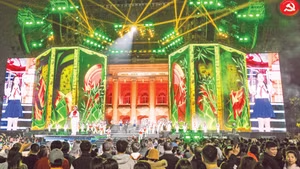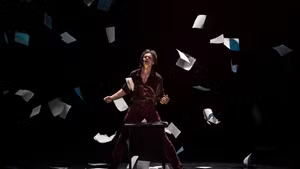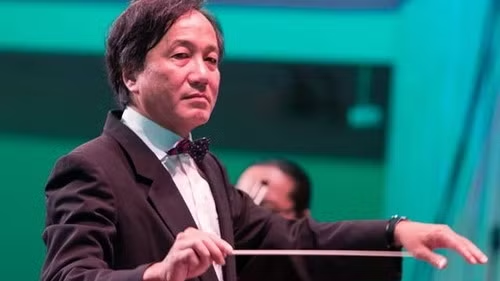
The activities include a show of excerpts from famous Broadway musicals, a performance of Tchaikovsky's ballet ‘Nutcracker’ and an operatic concert ‘The Magic Flute’. Conductor Tran Vuong Thach, HBSO Director, provides readers with his view on the limitations of Vietnamese orchestras, as well as the HBSO’s upcoming programme.
You just came back from the Republic of Korea in mid-July, where you were invited to lead the Goyang Orchestra. Is there any difference between Vietnamese and Korean orchestras?
Conductor Tran Vuong Thach: On the occasion of the orchestra’s 15th anniversary, violinist Tran Huu Quoc, who is also a soloist of the orchestra, proposed the Directory Board invite me as a guest conductor. Accompanying the Korean orchestra, I noticed no different level in qualification between the Korean instrumentalists and ours, but the Koreans are better than us in some aspects.
First of all, their orchestra has more full members than ours. They have 26 violinists, 10 viola players, 10 cellists and five contrabassists while the HBSO has merely 17 violinists and six viola players. It is difficult for us to recruit new members.
Secondly, they have a serious and professional work attitude. I think it is part of Korean character. Thanks to this discipline at work, we could complete a difficult programme of performance, including the No.4 Concerto by Tchaikovsky, a concerto by Mendelssohn and a Vietnamese work titled ‘Tro Ve Dat Me’ (Returning Motherland).
Last but not least, they are lucky to perform at a wonderful theatre. Although it is a provincial theatre, it is truly a philharmonic theatre, as its hall is fully equipped for international standard sound quality. Meanwhile, our theatres were built at a scale of an opera house.
As you have said, the musical ability of Korean and Vietnamese instrumentalists are the same, so what are the obstacles for our artists in your opinion?
What makes the difference, I think, is the work attitude. Discipline can bring results in many areas in the society, including in the arts. However, our instrumentalists have not yet exercised discipline in their work as well as their foreign peers.
It is sad to say that we have not cultivated a good working method – which is considered as the key to success. If you are working in an orchestra, the work method of the instrumentalists, rather than musical ability of each artist, is essential to generate satisfactory outcomes.
The success of an orchestra is the fruit of a collective effort; thus it is different from solo performances. Meanwhile, Vietnamese instrumentalists seem to practice as soloists, thus they have not yet created a harmonious co-ordination while performing in an orchestra. The arts made by a collective require co-ordination, harmony and a general discipline which every member has to follow. We lack all of these criteria, while Koreans do it very well.
The HBSO recently staged a Broadway musical night in July, bringing a fresh change for the orchestra after a long tradition of classical music performances. Broadway musical programmes have been held in Vietnam before, but they received little enthusiasm from the public. What is the key to your success?
Broadway music has been observed since the early 20th century as a new form of operetta. The masterpieces of the contemporary arts include ‘Cats’, ‘The Phantom of the Opera’, ‘Notre dame de Paris, and ‘Les Miserables’.
Although it is the first time we have put on stage a programme on Broadway music, tickets for the event were sold out; and it was a heartening sign for us at the debut.
I thought the failure of the former Broadway programme resulted from the fact that the artists do their jobs by halves. Thus, they fail to convey the typical characters of the art they are performing and they fail to win the hearts of the audiences.
At HBSO, we try to capture integral features of what we plan to perform, whether it is an opera, a ballet, or a symphony.
We had meetings with the US Kennedy Centre to ask for its support in developing Broadway music in Vietnam. We will work together on ‘The Magic Flute’ opera this November. The US artists are also about to come to Vietnam next year to stage a Broadway play.
The HBSO artists have also worked with Belgian ‘Les ballet C de la B’, one of the best contemporary dance groups, for a joint performance in late August.
Does it mean that the HBSO’s programmes in future will focus on entertaining the public?
Not really. Staging a programme does not aim to make it easy to reach the public, but it is important to make a high-quality and interesting event.
I prefer “interesting” events rather than events “close to or familiar with audiences’ ears”. Organisers often develop a programme with pieces familiar to audience taste. But I think the audiences prefer to enjoy a truly authentic symphony, rather than works that are easy to listen to.
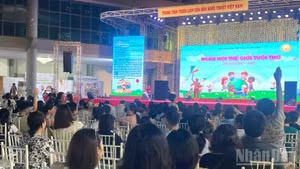
We are also targeting students. We have held regular ‘Melodies for the Youth’, which is a free for students as long as they resister for free tickets beforehand. We will continue such kind of event as a good way to promote our future audiences.
Thank you for the interview.