The national programme on science, technology and innovation, approved by the government in 2025, focuses on developing six strategic technological products: large language models and Vietnamese virtual assistants, edge-processing AI cameras, autonomous mobile robots, 5G mobile network equipment systems, blockchain infrastructure and related applications, and unmanned aerial vehicles (UAVs).
A common feature across these fields is their mathematical foundation. In addition, many other cutting-edge sectors, such as semiconductors, biomedical science, advanced materials and new energy, also require a strong grounding in mathematics.
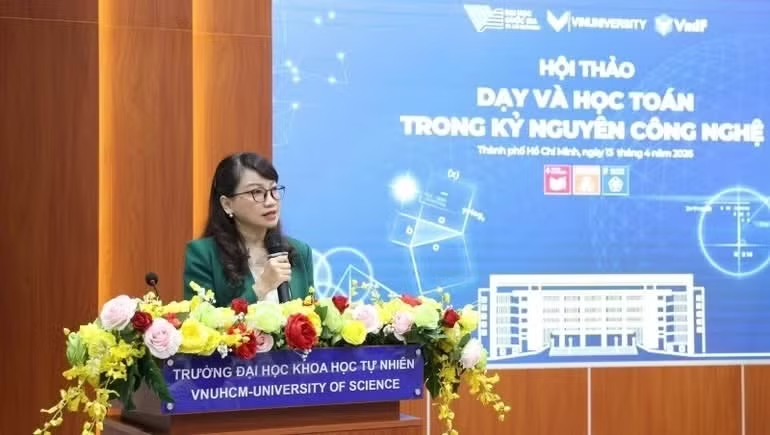
Speaking at the conference, Professor Nguyen Thi Thanh Mai, President of VNU-HCM, noted that although the university has many outstanding mathematics students and a strong cohort of mathematicians, the integration of mathematics into technological fields and real-world applications within its training programmes remains limited.
Meanwhile, international trends show that modern mathematics curricula are increasingly prioritising modelling thinking, computational thinking, interdisciplinarity, and the ability to apply knowledge to real-world problems.
According to Professor Mai, the challenge is not only to help learners recognise the usefulness of mathematics, but more fundamentally to redesign the learning pathway.
From secondary school to undergraduate and postgraduate levels, learners need to follow a coherent trajectory encompassing modelling thinking, probability and statistics, optimisation, algorithms, scientific computing, data analysis, and interdisciplinary skills.
Mathematics, therefore, can no longer remain merely a foundational subject in the traditional sense; it must become the design language of technology, a tool for solving business problems, and the knowledge infrastructure for innovation.
To achieve this, Professor Mai emphasised the need for a coordinated shift across three dimensions: from teaching mathematics as a closed system of knowledge to teaching it as an open problem-solving capability; from fragmented training across secondary, undergraduate and postgraduate levels to designing integrated pathways for identifying and nurturing talent; and from providing programmes around existing resources to training aligned with strategic technological challenges and national development needs.
The conference was expected to generate concrete, action-oriented recommendations, contributing to the reform of mathematics education in Viet Nam.
It also aimed to build a skilled mathematics workforce capable of serving the country’s strategic technology sectors amid rapid digital transformation.